Showing posts with label Accra. Show all posts

Tuesday, December 05, 2006

Scenes from the Accra cultural center


Ordinarily, I like to intersperse photos with text. However, Blogger was so obstinate when I was working on the post on A City of Contrast. I finally gave up trying to post some photos of the cultural center. So, this evening, I decided to try posting mostly photos, one at a time, and just waiting patiently while Blogger putzed away uploading them. Here they are. . .enjoy, as who knows when I will feel like sitting in front of a computer screen just looking at it?
Scenes from our visit to the cultural center--this first photo is taken just outside the cultural center--when you stand outside the center, you would never guess the space is filled with arts and crafts displays.
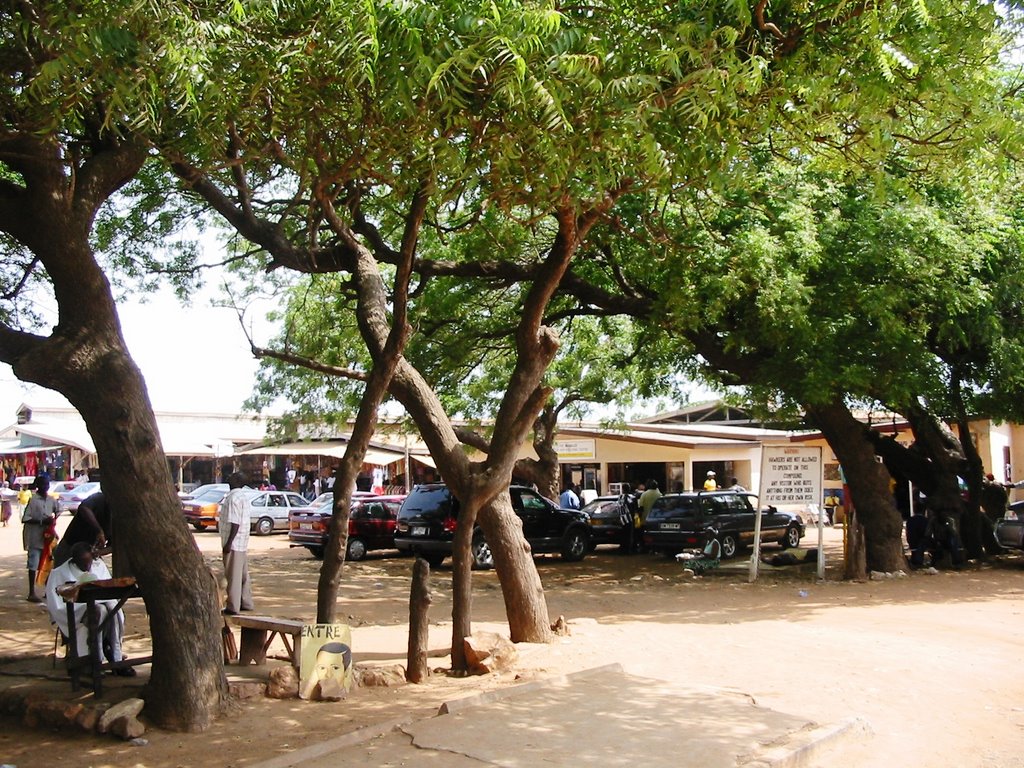

Note how the craft stalls are randomly arranged.
Behind where these stalls were meager places that presumably were homes for some of the craftspeople.

Many stalls had drums and items carved from wood, or made from animal skins. I wasn't too sure that bringing an animal skin product back through customs would be a good idea.
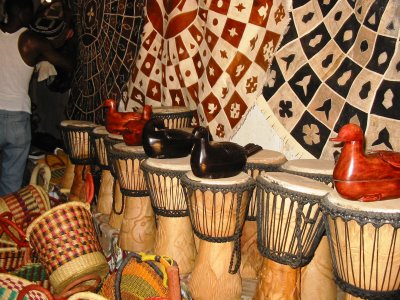
Understandably, the craftsmen are proud of their work. I asked before I took a photo, and always the response was positive.


This man was silently weaving kente cloth. I asked another man in the shop if it was OK to take a photo, and he readily agreed, but the weaver never broke his concentration. Note how he is anchoring one of the thread spools between his toes.

Monday, December 04, 2006

A City of Contrasts

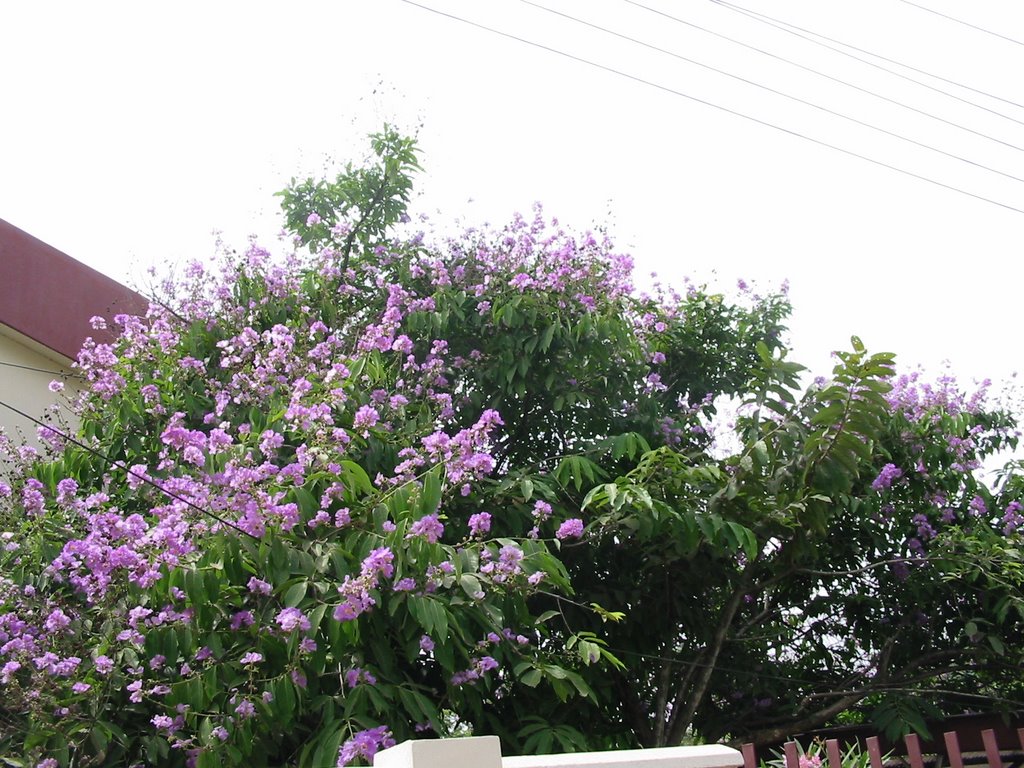
Accra is a city of great contrasts—there are four lane highways, dirt roads, gleaming glass buildings, impromptu lean-tos, lush gorgeous flowers, open sewerage ditches. There are sections that you drive through where you could almost be in Europe, or some other developed place in the world, then other areas where you clearly are in an emerging country.

The most striking feature to me is the haphazardness of all this. Suddenly you leave the relatively nice homes section and see chickens scratching in the dirt next to roadside hovels. Right next door to the hotel was a large open field where it appeared that people lived, or at least slept, almost out in the open.

The city is a city planner’s worst nightmare. The sections of Accra have grown up seemingly unaware of other sections. So access becomes the great problem. Roads between the sections, such as the Ring Road, become very clogged. And there is no concept of air pollution control.

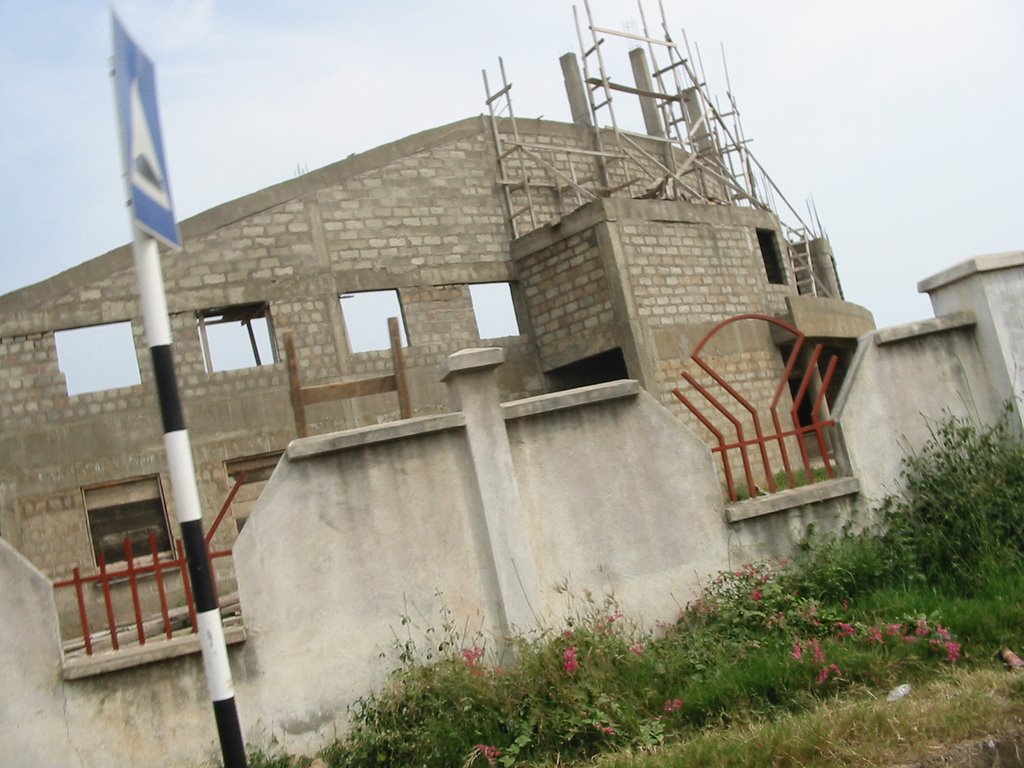
One of the most striking contrasts is one of the architectural features of the city. There is a large arch in Liberation Square. This whole area commemorates Ghana's 1957 independence from being a British colony. As official and celebratory as the area is, it is hardly ever used. We drove by, but there were very few people viewing the area. It is used on official or holiday occasions, but usually no one is there. Imagine such a public square in Paris or in Berlin that would be empty of people much of the time. In contrast to such an official edifice that goes largely unused, there are many half-built buildings all around Accra. Whether these are remnants of Soviet investment that dried up, or are structures designed to prove one's ownership to a piece of land is unclear. However, some of these structures clearly have people living in them. You will sometimes see a cloth draped across an open space to provide some protection.

My daughter and I visited the cultural centre (where arts and crafts are sold) on one of my last days in Accra. This section is the city in miniature. It is a low-walled in area with craft stalls—not laid out in a grid pattern, but more randomly. Some stalls are quite stable and fixed in location; others are ramshackle. Some have adobe walls; some are pole and tin-roof construction.

But everyone wants to sell. I wrote earlier about the pressure to buy, and, if not to buy, well, at least you can look. If you don't buy, no problem. Unlike Tangier, where the vendors kept dogging your every step, here people relented if you persisted and walked on by. Most everyone is amazingly friendly, and usually they ask where you come from.

There are many ways to spend money (in modest amounts). In addition to the craft stalls, and the road side hawkers, there are beggars—people who have various infirmities: a blind woman being led by a small boy, a crippled man in an improvised wheel chair—a lawn chair on wheels; a one-legged man moving swiftly on crutches. As the taxi stops at a traffic light, they approach, less insistently than the hawkers, but still asking for money. My daughter usually gives them something, noting how hard it must be to be physically disabled in a country that almost demands able-bodied ness.

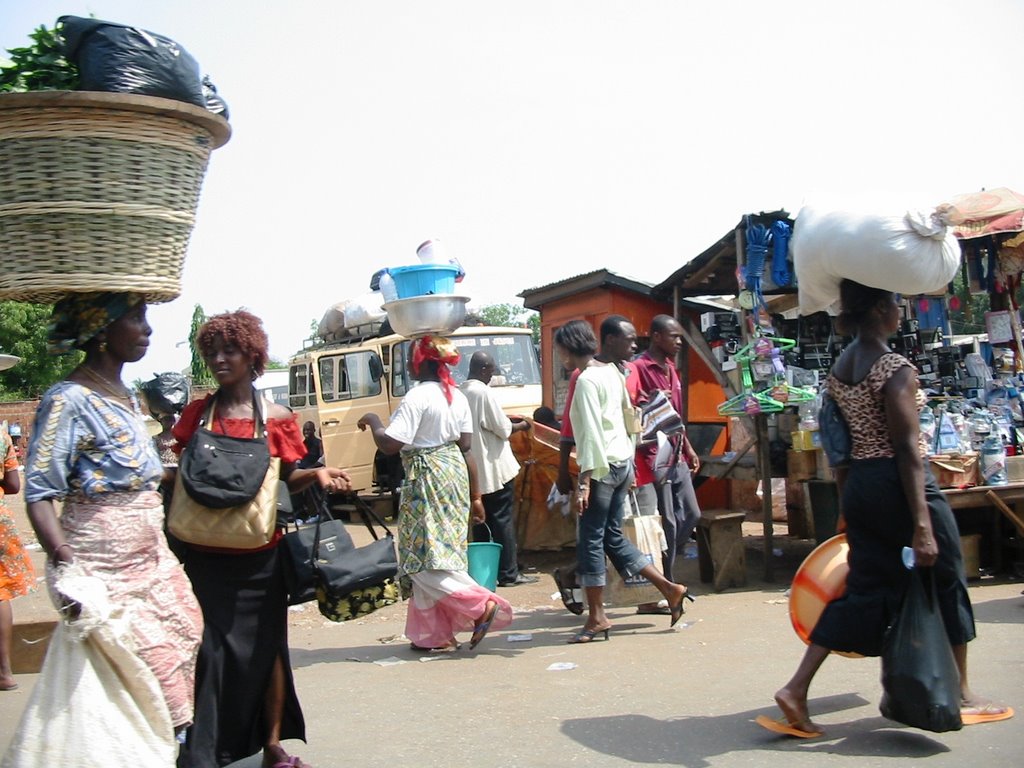
One more contrast comes to me—the extreme physical labor you see people engaging in and the people taking impromptu naps seemingly at any time of day. Among examples of the physical labor, of course, are all the people, typically women, I saw carrying everything on their heads. This brought back many familiar recollections from my childhood. But people also wheeled carts down the road piled high with firewood or yams. While we were at the beach, we watched three men pushing a heavy cart filled with dirt down the beach. After a half an hour we saw them return with the cart empty, and a half an hour after that, they were back pushing the reloaded cart down the beach. I have no idea from where and to where the dirt was being moved.

The impromptu naps take the concept of siestas far beyond a mid-afternoon snooze. As we walked around the Makola Market, we passed several stalls where the supposed proprietor was stretched out, next to whatever the goods for sale were, sound asleep.

Such a city of contrasts.

Friday, December 01, 2006

Priceless

Remember the recent commercial that goes through the price of various items, all leading up to what the experience itself is—and the tag line is PRICELESS. Well, I had several priceless moments during my visit to Accra.

One of the first came after my first full day in Accra. It had been a busy full day, and with the heat, returning to the hotel and its lovely pool was so welcome. After going out to dinner at a Ghanaian restaurant and then returning again poolside, my daughter and I sat sipping a drink and taking in the cooler night air. Soon a band began to play across the pool. They played music in the high life style—a soft melodic jazzy type music featuring brass. But this group was singing all sorts of pop tunes. It got to be quite funny listening to the morphed pop tunes, and given the accent of a Ghanaian singer who learned English as a second language, the words didn’t always come out just right. For example the old classic “Que Sera, Sera,” the line “the future’s not ours to see” came out “Future not ours to see.” When the main singer struck up “I Believe in Miracles” we were primed. When he sang that constant refrain, it actually came out “ I Believe in Merkel.” Sort of a theme song for the German chancellor. Priceless.

During my second day in Accra, we visited Makola Market. This is a sprawling market near the city’s center with all manner of stalls selling seemingly everything: cloth, glass beads, food, water, plastic ware from China, dishes, mattresses, shoes, dresses, open containers of various grains, little bags of spices. People were everywhere, walking, selling, shopping, some sleeping. And soon after we began walking around, we heard Christmas carols playing—What Child is This? At one point we passed two separate street preachers with their own loud speakers blaring away. Also church music blared through the speakers. I was struck with the shoppers who seemingly paid these preachers no mind, even as they hummed the Christmas carols that were playing. The entire scene—priceless.

One afternoon we planned to head out to Labadi Beach in Accra. Our plan was to watch the sun set over the Atlantic. There are several beach restaurants selling refreshments, and they have chairs and tables for patrons. We settled on one, then watched and waited for 6 p.m. Since Accra is very near the equator, the day is almost precisely 12 hours long. We sat reading our books, sipping on our drinks, snacking on plantain chips and ground nuts sold by a vendor. And watched the waves crashing in. This is not a calm beach with easy swimming. The few swimmers do not venture out more than a hundred feet or so. The undertow is extremely strong, so swimming is not recommended. Like so many places in Accra, this peaceful scene was disrupted by multiple vendors—selling jewelry or nail polish, drums, or paintings. There were also several extraordinarily athletic young men who kept kicking a soccer ball back and forth. The sunset itself was almost anti-climactic, a pale sun slipping behind the clouds. However, the priceless moment was about to come. We decided to leave a bit ahead of the quickening dark—so we asked for the bill for our drinks. The bill for 24,000 cedis, so my daughter gave the young man 30,000 cedis and asked for change. He said he didn’t have it and would have to go get it. He disappeared. Five minutes, then ten minutes went by; then fifteen. By now, waiting for change has become stand on principle. Finally the young man returns with the change—and announces to my daughter that he should keep it for his trouble of having to go get it. Priceless! Incredulous, she said NO!

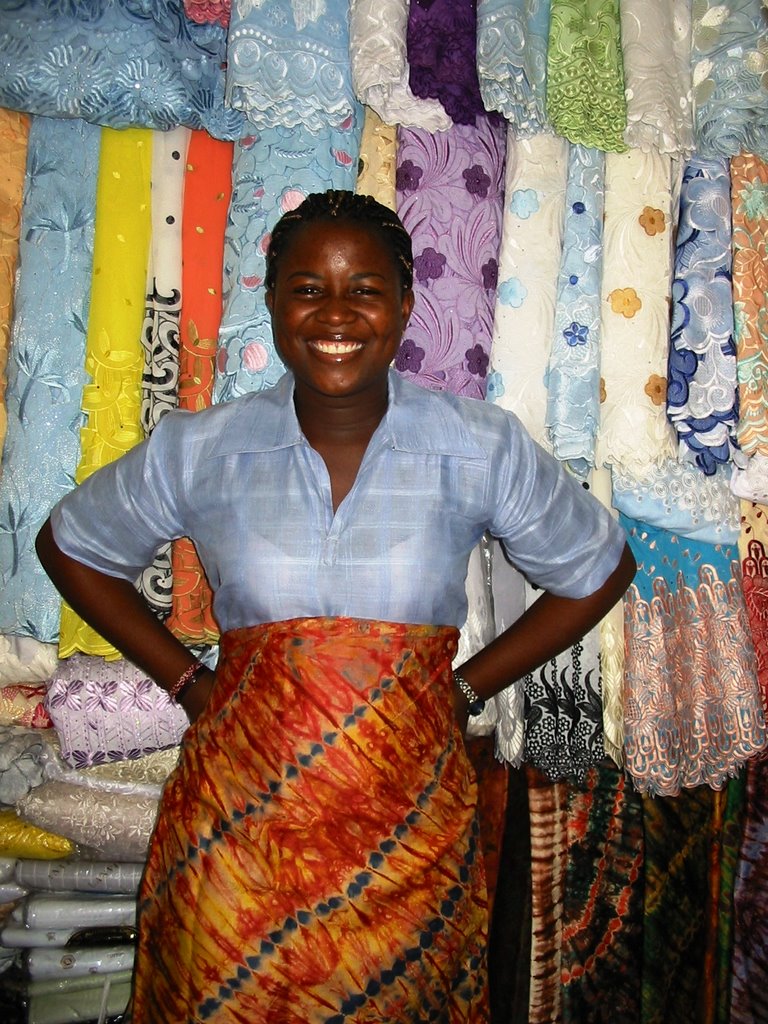
The final priceless moment occurred in the Centre for National Culture. Close to the Makola Market, the Centre sells various arts and crafts of Ghana. This is a walled in section of the city with the craft stalls laid in a part grid, part random fashion. All the vendors are anxious to sell, and beseech you to come see their wares—kente cloth; all manner of jewelry, made from beads, stones, pottery, wood, silver, gold; carvings of animals, salad tongs, ingenious stools, phallic symbols, mother and child; games; basket of every shape and size. And everyone is calling—hey, stop at my shop, stop here. They call my daughter “sister”, and (I assume because of my age) they call me “mama.” In one stall, the man asks my daughter—is this your mama? She says—yes, can’t you tell? The man says—no! your mama, she is big; you small. Happily for me, I am the right size here! Priceless.

Thursday, November 30, 2006

Getting around in Accra

Accra, which is the capital of Ghana, is a sprawling city of about 3 million people. Everywhere you go, there are teeming crowds of people—going here and there, working, pushing carts, riding on flatbed trucks, carrying merchandise on their heads. The scene is chaotic to my western eye. I have obviously seen large crowds before—say, in New York City when you encounter people walking en masse in Times Square, or at a college football game when fans swarm into the stadium, and then equally swarm out after the game. But the crowds in Ghana seem more random to me. That does not mean the people are purposeless—it has more to do with the open spaces, and the lack of sidewalks, and the higgledy-piggledy arrangement of streets. Look at a map of Accra, and you get the false impression of order. What I experienced was constant disorientation (although places did begin to look familiar after traveling over the same roads for several days).

While Ghanaian people seemingly walk everywhere, I was less likely to walk, not because of reluctance, but simply because where my hotel was in relation to places I wanted to see required getting transportation. Enter taxis. Taxis—taxis in Accra. Well, let’s just say that in my opinion while the Accra drivers could hold their own in New York City, the overall experience of a taxi ride is most interesting, unlike anything I have ever experienced.

First, there are the vehicles themselves. Many taxis are small cars. Most have multiple bashes and dents. (In fact on one ride, the taxi I was in got rear-ended in a minor bump, the driver got out, looked his bumper over, then drove on.) Almost all I rode in had cracked windshields (or windscreens, as the Brits would say). Many had fancy windshield wipers that at night were lit up with multiple color—sort of a neon wiper. And then there are the signs on the taxis—more on that in a bit.

Next, there is the whole ritual of getting a taxi. My daughter has mastered this routine. I wrote it down the first day and read my description to her. Her response was that while she hadn’t noted that she had such a set dialogue that I got the details right. First, as you stand along side the road and see a taxi coming you wave your hand with your arm down—almost like shushing the ground. The taxi pulls over—my daughter looks in the window saying to the driver—Hello, how are you? (Can you imagine asking that of a New York cabbie). The driver responds, I am well. Then she says—we are going to the restaurant (or wherever your destination is). The driver may look knowing or puzzled. She explains, It is near—and then gives a landmark or nearby establishment. By now the driver might say, I know where it is. He may or may not (I saw only male taxi drivers). Then she asks, How much? Remember the hyperinflation factor. So the driver might say, 40,000 cedis. To this, she says, Oh no, my friend, it is too much. It is close. I go there all the time; it is only 20,000 cedis. Once she said—you are asking obruni (white) price. Meaning, we are white and look like tourists, so presumably we wouldn’t know how much the ride should cost. If the driver persists on 40,000 cedis, she says, OK we get another car. And we walk away from the taxi. Sometimes, the driver relents, sometimes not. (No doubt, you have figured out the taxis are not metered, so the whole price interchange MUST occur before you get into the taxi.)


This entire exchange is most amicable. It is just a necessary precursor to actually taking a taxi somewhere. Once in the taxi, it is acceptable, perhaps even polite, to inquire of the driver, How are you? Or to exchange some pleasantry.

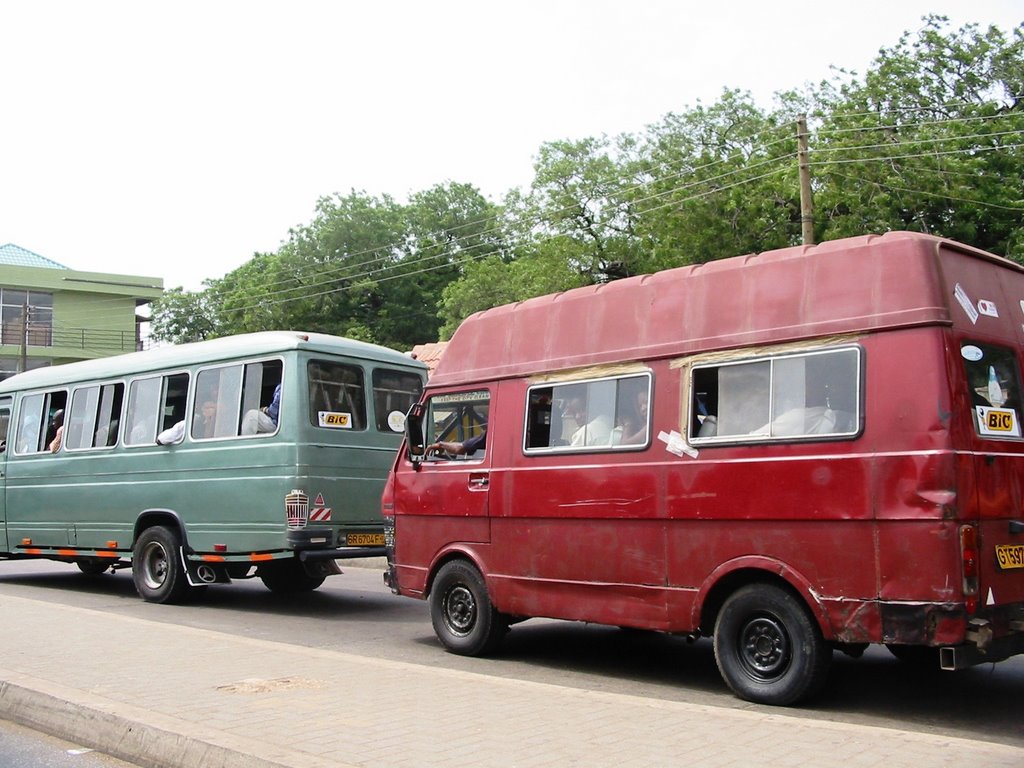
Of course, there is another form of readily available public transportation. These are the tro-tros. The best way to describe of tro-tro is to picture first a mini-van, with the usual interior seats removed, and in their place a double row of seats, very much like bus seats. Tro-tros are like miniature buses. There is even a large tro-tro station in Accra, a kind of traffic circle, where the interior of the whole circle is filled with tro-tros. Tro-tros go everywhere, both within Accra and to outer areas. They go between the towns. There is obviously a driver, but he is assisted by a mate who collects the money and who calls out the approximate stops. I did not ride in a tro-tro, so I am dependent on my daughter’s experience and the description at
this site. One of the most entertaining things to do while riding in a taxi is to read the signs on the back of the tro-tros. Seemingly every tro-tro has some sign, homemade, posted on the back. Most of the signs are religious, many are in English, and a fair few at utterly incomprehensible—example, Beware of Friends.

In fact, the religious signs are sprinkled all throughout Accra, on tro-tros, on taxis and on many business establishment and advertisement signs. The best example I have of a religious sign (having spent only a week in Accra, my experience is limited, and had I stayed longer, I am sure I would have a new “best”) was the taxi I took back to the hotel one night. The driver knew where I wanted to go, and my daughter had negotiated the price, but then the engine was reluctant to start. Finally, it sprang into life and off through the streets of Accra we went. The taxi sounded as though it would die at each intersection. Before I had gotten in the taxi, I saw the homemade sign on the back—IN GOD WE TRUST. Below it was a picture of Jesus, the shepherd holding a lamb. Of course, I got the hotel safely, asked the driver if I could take a photo of his sign. But as he pulled away, I thought—well, trust in God; yeah, that and a good mechanic!

Tuesday, November 28, 2006

First Impressions


Having grown up in southern Africa, I very much looked forward to a chance to return to somewhere on the African continent. Admittedly, my husband and I were in Africa this past summer--for two days in Morocco, but that didn't feel like Africa to me. So with my daughter on a work assignment in Ghana, I took the opportunity to visit her. I realize that there will be differences between my childhood experience of quite some time ago in another part of Africa, and my adult visit to a country in west Africa.

Hence--I offer first impressions as my visit to Accra, Ghana began. I am struck by the extravagance of Africa. Riotous trees, people everywhere, cars, trucks, buses, tro-tros, a jumble of buildings, ditches along the road which are for both rain run-off and daily sewerage, women walking with all manner of goods on their heads, at every intersection where the taxi must stop, there are vendors pushing wares. Everything from air fresheners to fruit--apples, bananas, papaya--to pens to toilet paper to sun glasses to jumper cables to water in plastic bags, to maps of Ghana, maps of Africa to flags to key chains to bathroom scales!

Even the air is extravagant. As I first stepped off the plane into the night air at Accra airport, I was hit with a wave of humid air. Past 9 o'clock which made it 3 hours after sunset, the air was so moist it felt like a steambath. During the day, as we ride anywhere in taxis, the air hangs blue redolent with wood fire smoke and vehicle emissions from all manner of traffic belching unfiltered fumes. But the smell is one I remember. The pungence of wood fire smoke that bites my nose is completely reminiscent of childhood.

The monetary system is extravagant. Of course, one needs to change U.S. dollars into local currency, which was one of the first things my daughter took me to do. We tried two established banks intially. In the first, we sat for some time waiting for someone to deal with us, until finally someone said--no, they did not change money here. We could have been told that to begin with! The second bank was faster on the information, but the information was the same--only service for customers. So we went off to a local currency exchanger. He happily handled the exchange. For some $300 U.S. we get back about 3 million cedis (pronounced CDs). So, when calculating the price of anything, I simply removed 4 zeros and got the approximate U.S. price. The hyperinflation is a little disorienting, and since the largest denomination paper note is a 20,000 cedi, one walks around with a stuffed wallet.

Finally the people are extravagant. They are wonderfully friendly and welcoming. They are quick to say hello, to ask how you like Ghana, and to ask when are you coming back. Upon first encountering someone, it is expected that you will go through a brief interchange of--hello, how are you--before you get down to business. Very relational. Everyone asks your name--and if you have looked it up in advance you can tell them your name which correlates to the day you were born (more on this later). And they shake your hand--an interesting variation on which I, as an American, had to be instructed. First you shake as one would in the west, then leaving go of each other's hands by dragging the fingers apart, then finally snapping your thumb and middle finger. It takes a bit of practice, and I don't have it mastered yet.