Showing posts with label Portugal. Show all posts

Saturday, July 22, 2006

Iberian Adventures Part IV

DAY 9--2 July 2006 Sun
Images of Morocco:
*People walking everywhere
*Herds of animals—sheep, goats, cows—always with a herder
*Casbah—fortified part of town
*Medina—part of town not fortified
*Morocco—population predominantly Berber
*Doctor monthly salary: $900/ teacher $450
*Tangier at one time was an international city

Our morning began with a brief bus tour of
Tangier. For many years, the city was an international zone run by 9 foreign governors + 1 Jewish and 1 Muslim. Morocco gained independence in 1955.
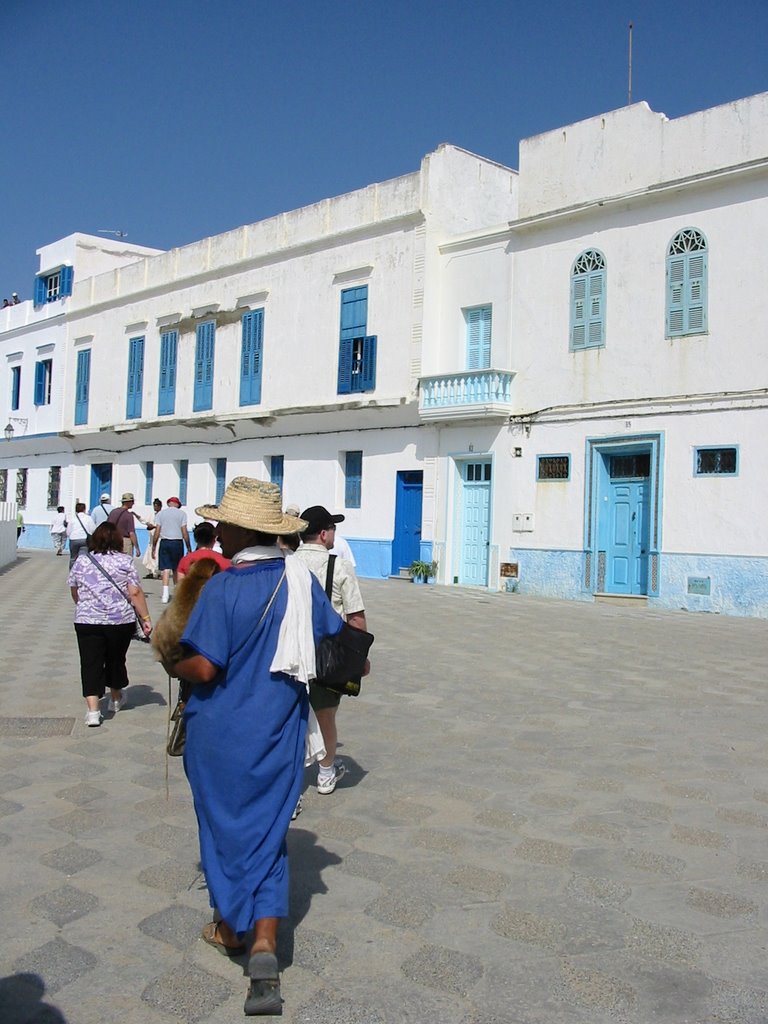
We then took a walking tour of the Casbah—as soon as we entered the walled area, we were besieged by vendors, peddlers & hawkers of various wares—jewelry, clothing, leather goods, carvings. The streets were incredibly narrow, winding around (sense a theme here?) going off in all sorts of angles, up stairs, down stairs, but mostly narrow. We were heading to a government regulated bazaar—but the vendors stayed with us. Finally, one who had been trailing me trying to sell 5 copper bracelets for 20 €—I kept saying no; then he said 15 €, I said 5; he said 10; I held at 5 and started to walk away. So he quickly said—OK 5 for 5 AND my Pilot gel pen. SOLD.

Inside the carpet bazaar, we were first given a demonstration showing levels of quality, how carpets are tied, etc. Good carpets can be shown on both sides. With each new level, a man came out carrying a carpet that he unrolled in front of us. After the demonstration, suddenly a whole group of men appeared, seemingly from nowhere to herd each of us around trying to make sales. There were carpets, brass ware, ceramics, clothing—two women in our tour group had asked Carlin to help them bargain: one had picked a blouse, the other two caftans. As it turned out they did their own bargaining without help (except, I suppose, the moral support).


As soon as we left—once again, the street vendors swarmed. One picked out Carlin, offering a djellaba. Carlin kept saying no, and when we went into an herbalist shop, the street vendors left. The herbalist showed us all sorts of homeopathic items—sort of bizarre—very showman in his presentation. There was a cream or a powder for every ailment: acne, snoring, weight reduction, and asthma. The minute we left the shop, the same street vendor appeared to continue his sale to Carlin. Just when we were ready to leave the casbah and get on the bus, he suddenly agreed to a price, about $20.


Leaving Tangier, we drove slowing past all the new hotels, then drove back to the ferry connection to go to Terifa—back through customs. The bus then began our drive to Torremolinos on the Costa del Sol. We first passed the Rock of Gibraltar where we made a photo stop.
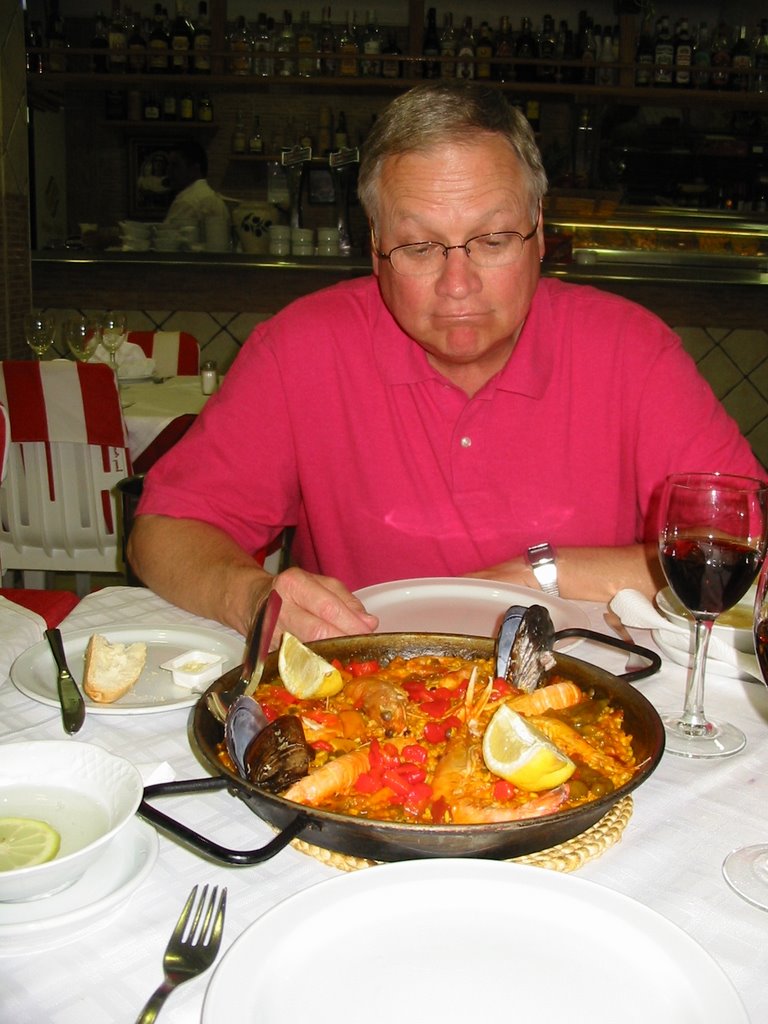

The drive to Torremolinos was a 2 ½ drive, all along the Mediterranean coast. The amount of construction is unbelievable—an explosion of growth. Once at the hotel, we had supper on our own for the evening, so we linked up with a couple from NYC (Lee & Barbara) and two teachers from California (Lucille & Kim). We walked along the beach until we picked out a restaurant. Carlin and I got paella and red wine. A Spanish treat!

----------------------------------------------------------

DAY 10--3 July 2006 Mon
We had today at leisure, so we slept until we awoke (i.e. no alarm)—after breakfast, we went walking through a shopping area: part NJ shore and part class jewelry stores. I got a white cotton skirt, and we also got various items for gifts.
We stopped for beer, and people watching. We also went looking for a local bank to break a 500 € note.


Once back in hotel, around 2:30 (all the stores closed at 2 for siesta) we relaxed, had a bottle of green wine, and got ready for dinner.


Our tour group went first to Mijas—a charming mountainside village with white washed houses and donkey carts and a spectacular view of the Mediterranean.
Then we drove to Carihuela, a former fishing village, for dinner. We had various fish dishes—clams, sardines, grouper, and calamari as appetizers; then sea bass baked in rock salt.


Carihuela is right next to Torremolinos, so we walked back to the hotel—a 10 minute walk, while the bus took about 20 minutes, since it couldn’t go straight down the beach. I did a quick detour to dip my toes in the Mediterranean.

Friday, July 21, 2006

Iberian Adventures Part III

DAY 6--29 June 2006 Thurs
For today’s journey to Seville, we took a newly opened super highway that reduced the time of the trip, so we were able to do the city tour of Seville upon arrival.
The result was an uneventful drive through unappealing countryside. We did see many oak cork trees—they harvest cork by removing the outer layer from the bottom of the tree every 9 years.
We crossed back into Spain just after our lunch. Now in Andalusia. We saw many olive trees—our guide says there are 260 million olive trees in Spain!
We arrived in Seville about 3:30 and began city tour immediately. We went first to cathedral—said to be 3rd largest in Europe after St. Peter’s in Rome & St. Paul’s in London. Where the cathedral stands was once the site of a mosque—so the bell tower replaced a minaret. In the church, the altar is a huge gold one. The cathedral houses the tomb of Christopher Columbus. There are also several paintings there by the Spanish artist Murillo, who was born in Seville.
We then went to the old Jewish quarter with tiny winding streets and shops & restaurants.
From there we went to the Parque Maria Luisa which has buildings from a World Exhibition held in Seville in 1929. The primary building there is at the Plaza de EspaƱa, which was Spain’s building.
On the drive back to the hotel, we passed the university , with one building which had been a factory, the setting for the fictional story of Carmen.

------------------------------------------------------
DAY 7--30 June 2006 Fri
All day in Seville—a group of us had signed up for a trip to Carmona, a nearby town with extensive Roman ruins.
The first stop was at a necropolis where had been excavated. In the distance, we could also see an amphitheater outline, apparently not yet excavated. The necropolis was quite open for us to walk around. Two large chambers—the Elephant Grave (so called from a figure of an elephant that had been unearthed) and the Servilia tomb complete with a small temple. The remains of those who died would be cremated then the ashes buried in small niches.
We drove to the Parador, a government built and run hotel (these are all over Spain, existing in old castles, etc. to preserve the buildings). It blends in with the overall architecture of the fortress at Carmona. The bus had a time driving through the narrow winding streets. We went into the Parador, had a refreshing drink, and did a bit of shopping at a very nice little gift shop. We then went back to the town, and continued a walk around, past unique doors, hallways tiled covered, narrow streets with awnings drawn across for shade. We ended at the fortress at the far end of town where we climbed the Torre de Oro.
Once back in Seville, we had tapas for lunch, shopped at El Cortes de Ingles, then returned to our hotel to watch a bit of world cup soccer (Germany vs. Argentina). Our evening entertainment was flamenco dancing and dinner. Watched more world cup (Italy vs. Ukraine).

------------------------------------------------------
DAY 8--
1 July 2006 Sat
Today we go to Morocco—we need to catch a fast ferry across the Straits of Gibraltar at 2 p.m. We arrived at Algeciras with time to buy lunch. As it is the beginning of July, and Moroccans head home from jobs in Europe, we expected many other travelers. The ferry was full, with many family groups. With birth rates so high, poor countries’ populations will pass European countries easily.
The ferry also took cars—each car was LOADED to the hilt with possessions! The overall ride took 2 hrs., sailing right past the Rock of Gibraltar. When we landed, we all went through a very brief security check. Our tour guide had given all our passports while we were on the ship for entry stamping. We met up with our local guide—Rashid—and the local driver Mohammed (we had left our bus in Spain). We drove first to a small village called Asilah—again narrow winding streets. There were vendors of many kinds following us and trying to persuade us to buy brass, copper, red coral. Carlin finally bought a flask made of brass & copper.
We then drove along the coast to Cap Spartel. We passed some lovely homes along the coast, side by side with absolute squalor. On the way, we stopped by some camels and some in the tour group decided to go for a ride, with the camels protesting all the while. We went to a hotel where we were served hot mint tea and cookies. I bought a silk caftan there and two stone carvings, a camel and an egg.
Delicious dinner tonight of lamb, prunes and almonds all baked together.

Thursday, July 20, 2006

More Iberian Adventures


DAY 3--26 June 2006 Mon

Left Madrid traveling first to Segovia where there is a 2000 yr old aqueduct. Then we drove to Avila where the town wall still stands with 88 towers intact. The town was an important stop on the medieval pilgrim routes—so one of the photos I took is of the four posts & cross, to mark the pilgrim’s way. The pilgrims were going to Santiago de Compostela (Santiago meaning James in Spanish).
By afternoon we arrived in Salamanca, which has a marvelous series of medieval vintage buildings. There was an old (vieja) and new (nueva) cathedral. Carlin & I walked from the hotel (a lovely hotel named Alameda Palace) to old quarters. The whole area has been declared a World Heritage site. We ate lunch along the way, then walked all through the university buildings. Salamanca was a famous university in medieval days.
Once back at the hotel, we had a group dinner. It turns out we have many teachers in our group—2nd, 3rd, and 5th grades, also kindergarten and a speech therapist. These folks are in addition to the university professors!
Tomorrow—Carlin’s long held dream of visiting Portugal will come true!
-------------------
DAY 4--27 June 2006 Tues

We left straight after breakfast and drove for Portugal. On the way, we stopped at
Fatima to see the place where the shepherd children had a vision of the Virgin Mary & subsequently received 3 prophecies. Hard to get into the scene as a Protestant. But there were some petitioners there going on knees to the chapel to pray to Mary. There is a long shiny sidewalk that on holy days is filled with people, all going on their knees to the chapel. Mass is constantly being said—or at least Hail Mary in whatever language. I am too Protestant.
From there we drove to Lisbon. Amazingly, it is wonderfully cool here right now, some 22 o C. We got to our hotel—a Marriott which is another lovely facility.
This eve, we went across the Tagus River (major river on the Iberian Peninsula, beginning in Spain and continuing for some 625 miles, emptying into Lisbon harbor) for dinner. We had a wonderful meal, described as “typically Portuguese” food—mostly seafood based. Big hit of the evening—green wine. Also Carlin bought roses for all women at the dinner. What a guy!
-----------------

DAY 5 28 June 2006 Wed

We began the day with a city tour of Lisbon—or Lisboa as it is written in Portuguese. Our city guide, Helena, was excellent. She pointed out that Portugal is the oldest country in Europe, having consolidated into a single nation long before other European countries. The Romans were in Portugal, then barbarians, then the Moors, who were finally expelled in 1136.
We went first to Alfama, an old section of Lisbon that still has tiny winding streets and old houses close together. The whole area is gradually undergoing renovation with outside walls being retiled. Depressing amount of graffiti everywhere.
Our guide told us that any words in Portuguese or Spanish with AL as a prefix come from Arabic, so Alfama was where the Moors first settled. Also many towns have an old section called the Alfama.
We then went to see the Torre (Tower) de Belen—it was originally a fortress along the Tagus which is so wide at Lisbon it appears to be a sea. This tower was also the place where explorers sailed from as they launched out into the world. Nearby the tower is a monument, modern vintage, to Prince Henry the Navigator, with portraits of various explorers such as Vasco de Gama.
We next visited the Monastery of St. Jerome (Jeronimo) where Vasco de Gama’s tomb is. The architectural style is uniquely Portuguese—called Manueline. Among its features—rope, carved in stone.
The big historical event in Lisbon was an
earthquake in 1755 on Nov. 1 which destroyed much of Lisbon—either the earthquake itself or the resulting tsunami which killed thousands.
When Lisbon was rebuilt, then Prime Minister Marques de Pombal took charge and required wide avenues to be built. Lisbon’s appearance reflects his design.
In the afternoon, we went to Cascais, a sea resort. What a lovely place. We had lunch, walked around a bit. The weather is cool & breezy, atypical.
Then we drove to Sintra, a World Heritage site—it is a valley in the granite Serra Hills. The location protects it & gives it a cooler climate than Lisbon. We shopped buying some pottery to take home.
On our way back, we stopped at the Palace of Queluz (pronounced Kay-loosh), the “Versailles” or Portugal. We walked through the whole palace and exited into the gardens. Ahead of us was a group of school children with one little boy who had slipped away from his classmates to urinate in the garden. Surprise to him—he was in FULL view of our group as we all walked toward him. He beat a hasty retreat.
Tonight we went to a restaurant where Fado singing is held, along with folk dancing. A bit of local culture. Tomorrow we leave Portugal to go to Seville, Spain.