Friday, December 08, 2006

Where Cross the Crowded Ways of Life

When I was thinking of a title for this (maybe final) blog on Ghana, the first line of an old hymn came to mind: Where cross the crowded ways of life. I love hymns--I love singing them, especially in four part harmony, and this particular hymn is wonderful to sing. But the phrase came to me partly because there was something about this trip to Ghana that touched a place deep in my soul.

Accra, Ghana, is by no means the most attractive or interesting place I have ever visited. Parts of it are downright squalid. But there were some experiences that were just so vital that I would not have traded this trip for any other location in the world.

Here are some of the shining experiences.

One night, my daughter suggested we go to Bywel. Bywel is a nightclub by Accra standards.


The venue is primarily outdoor, with a fenced in area, a gate/door through which one must pass and pay an entrance fee. Once inside, there are relatively crude counters with rickety chairs to sit on. Patrons can order soft drinks or beer, and sit there in the humid night air. The entertainment is the draw. The overall space is a large open square, with the seats on two sides of the square, the refreshment bar on a third side, and the band on the fourth. The band plays highlife music. As we entered, they were playing, in highlife style, "What Child is This?" Seems to be a popular in Accra.


We sat down, ordered some drinks, and then listened to the music. After a short while, some people began dancing. One woman especially wanted to dance--so she stood where she had been sitting and moved enthusiastically in time to the music. After one whole number had played, during which she stood dancing the whole time, a man came along, took her hand and led her out to the dance floor section. Into the third number, he began dancing with another woman, so the first woman hip-bumped her competition out of the way.

We didn't stay long, but the scene is quite memorable and will stay with me a long time.

On another evening, my daughter suggested we go to Alliance Francais. The French government sponsors these cultural centers in over 100 countries. The night we went there, they had a drum and dance exhibition.

The drums were playing the polyrhythmic music that I associate with Africa, and the dancers performed a variety of numbers, each of which was preceded by a costume change. My personal favorite was announced as the Monkey Dance. Just how the dance was the monkey dance eluded me, although other patrons attending may have understood perfectly.

During the time that I was in Ghana, the US celebrated Thanksgiving. In fact, the Thanksgiving break at school facilitated the timing of my trip. Obviously, Ghana does not specifically celebrate this quintessential American holiday. But, since I was with my daughter, we decided to have a Thanksgiving dinner. Along with a friend of my daughter's, we went to a local restaurant--strangely an Argentinian restaurant. For Thanksgiving dinner, my daughter and I both ordered kebabs on a hanging skewer--mine was chicken (that's close to turkey, no?) and hers was beef. A most memorable Thanksgiving dinner!

Eating out was not much different than eating out in the US. However, the first night we went to a local Ghanaian restaurant. Among the ways in which this restaurant was different were the hand washing stands dotted around the restaurant. Some typical Ghanaian food is meant to be eaten with the hand, so washing hands first is a good idea.

The overall ambience of the restaurant was lovely--on a hot evening, we sat in an open air structure, with the breeze playing on the wind chimes. All around, in the night air, you could hear the evening sounds of traffic, voices, and night creatures (small ones--nothing vicious!).

On the Sunday that I was in Accra, my daughter had discovered where the closest Presbyterian church was--it was fairly close to where she lives. As we made our way to the church, we passed several other groups of worshippers, and you could hear the singing wafting up from the open buildings. The Eben-ezer Presbyterian Church is a large brick structure. The windows were all thrown open for the 7 a.m. (!) service--the English service.

We sat in the outer area which we learned the church had built several years before to accommodate all the extra worshippers they had. They called the overflow area the shed.

The hymns were unfamiliar--but, no matter. What I found most fascinating about the service was that in the course of the 2 1/2 hour long worship, they collected not one, not two but THREE offerings. First, they collected the tithes that went in wooden boxes. The givers had to come forward in special groups--the Session members first (then those boxes were taken away), then dignitaries and other important visitors (again, those boxes were removed) and finally all the other congregants. The second offering was a Thankoffering collection, no doubt for Thanksgiving Sunday. This was collected in deep bags that looked like knitting bags, that were passed in and out of the rows of worshippers. Finally, there was an announcement that since everyone has a special day, we should give in honor of that. While it took us a minute or two to figure out what the preacher meant, it soon became evident that you were to give in honor of your day of birth.

With the first offering, the choir had sung. The second offering had a jazz band playing very lively music. Now, this third offering also had the jazz band, but this time, everyone went in to the church to give their offering. We watched as section by section went up front--and the band kept playing. By now, members of the congregation were dancing up the aisles, on their way to give. Actually, there was a passing resemblance to Bywel! Finally our section got up, and my daughter and I made our way inside. What we discovered then was 7 baskets in the front of the church--one for every day of the week! So, I being born on a Tuesday put my contribution in he Tuesday basket. What a stroke of genius--an offering that builds in competition to see which day of the week has the best givers born on it! Ideas to take home to my church in Harrisburg! Another indelible memory.

I saved the best for last--what was the absolute best part of this whole trip? Getting to see my daughter. The photo below speaks for itself!

Wednesday, December 06, 2006

Peregrine Postscript

(A parenthetic note before I begin this short blog--I think I have at least one more Accra, Ghana blog in me. . .but the following blog is prompted by an observation today.)

Well, our neighborhood has been visited again by the peregrine. Actually, the first time I saw the peregrine was about a year after it began nesting in the Harrisburg area. That spring, I had obsessed with the unfolding story of the peregrines choosing the Rachel Carson building that houses our state department of environmental protection. I watched the webcam daily to see the eggs being laid one at a time, and then watched it to see the eyasses hatch and . . . (as I said, I obsessed).

One day, I looked out our window to see our backyard. We had an outdoor swing on an A-frame, and there perched on top of the A-frame was a bird that was clearly a raptor. I went scurrying off to check our bird guide, and concluded that based on size and markings, it had to be the peregrine.

Today the peregrine was back. As I walked our dog around the block, I saw a group of birds dipping and wheeling low in the sky. When I looked up, I realized it was the peregrine, but this time with full escort. Three crows were flying with the peregrine--no, actually they were not flying WITH the peregrine, but AT it. The crows were clearly harassing the peregrine. They would dive at it, clearly encroaching into its air space. The peregrine kept wheeling, trying to fly away from the crows. Finally, two crows gave up, but one kept up after the peregrine until it escaped and flew away.

I have seen crows do this before--but only with hawks. It is amazing how crows band together and go after a raptor that is clearly bigger than the crows. The crows are fearless. I don't know much about crow behavior, but the little bit I do, I tend to admire them. However, harassing my peregrine--that's forbidden. So, there I am, walking the dog, yelling up at the crows to "leave my peregrine alone." Only afterwards did it occur to me how looney that must have looked--after all, who's to say crows speak "human"?

Tuesday, December 05, 2006

Scenes from the Accra cultural center


Ordinarily, I like to intersperse photos with text. However, Blogger was so obstinate when I was working on the post on A City of Contrast. I finally gave up trying to post some photos of the cultural center. So, this evening, I decided to try posting mostly photos, one at a time, and just waiting patiently while Blogger putzed away uploading them. Here they are. . .enjoy, as who knows when I will feel like sitting in front of a computer screen just looking at it?
Scenes from our visit to the cultural center--this first photo is taken just outside the cultural center--when you stand outside the center, you would never guess the space is filled with arts and crafts displays.


Note how the craft stalls are randomly arranged.
Behind where these stalls were meager places that presumably were homes for some of the craftspeople.

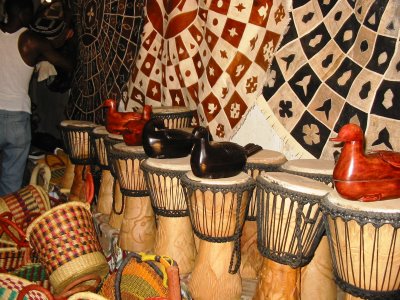
Many stalls had drums and items carved from wood, or made from animal skins. I wasn't too sure that bringing an animal skin product back through customs would be a good idea.

Understandably, the craftsmen are proud of their work. I asked before I took a photo, and always the response was positive.


This man was silently weaving kente cloth. I asked another man in the shop if it was OK to take a photo, and he readily agreed, but the weaver never broke his concentration. Note how he is anchoring one of the thread spools between his toes.

Monday, December 04, 2006

A City of Contrasts

Accra is a city of great contrasts—there are four lane highways, dirt roads, gleaming glass buildings, impromptu lean-tos, lush gorgeous flowers, open sewerage ditches. There are sections that you drive through where you could almost be in Europe, or some other developed place in the world, then other areas where you clearly are in an emerging country.

The most striking feature to me is the haphazardness of all this. Suddenly you leave the relatively nice homes section and see chickens scratching in the dirt next to roadside hovels. Right next door to the hotel was a large open field where it appeared that people lived, or at least slept, almost out in the open.

The city is a city planner’s worst nightmare. The sections of Accra have grown up seemingly unaware of other sections. So access becomes the great problem. Roads between the sections, such as the Ring Road, become very clogged. And there is no concept of air pollution control.

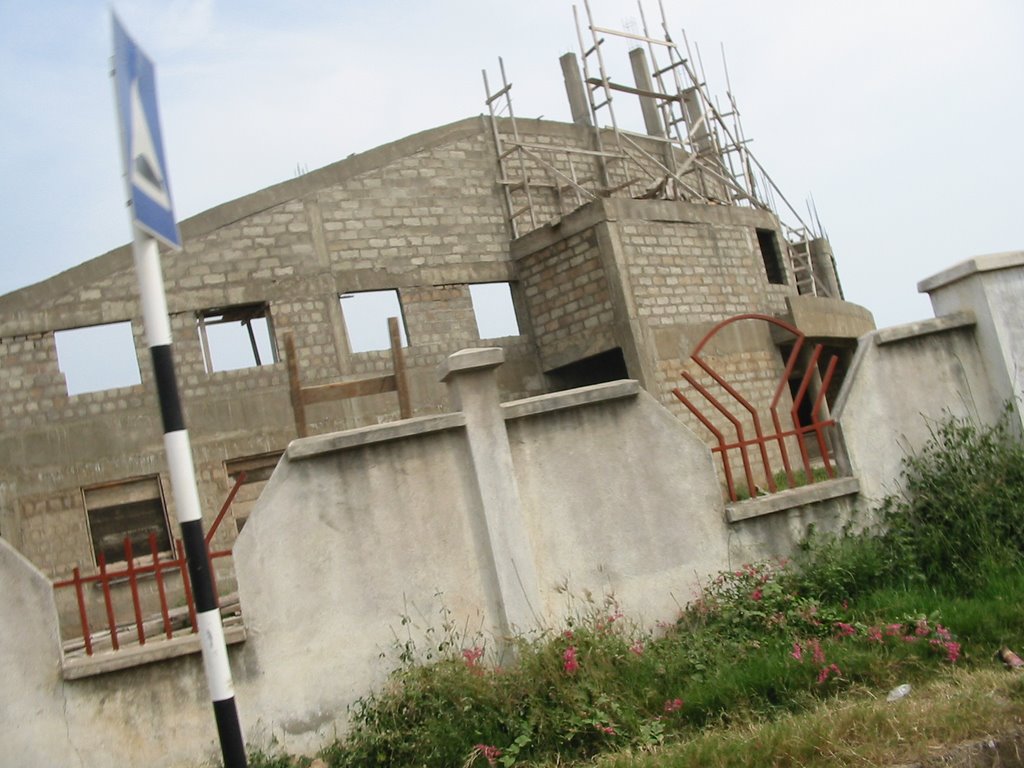
One of the most striking contrasts is one of the architectural features of the city. There is a large arch in Liberation Square. This whole area commemorates Ghana's 1957 independence from being a British colony. As official and celebratory as the area is, it is hardly ever used. We drove by, but there were very few people viewing the area. It is used on official or holiday occasions, but usually no one is there. Imagine such a public square in Paris or in Berlin that would be empty of people much of the time. In contrast to such an official edifice that goes largely unused, there are many half-built buildings all around Accra. Whether these are remnants of Soviet investment that dried up, or are structures designed to prove one's ownership to a piece of land is unclear. However, some of these structures clearly have people living in them. You will sometimes see a cloth draped across an open space to provide some protection.

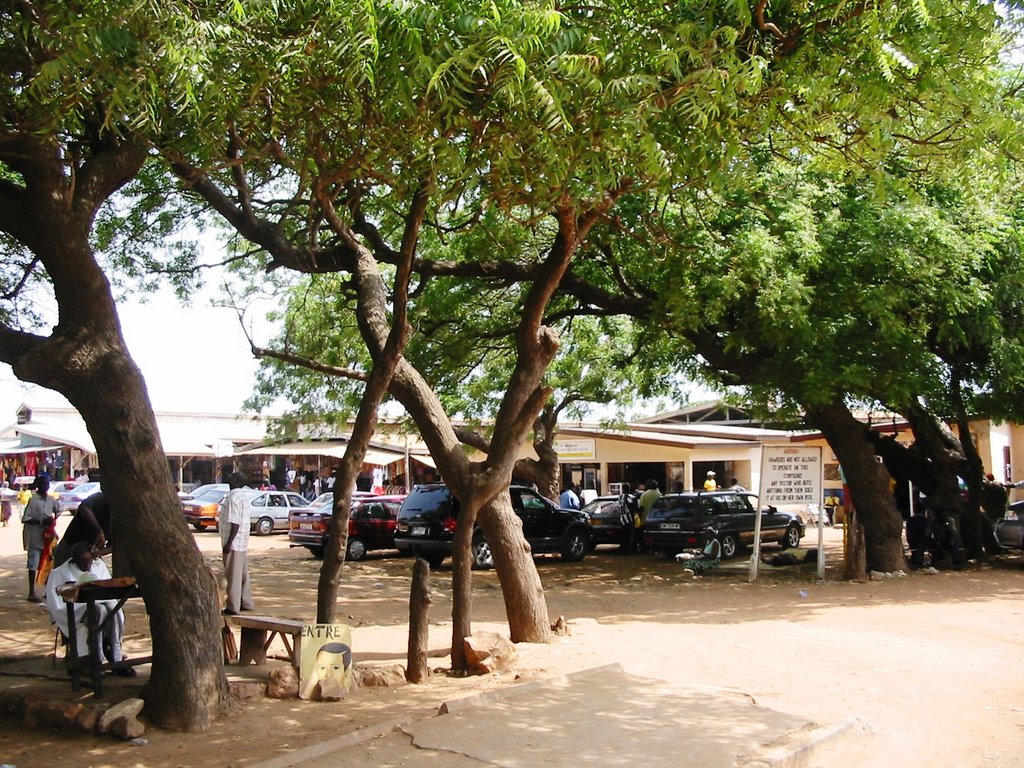
My daughter and I visited the cultural centre (where arts and crafts are sold) on one of my last days in Accra. This section is the city in miniature. It is a low-walled in area with craft stalls—not laid out in a grid pattern, but more randomly. Some stalls are quite stable and fixed in location; others are ramshackle. Some have adobe walls; some are pole and tin-roof construction.

But everyone wants to sell. I wrote earlier about the pressure to buy, and, if not to buy, well, at least you can look. If you don't buy, no problem. Unlike Tangier, where the vendors kept dogging your every step, here people relented if you persisted and walked on by. Most everyone is amazingly friendly, and usually they ask where you come from.

There are many ways to spend money (in modest amounts). In addition to the craft stalls, and the road side hawkers, there are beggars—people who have various infirmities: a blind woman being led by a small boy, a crippled man in an improvised wheel chair—a lawn chair on wheels; a one-legged man moving swiftly on crutches. As the taxi stops at a traffic light, they approach, less insistently than the hawkers, but still asking for money. My daughter usually gives them something, noting how hard it must be to be physically disabled in a country that almost demands able-bodied ness.

One more contrast comes to me—the extreme physical labor you see people engaging in and the people taking impromptu naps seemingly at any time of day. Among examples of the physical labor, of course, are all the people, typically women, I saw carrying everything on their heads. This brought back many familiar recollections from my childhood. But people also wheeled carts down the road piled high with firewood or yams. While we were at the beach, we watched three men pushing a heavy cart filled with dirt down the beach. After a half an hour we saw them return with the cart empty, and a half an hour after that, they were back pushing the reloaded cart down the beach. I have no idea from where and to where the dirt was being moved.

The impromptu naps take the concept of siestas far beyond a mid-afternoon snooze. As we walked around the Makola Market, we passed several stalls where the supposed proprietor was stretched out, next to whatever the goods for sale were, sound asleep.

Such a city of contrasts.

Friday, December 01, 2006

Priceless

Remember the recent commercial that goes through the price of various items, all leading up to what the experience itself is—and the tag line is PRICELESS. Well, I had several priceless moments during my visit to Accra.

One of the first came after my first full day in Accra. It had been a busy full day, and with the heat, returning to the hotel and its lovely pool was so welcome. After going out to dinner at a Ghanaian restaurant and then returning again poolside, my daughter and I sat sipping a drink and taking in the cooler night air. Soon a band began to play across the pool. They played music in the high life style—a soft melodic jazzy type music featuring brass. But this group was singing all sorts of pop tunes. It got to be quite funny listening to the morphed pop tunes, and given the accent of a Ghanaian singer who learned English as a second language, the words didn’t always come out just right. For example the old classic “Que Sera, Sera,” the line “the future’s not ours to see” came out “Future not ours to see.” When the main singer struck up “I Believe in Miracles” we were primed. When he sang that constant refrain, it actually came out “ I Believe in Merkel.” Sort of a theme song for the German chancellor. Priceless.

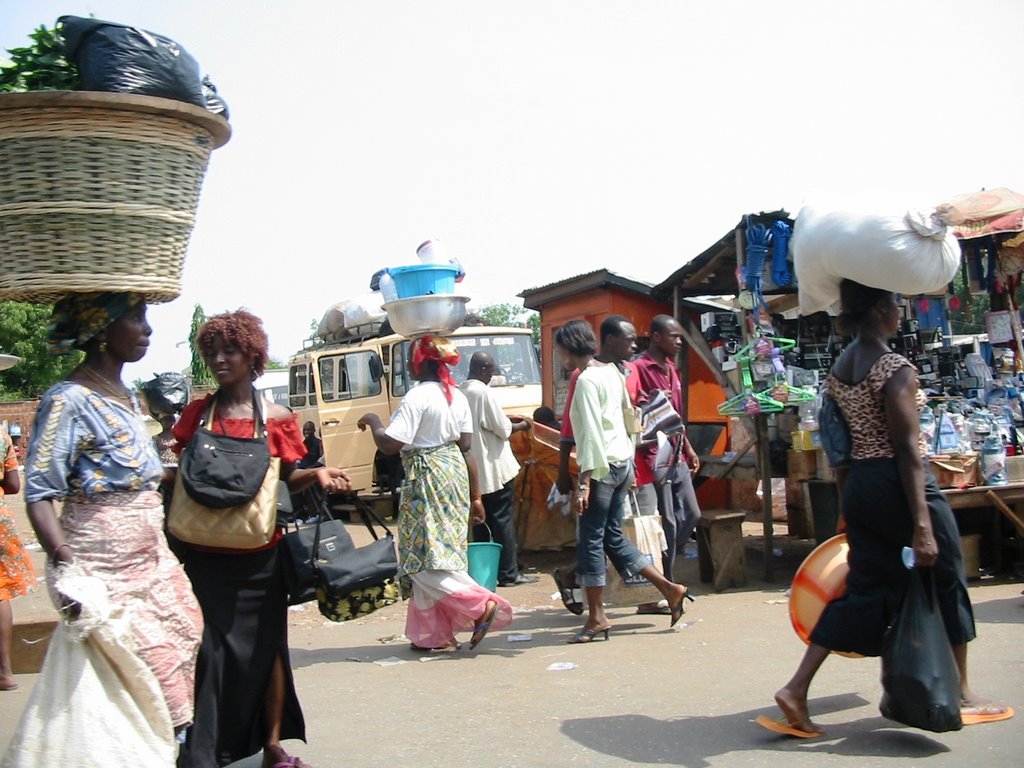
During my second day in Accra, we visited Makola Market. This is a sprawling market near the city’s center with all manner of stalls selling seemingly everything: cloth, glass beads, food, water, plastic ware from China, dishes, mattresses, shoes, dresses, open containers of various grains, little bags of spices. People were everywhere, walking, selling, shopping, some sleeping. And soon after we began walking around, we heard Christmas carols playing—What Child is This? At one point we passed two separate street preachers with their own loud speakers blaring away. Also church music blared through the speakers. I was struck with the shoppers who seemingly paid these preachers no mind, even as they hummed the Christmas carols that were playing. The entire scene—priceless.

One afternoon we planned to head out to Labadi Beach in Accra. Our plan was to watch the sun set over the Atlantic. There are several beach restaurants selling refreshments, and they have chairs and tables for patrons. We settled on one, then watched and waited for 6 p.m. Since Accra is very near the equator, the day is almost precisely 12 hours long. We sat reading our books, sipping on our drinks, snacking on plantain chips and ground nuts sold by a vendor. And watched the waves crashing in. This is not a calm beach with easy swimming. The few swimmers do not venture out more than a hundred feet or so. The undertow is extremely strong, so swimming is not recommended. Like so many places in Accra, this peaceful scene was disrupted by multiple vendors—selling jewelry or nail polish, drums, or paintings. There were also several extraordinarily athletic young men who kept kicking a soccer ball back and forth. The sunset itself was almost anti-climactic, a pale sun slipping behind the clouds. However, the priceless moment was about to come. We decided to leave a bit ahead of the quickening dark—so we asked for the bill for our drinks. The bill for 24,000 cedis, so my daughter gave the young man 30,000 cedis and asked for change. He said he didn’t have it and would have to go get it. He disappeared. Five minutes, then ten minutes went by; then fifteen. By now, waiting for change has become stand on principle. Finally the young man returns with the change—and announces to my daughter that he should keep it for his trouble of having to go get it. Priceless! Incredulous, she said NO!

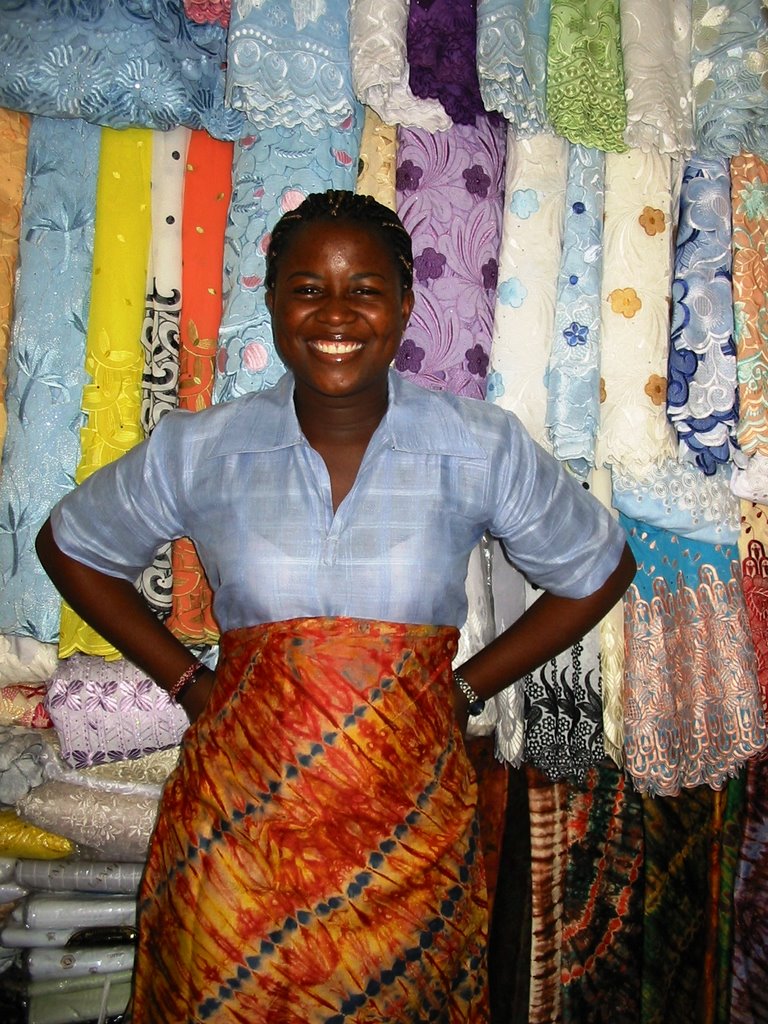
The final priceless moment occurred in the Centre for National Culture. Close to the Makola Market, the Centre sells various arts and crafts of Ghana. This is a walled in section of the city with the craft stalls laid in a part grid, part random fashion. All the vendors are anxious to sell, and beseech you to come see their wares—kente cloth; all manner of jewelry, made from beads, stones, pottery, wood, silver, gold; carvings of animals, salad tongs, ingenious stools, phallic symbols, mother and child; games; basket of every shape and size. And everyone is calling—hey, stop at my shop, stop here. They call my daughter “sister”, and (I assume because of my age) they call me “mama.” In one stall, the man asks my daughter—is this your mama? She says—yes, can’t you tell? The man says—no! your mama, she is big; you small. Happily for me, I am the right size here! Priceless.

Thursday, November 30, 2006

Getting around in Accra

Accra, which is the capital of Ghana, is a sprawling city of about 3 million people. Everywhere you go, there are teeming crowds of people—going here and there, working, pushing carts, riding on flatbed trucks, carrying merchandise on their heads. The scene is chaotic to my western eye. I have obviously seen large crowds before—say, in New York City when you encounter people walking en masse in Times Square, or at a college football game when fans swarm into the stadium, and then equally swarm out after the game. But the crowds in Ghana seem more random to me. That does not mean the people are purposeless—it has more to do with the open spaces, and the lack of sidewalks, and the higgledy-piggledy arrangement of streets. Look at a map of Accra, and you get the false impression of order. What I experienced was constant disorientation (although places did begin to look familiar after traveling over the same roads for several days).

While Ghanaian people seemingly walk everywhere, I was less likely to walk, not because of reluctance, but simply because where my hotel was in relation to places I wanted to see required getting transportation. Enter taxis. Taxis—taxis in Accra. Well, let’s just say that in my opinion while the Accra drivers could hold their own in New York City, the overall experience of a taxi ride is most interesting, unlike anything I have ever experienced.

First, there are the vehicles themselves. Many taxis are small cars. Most have multiple bashes and dents. (In fact on one ride, the taxi I was in got rear-ended in a minor bump, the driver got out, looked his bumper over, then drove on.) Almost all I rode in had cracked windshields (or windscreens, as the Brits would say). Many had fancy windshield wipers that at night were lit up with multiple color—sort of a neon wiper. And then there are the signs on the taxis—more on that in a bit.

Next, there is the whole ritual of getting a taxi. My daughter has mastered this routine. I wrote it down the first day and read my description to her. Her response was that while she hadn’t noted that she had such a set dialogue that I got the details right. First, as you stand along side the road and see a taxi coming you wave your hand with your arm down—almost like shushing the ground. The taxi pulls over—my daughter looks in the window saying to the driver—Hello, how are you? (Can you imagine asking that of a New York cabbie). The driver responds, I am well. Then she says—we are going to the restaurant (or wherever your destination is). The driver may look knowing or puzzled. She explains, It is near—and then gives a landmark or nearby establishment. By now the driver might say, I know where it is. He may or may not (I saw only male taxi drivers). Then she asks, How much? Remember the hyperinflation factor. So the driver might say, 40,000 cedis. To this, she says, Oh no, my friend, it is too much. It is close. I go there all the time; it is only 20,000 cedis. Once she said—you are asking obruni (white) price. Meaning, we are white and look like tourists, so presumably we wouldn’t know how much the ride should cost. If the driver persists on 40,000 cedis, she says, OK we get another car. And we walk away from the taxi. Sometimes, the driver relents, sometimes not. (No doubt, you have figured out the taxis are not metered, so the whole price interchange MUST occur before you get into the taxi.)


This entire exchange is most amicable. It is just a necessary precursor to actually taking a taxi somewhere. Once in the taxi, it is acceptable, perhaps even polite, to inquire of the driver, How are you? Or to exchange some pleasantry.

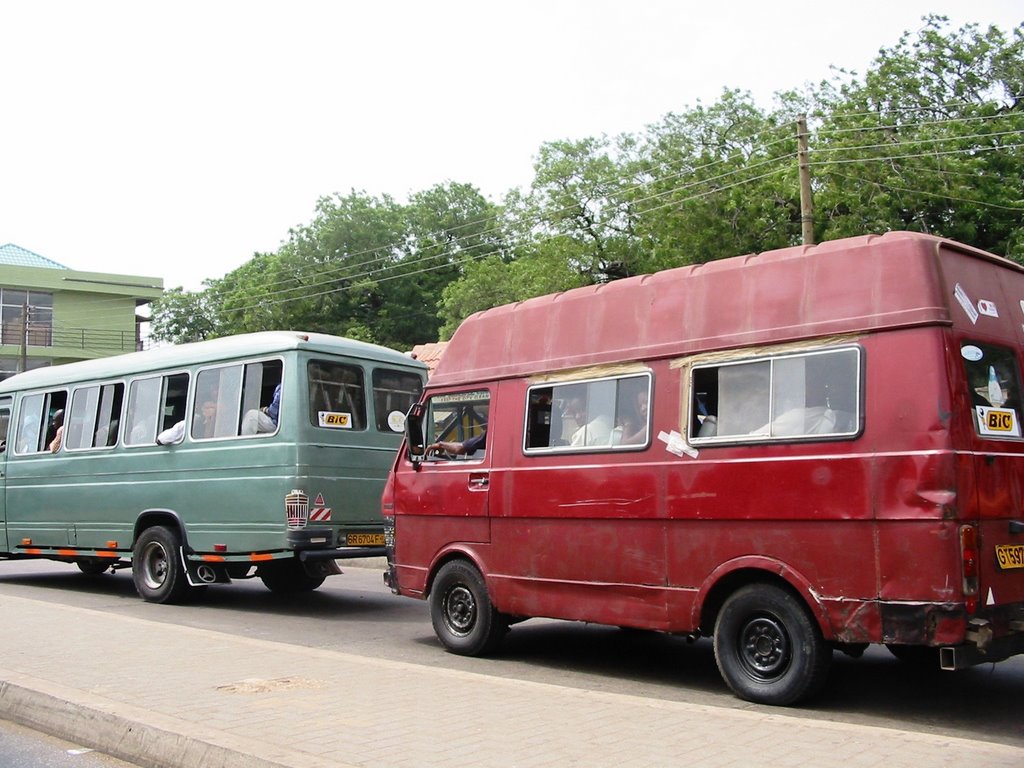
Of course, there is another form of readily available public transportation. These are the tro-tros. The best way to describe of tro-tro is to picture first a mini-van, with the usual interior seats removed, and in their place a double row of seats, very much like bus seats. Tro-tros are like miniature buses. There is even a large tro-tro station in Accra, a kind of traffic circle, where the interior of the whole circle is filled with tro-tros. Tro-tros go everywhere, both within Accra and to outer areas. They go between the towns. There is obviously a driver, but he is assisted by a mate who collects the money and who calls out the approximate stops. I did not ride in a tro-tro, so I am dependent on my daughter’s experience and the description at
this site. One of the most entertaining things to do while riding in a taxi is to read the signs on the back of the tro-tros. Seemingly every tro-tro has some sign, homemade, posted on the back. Most of the signs are religious, many are in English, and a fair few at utterly incomprehensible—example, Beware of Friends.

In fact, the religious signs are sprinkled all throughout Accra, on tro-tros, on taxis and on many business establishment and advertisement signs. The best example I have of a religious sign (having spent only a week in Accra, my experience is limited, and had I stayed longer, I am sure I would have a new “best”) was the taxi I took back to the hotel one night. The driver knew where I wanted to go, and my daughter had negotiated the price, but then the engine was reluctant to start. Finally, it sprang into life and off through the streets of Accra we went. The taxi sounded as though it would die at each intersection. Before I had gotten in the taxi, I saw the homemade sign on the back—IN GOD WE TRUST. Below it was a picture of Jesus, the shepherd holding a lamb. Of course, I got the hotel safely, asked the driver if I could take a photo of his sign. But as he pulled away, I thought—well, trust in God; yeah, that and a good mechanic!

Tuesday, November 28, 2006

First Impressions


Having grown up in southern Africa, I very much looked forward to a chance to return to somewhere on the African continent. Admittedly, my husband and I were in Africa this past summer--for two days in Morocco, but that didn't feel like Africa to me. So with my daughter on a work assignment in Ghana, I took the opportunity to visit her. I realize that there will be differences between my childhood experience of quite some time ago in another part of Africa, and my adult visit to a country in west Africa.

Hence--I offer first impressions as my visit to Accra, Ghana began. I am struck by the extravagance of Africa. Riotous trees, people everywhere, cars, trucks, buses, tro-tros, a jumble of buildings, ditches along the road which are for both rain run-off and daily sewerage, women walking with all manner of goods on their heads, at every intersection where the taxi must stop, there are vendors pushing wares. Everything from air fresheners to fruit--apples, bananas, papaya--to pens to toilet paper to sun glasses to jumper cables to water in plastic bags, to maps of Ghana, maps of Africa to flags to key chains to bathroom scales!

Even the air is extravagant. As I first stepped off the plane into the night air at Accra airport, I was hit with a wave of humid air. Past 9 o'clock which made it 3 hours after sunset, the air was so moist it felt like a steambath. During the day, as we ride anywhere in taxis, the air hangs blue redolent with wood fire smoke and vehicle emissions from all manner of traffic belching unfiltered fumes. But the smell is one I remember. The pungence of wood fire smoke that bites my nose is completely reminiscent of childhood.

The monetary system is extravagant. Of course, one needs to change U.S. dollars into local currency, which was one of the first things my daughter took me to do. We tried two established banks intially. In the first, we sat for some time waiting for someone to deal with us, until finally someone said--no, they did not change money here. We could have been told that to begin with! The second bank was faster on the information, but the information was the same--only service for customers. So we went off to a local currency exchanger. He happily handled the exchange. For some $300 U.S. we get back about 3 million cedis (pronounced CDs). So, when calculating the price of anything, I simply removed 4 zeros and got the approximate U.S. price. The hyperinflation is a little disorienting, and since the largest denomination paper note is a 20,000 cedi, one walks around with a stuffed wallet.

Finally the people are extravagant. They are wonderfully friendly and welcoming. They are quick to say hello, to ask how you like Ghana, and to ask when are you coming back. Upon first encountering someone, it is expected that you will go through a brief interchange of--hello, how are you--before you get down to business. Very relational. Everyone asks your name--and if you have looked it up in advance you can tell them your name which correlates to the day you were born (more on this later). And they shake your hand--an interesting variation on which I, as an American, had to be instructed. First you shake as one would in the west, then leaving go of each other's hands by dragging the fingers apart, then finally snapping your thumb and middle finger. It takes a bit of practice, and I don't have it mastered yet.

Sunday, November 19, 2006

Going, going Ghana

When our daughter, who is presently in Ghana, decided to write a blog about her experiences, she asked for name suggestions for her blog. She settled on Gone to Ghana, and has been regaling her readers since then with some of her experiences. Of the names suggested to her, one she did not pick was suggested by her brother (our son) and I have decided to use it for this entry.

I do not have much to say today, excepting that I will not be blogging for a week or so, while I take this trip. I have been busy doing all the things one does before undertaking such a trip. I previously wrote about all the immunizations I needed to get. In fact, today I begin taking my anti-malarial drug.

I have also been assembling a proverbial raft of material to take along--for myself and for our daughter. Things like computer flash drives and printer ink cartridges, mosquito nets, magazines, hard candies and soaps (for the occasional gift). I have been piling up clothing on the guest bed. Of course, a country in equatorial Africa is much hotter than central Pennsylvania, at this time of year (maybe at any time of year). So I have short sleeve cooler clothing to help, hopefully, with heat and humidity. I have swimsuits, hats and flip-flops. And I have sunscreen with as high an SPF as I can get--being a red haired, fair skinned, blue-eyed woman.

I have plane tickets, a passport, an entry visa, a yellow-fever certificate, photo-copied pages from various travel books describing Ghana, and a map of Accra.

I have reading material--oh, lots of reading material--to help get me through the layover in Heathrow going over and coming home.

Now I need to get it all into one suitcase, and hope the suitcase doesn't tip the scale at more than 50 lbs. so I stay under the limit.

And so, I must sign off and go PACK!

Monday, November 13, 2006

The Eyes Have It

From the time I have any recollection of my paternal grandfather, he was considered legally blind. He had developed both cataracts and glaucoma in a time when medical science had not sufficiently advanced to make those conditions curable. With the cataracts, his vision clouded, and with glaucoma it narrowed. Eventually he could no longer read, see to drive, or do anything which required precise vision. I distinctly remember him pulling out his pocket watch, which he always carried, flipping it open, and then carefully moving the face of the watch around until it caught in one small window of sight he had. That way, he could tell the time.

To compensate for his loss of sight, he had various capabilities and skills to fall back upon. In his youth, he had memorized a great many poems, and vast amounts of Scripture, so he could call up from memory these beloved passages. I have another vivid recollection of him—he and a friend, William Meikle (who for years taught at Messiah College and was himself a remarkable man: he lived in Harrisburg, some 15 miles from the college, and walked from his home to the college and back again!) would get together and entertain each other by reciting poetry.

My grandfather, who was a minister, also compensated for the loss of his sight by memorizing the number of steps he needed to take to get to specific places. Since he was sometimes called on to preach as a visiting minister, he memorized how many steps from the back of these churches to the pulpit in front, so that when he entered he could stride with purpose to the front. He always carried the quintessential blind person’s cane—tipped with white—and swung it back and forth in front of him, but always with purpose, never with hesistancy. When he moved to a retirement home, he and another elderly man would go for walks. My grandfather loved walking and would stride along. He compensated for his diminished vision by linking arms with this other man, who was unsteady on his feet, but clear-eyed. Thus my grandfather and his friend supported each other, together making a grand walking pair.

He was an inveterate letter writer, and continued to hand write letters to family and friends by guiding his pen along the paper with his non-writing hand, feeling where the edge of the paper was so he would stop writing. When his writing became too slanted, as he tended to write “up hill” using this method, and also began to overlap, he determined to learn how to type. So, blind and in old age, he taught himself to type. Tapping out on a manual typewriter, he resumed his letter writing. He put that typing skill to good use, as when his first wife (my grandmother) died, and he decided to “court” a woman who was a practical nurse at the nursing home where my grandfather lived, he did so in part by typing poems to her that he composed. I found some of these poems among my step-grandmother’s possessions after she died (I was the executor of her estate).

Several years ago, I wrote a biography of my paternal grandparents. In the course of doing research on them, I came upon a story about a conversation my grandfather, John, had with a brother of his, Laban. They were both in advancing years, and as they sat on a porch visiting, they had this interchange:

John: It's not so bad to be blind. I'd rather be blind than be deaf.
Laban: Oh, no! It's not so bad to be deaf. I'd much rather be deaf than blind.

What struck me about this marvelous conversation between two old men is that they had each accommodated to the infirmity they had. Neither begrudged his limitation.

I have been thinking of my grandfather lately and his ability to forge ahead in spite of diminished eyesight, partly because I recently had surgery on my eyelid. I had a small red spot that had stayed put for almost a year. After asking three doctors about it, I finally was treated by an oculo-plastic surgeon who removed the spot, had it tested by a pathologist, and determined that it was a basal cell cancer. It has all been removed, but the presence of such a growth so close to my eye freaked me.

As someone who majored in literature in college, I know that the loss of eyesight is frequently a metaphor for gaining knowledge. Take, for example,
Oedipus. He pushes and pushes for knowledge, trying to unravel the secret of his background as well as the cause of the curse that afflicts Thebes. Time and again, he is warned to cease his quest, that it could only end badly. One of the most urgent cautioners is the blind prophet Tiresias, who Oedipus accuses of lying. When Oedipus eventually discovers the truth, and learns all that he has done, albeit in ignorance, he cannot stand what he has learned, and seizing his wife/mother’s Jocasta’s brooch, he blinds himself. Once deprived of sight, he can fully see his predicament.

And, of course, there is
John Milton, the famous poet who having become blind continued to write poetry composing it in his head, and then dictating to his daughter and aides who faithfully recorded it. Thus was Paradise Lost, Milton’s great masterpiece written. Here is the sonnet he wrote when he first became blind.
--------

Sonnet: On his blindness

When I consider how my light is spent,
Ere half my days, in this dark world and wide,
And that one talent which is death to hide,
Lodged with me useless, though my soul more bent
To serve therewith my maker, and present
My true account, lest he returning chide,
Doth God exact day-labour, light denied?
I fondly ask; but Patience to prevent
That murmur, soon replies, God doth not need
Either man's work or his own gifts, who best
Bear his mild yoke, they serve him best, his state
Is kingly. Thousands at his bidding speed
And post o'er land and ocean without rest:
They also serve who only stand and wait.
----------

Oh, yes, folks, the eyes have it.

Thursday, November 09, 2006

Falco peregrinus


Just as I was heading out today to run some errands (with my dog in tow--she LOVES to go for rides), I caught sight of a bird soaring overhead. I stopped to watch, and to my great pleasure realized it was one of the peregrine falcons that makes Harrisburg its home. (Photo at right credit: Joe Kosack / PGC Photo)

Ever since peregrines began nesting on a ledge outside of the Pennsylvania Department of Environmental Protection building (!), I have become obsessed with peregrines. In a wonderful twist of situational irony, the name of the building where our Department of Environmental Protection (DEP) is housed is the Rachel Carson Building. Had it not been for Rachel Carson, a Pennsylvanian, and her prophetic book
Silent Spring, we might not have peregrines and some other raptors around these days.

When the peregrines first began nesting on the ledge, the DEP set up a
webcam, which I now watch each spring. When the eyasses first hatch, they are lovely little fuzz balls. Miraculously, they walk back and forth on the ledge, some 15 stories above the ground without falling. Finally they fledge, and each year I hold my breath hoping that none dies in the attempt. The customary mortality rate in the wild is between 25 to 30 %, so with 4 to 5 eyasses each year, I should expect some deaths. But I always hate it.

In fact, the peregrines are the reason I no longer put out bird seed in feeders around our house. The peregrines discovered the various bird feeders in our neighborhood (and, no doubt, other neighborhoods), so they would make periodic raids swooping in for easy kills. I don't mind that they eat street pigeons in the city, but my cardinals are off limits.

Anyway, there I stood with my patient dog by my side wondering why I was gazing sky-ward. The peregrine dipped and swooped, then hung seemingly motionless on a gentle updraft. I like to think we made eye contact, and that I, being a tad too large, was bypassed as a meal, but recognized as a fan!

OK, OK--so it's a bit slurpy, I know, but I do love peregrines.

Vox populi

As I began to write this blog, the election of 2006 had concluded, but the Senate races in Virginia and Montana had still not been decided with certainty. They were leaning toward the Democratic candidates. Now that outcome is known: both seats have gone Democratic, and with that determination, the control of the Senate.

And the House of Representatives will be Democratic controlled for the first time since the so-called Republican revolution. As a registered Democrat, I am happy. But I temper my enthusiasm and remind myself of that great concept from the medieval era:
the wheel of fortune.

Tonight, in my literature class, I have asked students to bring a favorite poem, and to explain it. Also, I asked them to provide copies of the poem, or submit them to me, and I would make copies. One student has picked “O Fortuna” the marvelous text that Orff uses in his opening number in
Carmina Burana. That choice couldn’t be more apt.

The medieval concept was that fortune is determined by a great wheel that spins arbitrarily and either casts one up or down. When I was in graduate school, and studied Chaucer, each of the students in the seminar class had to select one area of concentration. I happily selected Religion and Philosophy. Consequently, I ended up reading huge swaths of Boethius’ Consolation of Philosophy.
Boethius devoted major portions of his work Consolation of Philosophy to the vagaries of fortune. Fittingly, he wrote the work while he was in prison awaiting execution. Boethius had been an adviser to the emperor, but was charged with treason and sentenced to die. Almost sounds like some of the political folks we just threw out. . .except for the execution part.

So, why did the people voice their displeasure and throw the Republicans out (for now)? Well, as the pundits have explained, there are many reasons. But, I have my own theory—the arrogance of power. Sadly, when our political leaders assume office, they suddenly become quasi-imperialists: they believe in the divine right of rulers. They delude themselves that they can do no wrong. All too often they become corrupted by power, and forget that the genius of our system of government is that the PEOPLE get to speak. (Never mind all those times the people have become voiceless idiots).

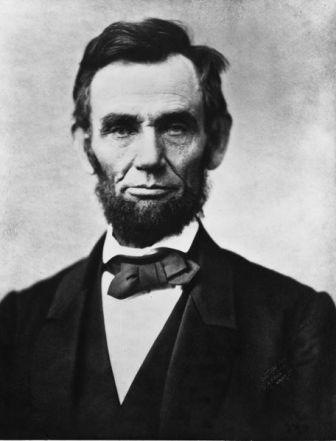
I recently read Doris Kearns Goodwin’s wonderful account of President Lincoln and his cabinet, Team of Rivals: The Political Genius of Abraham Lincoln. What truly set Lincoln apart was that, once he had won the election, he set about bringing in to his cabinet the very men who had run against him for the presidency. He sought men from both parties, and included them in his team. As I read this book, I couldn’t help but wish for such political genius today, or political humility. What a welcome change that would be from all the vaunted chest beating we have witnessed over the last several years.

Of course, another result of the 2006 elections is that with the Democrats in control of the House of Representatives, we will have our first ever woman Speaker of the House. The day of the election, I had to make an emergency trip to a local garage to get a new battery in one of our vehicles. There, along with other mechanics, was a young woman mechanic. She had greasy hands, wore the heavy flannel plaid shirt that seems a virtual mechanic uniform, and looked as tough as any of the young men. I was heartened to see her, and since it was Election Day, I chatted casually about the opportunity to vote. Oh, she said, I ain’t voted; I don’t watch the news, and don’t know who’s running. Besides, she continued, I don’t care who wins.

Oh, oh, oh! Vox populi. We have the right to vote—all of us. That right was hard fought, and won by inches through the course of our history. Who is in power may change, but the right, no the responsibility, to vote does not. So, keep in mind, that great wheel of fortune! And may those who rule be guided by the genius of Lincoln.

Sunday, November 05, 2006

An Anniversary Trip

Several years ago, for our 35th wedding anniversary, my husband and I decided to take a trip to Spain. Since we had gotten married on December 28, this trip would fall between Christmas and New Year’s. We offered to take our daughter along, as she had studied college level Spanish for several years and could serve as our interpreter and “tour guide.”

We booked our flight for Christmas Day. When Christmas dawned, the skies were leaden grey with a strong threat of snow. Predictably, it began snowing around 10 a.m. and continued to snow steadily. Since our flight was out of Philadelphia at 6 p.m. and mindful of the two hour window for advanced check-in, we left Harrisburg around 1 p.m. By now, there were nearly six inches of snow covering the roads.


Our trip along the Pennsylvania Turnpike was uneventful until thirty miles from Philadelphia. My husband suddenly yelled “Watch out” as a Tracker went zipping by us in the passing lane. The car fish-tailed, then struck the medial barrier, slid back across the right lane, rolled twice and came to rest on the side of the road. Incredibly, no other car was hit, but we were shaken. We quickly pulled off to the side of the road, as did several other cars. We ran to the Tracker, resting on its side, not knowing what we would see. The driver was completely alert, unzipped his window and climbed out.

Once back on the road, we chattered about the “close call” of the careening Tracker. Finally, we arrived at the Philadelphia Airport. The rest of the customary steps to traveling to Europe proceeded uneventfully. We checked our luggage, went through security ourselves and waited for our flight on Delta airlines.


Perhaps we should have seen the Tracker accident as a harbinger of future events, for when we boarded our flight, a short one to JFK, we took off and proceeded to fly for TWO hours. The usual flight time is thirty minutes, so we were attuned to some discrepancy. Finally, the pilot came on the public address system and announced that we were returning to Philadelphia as JFK was snowed in.

We spent the remainder of Christmas day in the Philadelphia Airport, rebooking our flights with overwhelmed ticket agents who had no idea a plane was returning to Philadelphia. With our new tickets in hand, we rushed to secure an overnight room at a local hotel. The following morning, we boarded an Air France flight to Paris, with a connection to Madrid. We endured one more setback when we missed our connecting flight in Paris. The Air France gate attendants were completely imperious, haughtily telling us “Sorry, even though it is early, the plane has left the gate and you cannot board.” Rerouted once more, we finally arrived in Madrid.

By now, we were on “Plan B” for our vacation. We had originally intended to stay overnight in Madrid and take an early morning train to our first destination, Granada. Since we obviously weren’t going to be staying in Madrid overnight, we were able to change our train time until late afternoon.

When we reached the Atocha train station, we were primed for our vacation to begin at last. The next challenge was reading the train schedules with little time. Not only were we in an unfamiliar train station, but reading destinations in Spanish took a little longer. When we figured out which track we needed to be on, we descended to the lower level where our train would depart.

I charged ahead, off to find the correct track. I was loaded down with a wheeled suitcase that I was dragging behind me, a backpack full of my immediate travel needs, a plastic bag with just-purchased soft drinks and snacks, and my purse slung over my shoulder.

When the train pulled into the station, we had five minutes to board. We located the correct car for our reserved seats, and I began to push my way onto the train. Suddenly, a woman got in front of me. With every move I made to go to our seats, she blocked my way. I was vaguely aware of her fiddling around in my plastic bag. My daughter, realizing this was very likely a gypsy woman, said, “Mom, yell at her to get out of the way.” So, dutifully I began saying, in English “Excuse me, EXCUSE ME.” Just as suddenly as she appeared, she vanished.

We found our seats, relieved, and sat down. Then, almost casually, my daughter said, “Are you sure you have everything?” I said, “I think so” but opened my purse to check anyway. My wallet was gone! I was stunned. Even though I knew the gypsy woman was doing “something” I was naïve enough to believe she was only fiddling with the plastic bag of recently purchased foods. Of course, that was a diversion for her real aim—unzipping, then reaching into, my purse and skillfully removing my wallet.

The events of the two days washed over me, and I excused myself and went into the bathroom. There, I sat and cried, out of frustration, and out of sadness. I did not mind losing my money, and I knew we could stop any charges on credits cards. What made me incredibly sad were all the family photographs I carried in my wallet, including a one of a kind photograph of my mother who has been dead for more than ten years.

I had to shake off my sadness, and focus on the happy family celebration ahead of us. The rest of the journey was blissfully uneventful. We marveled at each of the lovely Spanish cities we visited. We reported all the credits cards stolen, and made a police report of the theft. Even though we returned to the Madrid train station, authorities had found no sign of a stolen wallet. Somewhere, a gypsy woman was $300 richer, and had in her possession a much loved photograph of a white haired woman.


Tuesday, October 31, 2006

Do Unto Others

Perhaps the annual ritual of raking leaves does not put one in mind of applying the Golden Rule, but I will try to persuade you otherwise. I spent the better part of the morning raking leaves. Not so unusual, you say, considering that it is autumn. True, but the leaves I was raking came mostly from my neighbors’ trees. Thus begins my annual agony of determining the best course of action—do I rake all the leaves that blow into my yard AND try to rake from my neighbors’ yards the leaves that fall from my trees, or do I rake only the leaves from my trees, wherever they may be (within reasonable reach) or do I take the course my neighbors take and rake NO leaves?

Perhaps you can sense that this annual dilemma is a source of considerable annoyance to me. While we have many trees on our small slice of suburbia, more than half of them are mature evergreens. When we moved here more some 26 years ago, we were the first residents in our house which was in a newly built neighborhood. Either there were no trees here, or all trees had been banished during construction. Since I am a tree nut, I set about planting trees. I enlisted my not-so-willing but loving husband’s help, and he tilled a row all along the back end of our property. Since that was the north and northwest corner of our property, planting trees there made perfect sense as it cut the wind that whistled down off the gentle slope hitting the back of our house full force and freezing the bedrooms in winter. I selected 14 evergreens, a mixture of Douglas fir, Colorado blue spruce, Norway spruce, Austrian pine, white pine, and Japanese pine. They were all bare root stock, and I planted them about 6 feet apart—a distance that looked enormous with those little 18 inch trees struggling to grow. Well, grow they did and eventually we had to take down every other tree—fortunately what we took down were the Japanese pine which were not as attractive as they grew.

Sprinkled around our house are the hard wood trees—a pin oak, a green ash, a sunset maple, a Japanese maple that recently succumbed to some wilt, a white dogwood and a redbud. Many of these were also bare root stock. For reasons not entirely clear to me, except perhaps the genetic makeup of these trees, they tend to drop their leaves fairly early. The green ash tree thins out first, then the dogwood, with the pin oak stubbornly dropping a few leaves at a time. Finally the sunset maple drops its leaves. And I merrily rake as I go. BUT every year, after I have raked the leaves my trees drop, our yard fills up with large yellow maple leaves and spear-shaped leaves from an unidentified tree that do not come from my trees. And I begin to fume.

The topography of our yard mysteriously is tilted in such a way that all leaves blow into it. I have occasionally gently remarked to neighbors that it is curious that I have a yard full of leaves from trees I don’t have. One neighbor, several years ago, laughed and said—oh yes, we never rake our leaves, we just wait for them to blow out of our yard. AHA! I thought—I knew it. Some years, I have tried to shame neighbors into gathering their leaves by making huge conspicuous piles of leaves, just next to their yards, that they can’t possibly miss. Sometimes it works—suddenly a neighbor will appear, as I am out raking and picking up leaves, and pitch in helping ME move THEIR leaves to the curb for leaf-pickup.

In the literature course I am teaching this semester, last week we just read Robert Frost’s famous poem,
Mending Walls. Of course, I asked the students if they had read this poem before—most had. And I asked, what the most famous line is: “Good fences make good neighbors.” Then I ask, what is Frost trying to say with the poem—and of course the students repeat the famous line.

I confess that at this time of year, I long for good fences to help me have good neighbors. But, ironically, the true meaning of the poem rests in the other famous line—the opening line. Frost’s narrator, speaking very much in a Frostian voice, says “Something there is that doesn’t love a wall.” And so, in the poem you have the tension I experience every autumn. In our neighborhood, particularly on our street, we have back yards mostly unfettered by fences. I like that. It has been my (albeit limited) experience that neighborhoods with fences are unneighborly and those without fences are very neighborly.

So, I will struggle with leaves each autumn—I will rake leaves that blow into my yard that are not from my trees. I will grit my teeth, stifle my urge to write an indignant note to each neighbor saying—do you mind, pick up your own leaves! I will do to them what I wish them to do to me.

Monday, October 30, 2006

Love & Country

No, this is not going to be a post about country music—even though love and country are two favorite themes for such.

Last night, I finished reading the next in the
No. 1 Ladies Detective Agency series, by Alexander McCall Smith—this particular book being called In the Company Of Cheerful Ladies. The book ends with this paragraph:

“Love—that is what redeems us, that is what makes our pain and sorrow bearable—this giving of love to others, this sharing of the heart.”

This series is set in Botswana, Africa, and features the main character, Precious Ramotswe. While there are many other novels about Africa that are far better (for example
Nervous Conditions by Tsitsi Dangarembga), I gravitate to this series because in part it resurrects for me a view of the Africa in which I grew up.

When I was growing up in Africa, I used to attend the occasional movie at a theater in Bulawayo, and my memory is that the movies, distributed from the United States, would begin with a display of the American flag and the playing of our national anthem. I always felt a cachet of pride seeing the flag streaming in the wind. Secretly, I would think, a lone American among a theater full of white Rhodesians (remember this was in the 1950s), that’s MY country. I had a cachet of pride not unlike Precious Ramotswe’s strong feelings for Botswana.

I reflect with rue how times have changed for me. These days, when I attend an event where the national
anthem is played and the flag is displayed, I am almost overwhelmed with shame. Yes, the United States is still a great country, and I still do love this country, but I am so ashamed of our bullying stance in the world. If we decide that a country should behave a certain way, why, let’s just march “over there”—wherever there is, and impose our will. A one approach to government fits all. No wonder we are increasingly reviled around the globe.

Well, what about love? The other half of this blog’s subject. Precious Ramotswe loves country and she loves the people around her. In particular, she frequently reflects on her good fortune in loving one good man. (I don’t mean to turn this blog into a comparison between me and Precious, but. . .) I have been blessed with the good fortune in loving one good man—my husband and I will celebrate our 40th anniversary a year from now. So, as I finished the book, closed it, took off my glasses, I reflected—love, that is what redeems us.

Friday, October 20, 2006

Of all the cleaning tasks I hate. . .


So I threw myself into cleaning this morning. Yes, I do my own cleaning, but oh how I hate cleaning. Admittedly once the task is done, I feel a huge sense of accomplishment. Besides I can look at my work and have proof of having done something.

There was a time when I was working full time that we had one of the franchised companies come in and do cleaning. You could always tell they had been here, since the sinks were wiped off and you could see the fan pattern on the carpet indicating they had vacuumed. When I no longer worked full time, it seemed like such a waste of money. Then I read
Barbara Ehrenreich’s classic Nickel and Dimed: On Not Getting by in America. As part of her experiment with working in jobs that did not require an education to perform, she cleaned for just one of those franchised companies that we had used. Maybe even the same one. Her experiences were a revelation to me.

Among other things she revealed, she indicated that these companies do not use real cleaning agents. They “scrub” sinks but use not much more than water that they spray. The wonderful fan pattern on the carpet is a signature way the employees are taught to do as the last thing, so that no footprints mark the carpet and the customer has visible proof of cleaning. But, as far as actually cleaning goes, she points out they do little.

Perhaps far more disturbing was the way that these workers are treated. They receive something akin to day wages. So if they are sick and unable to work, they do not get paid. Ehrenreich recounted one sad occurrence when a co-worker of hers twisted her ankle. It was obviously badly sprained, but the woman persisted in her work. She pleaded with Ehrenreich, her working partner, not to tell anyone so she could keep working. Particularly she begged that her boyfriend not be told because he would be angry at her for being clumsy. When it was apparent that the injury was very serious, Ehrenreich took the woman to the doctor and paid for the care herself. Obviously, not only were these employees the equivalent of day laborers but they also had no health insurance.

Of all the cleaning tasks, the one I loathe the most is cleaning toilets. The only factor that redeems this task for me is a story about Gandhi. Among the goals that Gandhi had in his amazing life was to rid India of the odious
caste system. At the bottom of the caste system was the so-called untouchable. The jobs that fell to the untouchables were those tasks that others found so distasteful because it defiled their ritual purity, such as handling dead bodies, animal or human, tanning leather, collecting garbage and cleaning up animal and human waste.

At Gandhi’s ashram, he had decreed that there would be no private toilets, and that all the residents had to share public toilets. Further, he decreed that everyone had to empty the toilet buckets. He was using the issue of cleaning public toilets as a kind of object lesson, since in part the status of the untouchables as outcaste at the bottom of the system was reinforced by their obligation to clean public toilets. Gandhi set the model. Not only did he take the lead in carrying the buckets to the fields for emptying, but he insisted that everyone share in the task. When one resident at the ashram, who was from the Brahmin class, protested, the following exchange occurred:

Then he (the Brahmin) sought an excuse. "I hold a doctorate from the London School of Economics," he argued. "I am capable of doing great things. Why do you waste my time and talents on cleaning toilets?"
Gandhi replied: "I know of your capacity to do great things but I have yet to discover your capacity to do little things. So, if you wish to seek my guidance and blessings you will have to observe all the rules of the ashram."
from the
recollections of Arun Gandhi, Mahatma Gandhi’s grandson.

Well, I don’t plan on moving to any ashram, and I am not certain I have learned the lesson of humility that such an exchange must have brought about in the Brahmin. But, I remind myself as I clean, bathrooms and all, that first I am not a day laborer bereft of health insurance, nor am I so proud that I would put myself above Gandhi.

Oh, yes, and the house sparkles!

Thursday, October 12, 2006

That’s Entertainment

For no apparent reason, the other day I began humming to myself “Skeeters am a-humming on the honeysuckle vine. . .” Yes, those are actually words to a song. The song, Kentucky Babe, is one I grew up hearing my father sing to me. Now, I don’t know what stimulus prompted me to recall that old (and I mean old—the song was written in 1896!) song, but it got me to thinking how much what we consider entertainment has changed.

Along with that song, my father sang me quite a few others with equally quaint lyrics:
Mairzy Doats, Lonely Little Petunia, and other 1890s gems. Our family was a singing family—as we drove around to various churches while my parents were home from their mission work, we could tune up and sing a favorite hymn. We had four part harmony pretty well covered: my mother sang soprano, I sang alto, my brother tenor, and my father bass (sorry, Denise, you weren’t born yet).

Home entertainment a century before these family hymn sings might have consisted of family and friends getting together to play concerts. Not everyone was concert worthy, but many people played instruments and gathered for an evening of music. When my husband and I honeymooned in
Williamsburg, Virginia, one of the events we delighted in attending was a musical concert in the Governor’s mansion. There in the formal ballroom was a group of musicians playing period instruments of the 18th century. The sound was not pristine, but the candlelight and intimate setting made it a wonderful evening of entertainment.

Back to the lonely little petunia song. When my daughter was in fifth grade, she enjoyed a visit from her best friend from third grade. Her friend had moved away from central Pennsylvania at the end of third grade, going literally across country to the west coast. Two summers later, she returned to central Pennsylvania to visit with some family friends, and spend some time with us.

Our daughter decided she wanted to do something really special while her friend was visiting, and asked if the two girls could spend a night in a local bed and breakfast. Rather than just spring this idea on the proprietress of the place, we stopped by in advance to make sure that would be acceptable. The woman showed us all over the large Victorian house, stopping last in a formal parlor. There sat an old Victrola. Our daughter looked at it quizzically and said—what’s that. Well, the woman said, that is what we used for entertainment, and proceeded to wind it up. Then she set the needle down on an old record, and out came the music to “Lonely Little Petunia in an Onion Patch.” Our daughter listened for about a half minute, wrinkled up her nose and said: “You call THAT entertainment?”

Yes, that was entertainment!

Saturday, October 07, 2006

Living in a Land of Excess

In a prior blog I referenced George Carlin’s brilliant routine on Stuff. When I use that essay in one of my classes at the community college where I teach, I frequently get these blank stares when I ask students—why do we have all this “stuff”? It is easy for them to jot down a list of the stuff they own, but they are challenged when it comes to putting forth a reasonable explanation of WHY.

Our present national obsession with more and more acquisition really troubles me. We are no longer satisfied with the type of houses that dominated the housing boom post-World War II. Now, mega-mansions spring up, replacing the 2,000 to 3,000 square foot homes with ones that are 11,000 square feet. Our houses must be bigger, our cars ever expanding (witness the obscene Hummers), and our meals super-sized. It is no surprise that our bodies are expanding, resulting in increased sizing of everything needed to hold us, including eventually caskets! That’s right—there is now a line of larger caskets to hold the super-sized deceased.

Growing up in a church with Anabaptist roots, I came to appreciate the emphasis on simplicity in living. One of the visionary thinkers in this regard was Doris Janzen Longacre, who compiled the book
Living more with less . Published more than 25 years ago, this book is a collection of tips on how to live more frugally and simply. It is also much more than that—in many of the examples, we Americans are challenged by the ways in which people in emerging countries value things we take for granted. One particular example I recall is that of a woman who had lived in a country where people did not throw away envelopes in which the mail came. Rather, they carefully sliced the envelope open, so it would lie flat and provide a new sheet of paper ready to receive whatever needed to be written. I think of that example as I contend with the daily mail we receive, much of it uninvited.

The church I attend (
Market Square Presbyterian Church) houses an international service center. When this work first began, it was founded by Vietnamese refugees who helped their fellow country folk resettle in this country after the close of the Vietnam "conflict." During a recent renovation of our church, their offices were moved. To accomplish the move, the office staff for this center needed to dispose of used electronic equipment that had been donated. The result was a wrenching experience, since having done “without” for so long, they were loathe to part with equipment, even though these machines no longer worked. Contrast this approach to the easy disposable society most of us live in.

Several years ago, I heard the late senator Paul Simon speak at a Presbyterian conference. He challenged attendees to think about producing annual reports that included a Matthew 25 report. Senator Simon thought that every church should be able to report what we had done during any given year to feed the hungry, give water to the thirsty, clothe the naked, welcome the stranger, and visit the sick and imprisoned. When we become so focused on “stuff” that we lose sight of the least of these, then we have surely lost our souls.

Tuesday, October 03, 2006

Family Matters


Happy families are all alike; every unhappy family is unhappy in its own way.

So begins Leo Tolstoy’s Anna Karenina. While I don’t necessarily ascribe to Tolstoy’s prescriptive definition of family, it is most interesting to ponder—the Family.

We all have one—oh, maybe not the cookie cutter nuclear family of mother, father, and two children type, but at the very least, we all began somewhere.


I think about my own family. Obviously, as someone who is married with children, I have created my own family circle with my husband, our son and daughter, and their respective partners. Naturally (that’s what I think—but I realize how fortunate this circumstance is) I came from a family—a loving home with my mother and father and two siblings.

What an irony that as a nation we are engaged in an unseemly squabble over the definition of family. Political parties vie to see who can co-opt the term “family.” Family really can mean many things. It does not take Ozzie and Harriet Nelson to create family.

I have an aunt who never married, based on her own choice and the direction that her life took. To say she does not have a family is to completely mis-state her present situation. For a long time she lived in Manhattan, and there she had a close circle of friends. Together these people created a family, sharing lives, meals, spending holiday time together. As someone who was not married, she had no children of her own. However, she has nurtured nieces and nephews (including me). She has become a grandmother in her current neighborhood. When nearby neighbors had twins, my aunt was pulled in to help provide an extra set of arms to hold, hands to care for these girls. She is now their beloved “nana”—not a grandmother in flesh, but certainly in spirit and bonding.

In Robert Frost’s poem
“The Death of Hired Man” two characters named Warren and Mary, a husband and wife, talk about a hired man who has returned “home” to die. While their conversation revolves in part around a definition of “home” some of what they say makes me think of family:

“Home is the place where, when you have to go there,

They have to take you in.”


“I should have called it

Something you somehow haven’t to deserve.”

Several years ago, I read Sue Monk Kidd’s
Secret Life of Bees. This wonderful novel tells the story of Lily Owen, a young white teen struggling with an abusive father. She fixates on her dead mother, and sets off on a quest to unravel a family secret. In the process, she discovers a family—made up of three black sisters, who enfold her in their circle of caring.

While I was reading this novel, I attended the General Assembly of the
Presbyterian Church (USA) in Denver, Colorado. During that meeting, a Presbyterian study document on family was presented for our consideration. It was eventually returned to committee because a more conservative minority report did not find the definitions of family included in the document sufficiently Biblical. Perhaps I need not add that I was voting to have the document received.

Family, after all, can exist in many ways. It can exist as the birth families some of us are fortunate enough to experience; it can exist as families created out of a circle of friends and neighbors; it can even exist as strangers who take us in and nurture us in time of need.

Monday, September 25, 2006

Traveling Mercies

A fair bit of my life has been spent traveling. No doubt, that is either predictable (considering my parents were missionaries in Africa) or unavoidable (reference prior parenthetic comment).

Sometimes I enjoy traveling and sometimes dread it. I have been reflecting of late on several times when traveling was a somewhat terrifying experience.

When our son was born in January, I was teaching at a local college at the time. I had arranged to take off one month following his birth, and then planned to return to full time work to finish out the semester. So for one month, I was away from campus and had not picked up my mail. (Understand, this is in the days before email!) Not long before I was scheduled to return to work, my husband said “Let’s go over to the campus and get your mail.” A seemingly innocuous suggestion. BUT—(buts are always followed by music—dunh, dunh DUNH!) but it had snowed the night before. So now the roads between our house and campus were completely snowed covered, and in fact barely passable.

Anyway, I agreed. So we bundled up our son, put him in the back seat of the car in an infant bed (again, in the days before infant carriers) and off we went. Just as we approached the first intersection on the interstate route we were traveling, I had this flash—WE ARE ALL GOING TO BE KILLED! For the rest of the half hour journey, I was terrified. I should have relaxed; my husband is an excellent snow driver, having “practiced” doing donuts as a kid in the parking lot of his school. Suffice it to say, we all survived. And that trip, though vivid in memory, is now some 34 years ago.

Flash backward some eight years. When my parents returned to Africa for their final term as missionaries, I stayed behind to finish high school and begin college. We were apart for five years, so understandably I eagerly anticipated their return home. Just about the time they were due back, I was called into the office of the president of the college I was attending. He informed me that an unknown benefactor had paid for me to fly to London to meet my parents so we could be reunited more privately. That is the subject of this flashback.

I distinctly recall that journey. First, I took the train from Harrisburg to New York City. I had made plans to meet some local church workers there (who knew my parents) and they would transport me to JFK. Well, we were
meeting in Grand Central Station (I think) and somehow I waited at one kiosk while they waited at another. We never did link up. So I made a mad dash outside, corralled a taxi and in a panic asked him to drive me to JFK. He turned out to be a kindly (and VERY chatty) driver. By the time I got to the airport I had calmed down—some. Now for the flight. I was flying on then BOAC, at night. I recall looking out the plane window as we flew along, and it was full moon. The moon seemed to be right next to the plane. I kept thinking—if I die now, I will never see my parents again. Then, we landed, and my parents, siblings, and I were reunited. We spent several days in London, then flew to Amsterdam for a bit more sight-seeing. On that flight, I thought—now I have seen my parents, so whatever happens makes no difference.

So, why the reverie on traveling? Perhaps, because I am mid-process planning another trip. This time to Ghana. I am mostly through with all the
immunizations that are required, or suggested. I am booking a plane ticket, and making all the other plans that need to be in place. And this time, I will be visiting my daughter. I have no trepidation about this upcoming trip, although the list of required and recommended immunizations is intimidating.

It is no wonder that many writers have used the metaphor of a journey to describe a character’s moving through life transitions. My trips have not really marked passages from one stage of life to another, but I recall each and use them almost like a jeweler’s loupe to view closely a facet of my life.

Thursday, September 21, 2006

There's a Nip in the Air

I love autumn!

So these last few mornings, when I get up and feel the nippy air, I am exhilirated. While I do love all the changing seasons, autumn has always been my favorite time of year.

I recall one time during a discussion, someone asked what time of day I liked best, and what time of year. Well, the time of day I love is sunset; and the time of year autumn. That response prompted the questionner to raise an eyebrow and ask: why do you like the two times that are symbolic of things drawing to a close? Short answer--I don't know.

Maybe it has something to do with good things happening in autumn: my daughter was born in October!

Maybe it has something to do with color. I love autumnal shades: vermillions, deep purples, yellows--all the colors.

Maybe it has something to do with football--a game I do love to watch, especially if it is
Penn State football. For more almost 30 years, my husband and I have gone to many of Penn State's home games. The drive to State College is wondrous, (if you can ignore the awful traffic jams) particularly when the trees that cover Pennsylvania's rolling hills begin to turn color.

Maybe it has something to do with the crispness in the air. As I walk, I sometimes catch a drift of a wood burning fire, somewhere. That smell alone transports me to childhood days where the air frequently hung heavy with wood burning. (Scientists have demonstrated that the sense of smell is the most evocative sense we have--it can trigger memories like no other sense! Check out
this site for info.)

Well, back to autumn. One poem captures the aspects of autumn that resonate with me--a sense that time is fleeting, but, oh so sweet in the present. Shakespeare (you knew it was coming, didn't you?) wrote Sonnet 73 which I have included as the fitting conclusion to this reverie on autumn.

SONNET 73
That time of year thou mayst in me behold
When yellow leaves, or none, or few, do hang
Upon those boughs which shake against the cold,
Bare ruin'd choirs, where late the sweet birds sang.
In me thou seest the twilight of such day
As after sunset fadeth in the west,
Which by and by black night doth take away,
Death's second self, that seals up all in rest.
In me thou see'st the glowing of such fire
That on the ashes of his youth doth lie,
As the death-bed whereon it must expire
Consumed with that which it was nourish'd by.
This thou perceivest, which makes thy love more strong,
To love that well which thou must leave ere long.

Friday, September 08, 2006

Ahh--aging!

When my daughter was a little girl, I took her with me to the nursing home where my grandmother lived. While we usually visited my grandmother in her room, on this particular day she wasn't there, so we went looking for her. As we walked around the halls of the nursing home, we encountered one old woman who, while seated in a wheelchair, pulled herself along with her foot. You read correctly--foot. She had apparently had one leg amputated at some point, so her remaining leg and foot was all she had to propel herself.

As she pulled herself along, she kept repeating in a most plaintive voice: "Help! I've lost myself." Repeating this plea over and over again. We hurried on by her, still looking for my grandmother. Just as we got out of her earshot, my 4 year old daughter whispered loudly to me--"Do you think she lost her leg, too?"

At the time, it was wonderfully funny. But some twenty years later, I think about those folks that I encountered when I went to visit my grandmother. And, I also do much thinking about my own aging.

I am of two minds: in one mind, I am quite proud of being in relatively good health and physical shape (for, as they say, a woman of my age); in the other mind, I resent every creak I feel. I also find myself noting the ages of people I know who have died (or even the ages of those listed in the local obituaries). Then, I instantly do the math--that person was 72; well, that's 11 more years than I; or that one was 50, ha! I've got that beat.

There is a story that
Ingrid Bergman was asked, on the occasion of her birthday, how she felt now that she had reached the advanced age of 60. She reportedly responded: "I like it just fine, considering the alternative." Perhaps the story is apocryphal, but I like it. It captures exactly my feelings. While I can wish that aging weren't accompanied by aches and pains, or by some of the alarming physical changes one experiences, I still like it just fine considering the alternative.