OK, so the title is a bit hyperbolic.
Here's the setup. A friend on Facebook recently opined that she misses blogging, and her circle of blogging friends (of which I am happy to say I am a part). But she also challenged us--let's get back to blogging. (Here's a link to her blog....heh heh, that will get her back to blogging!)
Another Facebook friend, and blogger (her blog) threw down the proverbial gauntlet by providing a prompt to get us bloggers back to blogging. The prompt: think and write about why we STARTED blogging in the first place.
So, here goes.
The first several blogs that I wrote were about a trip my husband and I took to Spain, in 2006. By beginning to blog, I took a new approach to the traditional travel journal. I try to write a journal on any long vacation trip, to capture some of what we saw and did, and to save place names and events so I can identify photos. Blogging provided a nice intersection of the two--write about it, and show some pictures of the trip.
Very quickly, my blog became a vehicle for writing about my childhood, my family, my past.
Writing is a bit like breathing for me. I majored in English Literature in college, and loved READING (the companion of writing). I spent the first 8 years and the last 7 years of my working life teaching college composition. So I cherish writing. Grammar matters to me. Knowing how to craft a well-written sentence matters to me. Knowing how to write in different tones--formal, informal, narrative, humorous, etc--matters to me.
When I was teaching writing, students would ask--how do I get started in writing? That was always a tough question for me to answer, because as soon as my fingers touch the keyboard, the words start flowing.
Now, given that free-flowing of words, you might wonder why has my blogging slowed down. I have not stopped blogging, but I acknowledge I have ... shall we say, slowed down. Oh, lots of reasons. Part of it I explained in the blog post immediately preceding this one. Part of it just plain being distracted. Too many frittery things to do--read Facebook, played Scrabble or Words with Friends, play a game or two of Free Cell, take photos, walk the dog, work in the flower garden. And on and on.
But I am up for the challenge--so there you have it. I write because I must. And I began writing my blog because...well, because it seemed more accessible than writing a book.
By the way, I can guarantee that those of us who want to get back to blogging won't run out of prompts. I have a whole file full of them from when I was teaching!
Showing posts with label writing. Show all posts
Showing posts with label writing. Show all posts
Friday, April 15, 2016

Thursday, April 25, 2013
The Last Word...
...for a time, dear reader, just for a time.
When I first became aware of blogging, I began writing and reading. My first blog entry was about a trip to Spain we had recently completed. Once I wrote up the entire vacation experiences, I moved on to other topics--plumbing childhood memory depths, then observations about teaching, life, movies, along with the occasional rant.
I also began reading other writers' blogs. Blogging is so much more satisfying for me than tweeting, or than reading Facebook entries. First, almost every subject I can think of as a potential writing topic requires more than the truncated entry requirement of Twitter, and more than the clever or titillating bon mot that catches my eye on Facebook. Second, I tend to limit whose blogs I read, which I also do with Twitter (for me, the least used of these self-expression media), but which I am less inclined to do with Facebook. While I don't accept every request to "be friends" on Facebook, I have a wider circle there than I do in the blogging world.
But what I observe is that blogging is slowly falling out of favor. Some of the early blogs I read no longer exist--in a few instances, the writers have died: they wrote bravely about their struggles with diseases that eventually silenced them. Some of the blogs I read have fallen by the wayside as the writers move on to other ventures. Some bloggers are still perking along, bubbling with a fountain of creativity as prolific as Ponce de Leon's mythical fountain of youth. Sometimes I find a new blog to read and enjoy (see Pieces of Peace).
I know, in the core of my writing being, that Facebook will also fade. And as I peruse the entries each day, I see it fading. No need to catalog the Facebook complaints and woes here.
So, why my dire "The Last Word..." title? Because I am about to take a mini-blogging break.
 While you know we have traveled--both to the west (California, here we come!) and east (maybe something to do with this sweetie), ----------->
I will soon be venturing down a path that age has set me upon.
SIGH. The knee that has plagued me since college basketball is about to be replaced. And I will provide humor fodder for my husband as I try to make my way around with a walker.
When I muster enough energy to come back to writing, I will. Maybe I will have some new hospital stories. Maybe I will have a rant or two. But, whatever I do, I will pick up the proverbial pen and resume writing.
When I first became aware of blogging, I began writing and reading. My first blog entry was about a trip to Spain we had recently completed. Once I wrote up the entire vacation experiences, I moved on to other topics--plumbing childhood memory depths, then observations about teaching, life, movies, along with the occasional rant.
I also began reading other writers' blogs. Blogging is so much more satisfying for me than tweeting, or than reading Facebook entries. First, almost every subject I can think of as a potential writing topic requires more than the truncated entry requirement of Twitter, and more than the clever or titillating bon mot that catches my eye on Facebook. Second, I tend to limit whose blogs I read, which I also do with Twitter (for me, the least used of these self-expression media), but which I am less inclined to do with Facebook. While I don't accept every request to "be friends" on Facebook, I have a wider circle there than I do in the blogging world.
But what I observe is that blogging is slowly falling out of favor. Some of the early blogs I read no longer exist--in a few instances, the writers have died: they wrote bravely about their struggles with diseases that eventually silenced them. Some of the blogs I read have fallen by the wayside as the writers move on to other ventures. Some bloggers are still perking along, bubbling with a fountain of creativity as prolific as Ponce de Leon's mythical fountain of youth. Sometimes I find a new blog to read and enjoy (see Pieces of Peace).
I know, in the core of my writing being, that Facebook will also fade. And as I peruse the entries each day, I see it fading. No need to catalog the Facebook complaints and woes here.
So, why my dire "The Last Word..." title? Because I am about to take a mini-blogging break.

I will soon be venturing down a path that age has set me upon.
SIGH. The knee that has plagued me since college basketball is about to be replaced. And I will provide humor fodder for my husband as I try to make my way around with a walker.
When I muster enough energy to come back to writing, I will. Maybe I will have some new hospital stories. Maybe I will have a rant or two. But, whatever I do, I will pick up the proverbial pen and resume writing.
Thursday, March 31, 2011
Words, words, words
Yesterday’s Writer’s Almanac imparted wondrous trivia about the humble pencil. Herewith some of the tidbits. A common pencil (think No. 2) is hexagonal to keep it from rolling off the table. It is yellow because the best graphite—what we incorrectly call lead—came from China and yellow was the traditional color of royalty in China. Start drawing a line with a common pencil and you can go for 35 miles before you run out of graphite.
Before the advent of computers, or even typewriters, writing was a hand affair. Some of America’s best writers wrote their masterpieces long hand using pencil. John Steinbeck particularly favored the pencil. He started every day by sharpening 24 new pencils. When he wrote East of Eden (oh, I do recommend it if you’ve never read it), he used 300 pencils.
Why this reverie on pencils? Well, writing and more  specifically writing words. Words words words. I just finished reading a marvelous new literary biography: Lyndall Gordon’s Lives Like Loaded Guns. The subject is Emily Dickinson, who had her own way with words. Gordon has a dual thesis—first, she posits quite convincingly that Emily suffered from epilepsy, and that the disease may have accounted for her success as a poet. In part, the disease fueled some of the content of her poems, both in subject matter and style. A poem such as “I Felt a Funeral in My Brain” which is sometimes interpreted as a description of madness makes much more sense if you understand it as a foreboding of the effects of a seizure. As for style, Gordon points out how Emily’s unorthodox use of words and punctuation can be a verbal representation of a seizure like state. Read a poem such as “After great pain a formal feeling comes” and think epilepsy. The closing line “First – Chill – then Stupor – then the letting go –“ sounds so like the onset of a seizure.
Not only do the poems shed light on the prospect of Emily’s awareness of her illness, but also the details of her life line up in support. Gordon most convincingly traces the historical record of visits to physicians and medications prescribed for Emily. She slowly withdrew from the world, narrowing her circle of contacts. That is not to say that she did not carry on lively correspondence with various friends. But, if you accept that she suffered from epilepsy, for which at the time there was no effective treatment to forestall seizures, her withdrawal makes absolute sense. She would have isolated herself to avoid the stigma that accompanied having a seizure in public.
Gordon points out that Emily’s father in his effort to help his daughter exempted her from most household chores, which freed her to write poetry. She may have been counseled not to marry—which also freed her. Read this little poem—and see how its meaning dovetails nicely with Emily’s awareness that her illness freed her.
A Death blow is a Life blow to Some
Who till they died, did not alive become —
Who had they lived, had died but when
They died, Vitality begun
Second, Gordon chronicles the adulterous affair between Emily Dickinson’s brother, Austin, and Mabel Loomis Todd, wife of an Amherst professor. Emily Dickinson’s grandfather had built a homestead on Main Street in Amherst. There, Emily’s family—her parents and her brother Austin and sister Lavinia—lived. When Austin married, he and his wife Susan had moved into a house (called the Evergreens) built immediately next door to the Homestead. When Austin began his affair, some 27 years into his marriage, he and Mabel would meet at the Homestead. By then, the senior Dickinson parents were dead, and the Homestead belonged to Emily and Lavinia.
Imagine, sometimes up to three times a week for several hours at a time, the house being taken over by the lovers. They used a room downstairs, the dining room, as their place of assignation. Emily presumably stayed upstairs, writing poetry. No wonder her “life stood like a loaded gun.” Gordon credibly writes that the stress of this untenable situation may have hastened Emily’s death.
The stress of the affair may have killed or at the least hastened Emily’s death, and it also led to a multi-generation feud over who was the heir to Emily’s writings. Sue, Austin’s estranged wife who had been Emily’s dear friend, and Mabel, the mistress, each thought themselves the true beneficiaries of Emily’s life work. Their feud then was passed on to the next generation with Sue’s daughter and Mabel’s daughter each claiming the right to Emily’s words.
WORDS. Wondrous that we have pencils that write them. Wondrous that we have a poet such as Emily who flexed them to her use. And wondrous that we have a biographer such as Gordon to ferret out the details of a complicated life and record that life in words.
---------------------
photo of Emily Dickinson:
Daguerreotype of the poet Emily Dickinson, taken circa 1848. (Original is scratched.) From the Todd-Bingham Picture Collection and Family Papers, Yale University Manuscripts & Archives Digital Images Database, Yale University, New Haven, Connecticut.
Friday, March 25, 2011
A Good Man is Hard to Find
 ...and a good woman, for that matter. And a good writer is even more rare.
I have a candidate for a good writer--and today is her birthday, so recognition is not only merited but timely. Flannery O'Connor.
A prototypical story of hers, one of the best, is "A Good Man is Hard to Find." If you've never read it, you can go to the link, and read. It is a disturbing story. It centers on a family going on vacation. The son and his wife, along with three children, are accompanied by the matriarch of the family. She is one of the central characters. She is a complaining nagging domineering woman. She complains about their vacation destination. She begins to obsess about an escaped convict called the Misfit.
After a lunch stop, she recalls a house with secret passages that she believes is along the route they are taking. The family diverts to visit the house--and then the matriarch realizes that the house is not even in the state where they are traveling. She becomes flustered, her cat becomes agitated, and in the ensuing ruckus, their car crashes. As they assess their situation, another car approaches, and soon some people begin approaching them. It is none other than the Misfit and his cohorts.
The family is taken captive and the matriarch cannot shut up. Eventually, she begins babbling about salvation, realizing the potential evil of the Misfit, and begging him to turn to Jesus. Of course, he is not persuaded by her newly found grace. I won't characterize the unraveling of the story. But it is indeed a grim tale.
The themes that Flannery O'Connor explores focus on the possibility of redemption. She is always identified as a Christian writer. It may be difficult to discern that strain in her writing, yet it is undeniably there. You can read a fuller treatment of her themes here.
Her stories are dark--no question. She is sometimes identified as being a Southern Gothic writer. But it is not unreasonable to see how they emerged from the crucible of her own life.
She was an only child whose father died in 1941, of lupus, when she was only 16. Ten years later, when she was 26, she was diagnosed with lupus from which she suffered the remainder of her life.
She never married, continuing to live with her mother on the family farm. She loved birds of all sorts, including peacocks. As a young girl, she had taught a chicken to walk backwards--which garnered her some fame. She wryly noted that "When I was six I had a chicken that walked backward and was in the news. I was in it too with the chicken. I was just there to assist the chicken but it was the high point in my life. Everything since has been anticlimax."
At age 39, she died of complications of lupus.
Her small body of work is extraordinary. I can think of no other writer who wrote the kind of stories she did. The characters are grotesque, yet they are searching for the same thing we all yearn for. Her humor is grim, while her vision is clear-eyed.
While I do love Flannery O'Connor's dark vision in her stories, I have another reason to love her. As someone who taught writing at times in my career, I love what she had to say about that:
"Everywhere I go, I'm asked if I think the universities stifle writers. My opinion is that they don't stifle enough of them. There's many a best seller that could have been prevented by a good teacher."
I am not sure if I did my part, but I hope I dissuaded some from writing best sellers!
Happy birthday, Flannery!
Monday, November 29, 2010
A Magnificent Trio
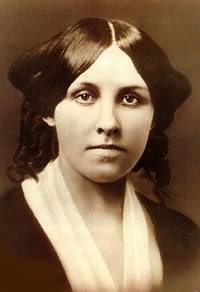 I wonder how many girls there are these days whose life-long reading careers start with Louisa May Alcott's Little Women? This marvelous book begins with these words:
"Christmas won't be Christmas without any presents," grumbled Jo, lying on the rug.
"It's so dreadful to be poor!" sighed Meg, looking down at her old dress.
"I don't think it's fair for some girls to have plenty of pretty things, and other girls nothing at all," added little Amy, with an injured sniff.
"We've got Father and Mother, and each other," said Beth contentedly from her corner.
With those four lines of dialogue, the reader is introduced to the four little women whose lives and personalities dominate the story. The reader is also introduced to each of their personalities in brief.
Well, the purpose of this post is not to go on about Little Women. It is to celebrate the lives of three marvelous authors, all of whom have one thing in common. They were born on this day.
Of course, since you are an astute reader, you will have gleaned that one of those three must be Louisa May Alcott. Though most of us would associate Alcott with New England, she was in fact born just outside of Philadelphia, PA. When she was two, the family moved to Massachusetts, where her father was involved in an experimental school as well as an early commune. Among the people with whom she interacted as a child were Ralph Waldo Emerson, Nathaniel Hawthorne, and Henry David Thoreau.
Her most famous work parallels greatly the life her own family was living. She had three sisters, and patterned her four little women on herself and her sisters. The Alcotts were poor, as were the Marchs. Her one sister died young, just as in the novel.
The second author of the magnificent trio born on this day is another author born in one country and mostly associated with another: C. S. Lewis. He was born in Belfast, Ireland. When he was a teen, he was sent to boarding school in England, a searing negative experience.
He wrote of that first encounter with England,
Of course, since you are an astute reader, you will have gleaned that one of those three must be Louisa May Alcott. Though most of us would associate Alcott with New England, she was in fact born just outside of Philadelphia, PA. When she was two, the family moved to Massachusetts, where her father was involved in an experimental school as well as an early commune. Among the people with whom she interacted as a child were Ralph Waldo Emerson, Nathaniel Hawthorne, and Henry David Thoreau.
Her most famous work parallels greatly the life her own family was living. She had three sisters, and patterned her four little women on herself and her sisters. The Alcotts were poor, as were the Marchs. Her one sister died young, just as in the novel.
The second author of the magnificent trio born on this day is another author born in one country and mostly associated with another: C. S. Lewis. He was born in Belfast, Ireland. When he was a teen, he was sent to boarding school in England, a searing negative experience.
He wrote of that first encounter with England,
No Englishman will be able to understand my first impressions of England...The strange English accents with which I was surrounded seemed like the voices of demons. But what was worst was the English landscape ... I have made up the quarrel since; but at that moment I conceived a hatred for England which took many years to heal.

Of course, most readers would now associate Lewis with his long career both as a student and then as a professor at Oxford. There, he was part of a circle of friends that included J.R.R. Tolkein. While Lewis was a prolific writer, he is most associated today with his Narnia series, the first book of which is The Lion, the Witch, and the Wardrobe.
The last of the magnificent trio is Madeleine L'Engle. She has something in common with each of the writers above--obviously, like Louisa May Alcott, she is a woman author whose works are popular among young readers; like C. S. Lewis she is sometimes referred to as a Christian author. Her own growing awareness of religion was a sense that "all will be redeemed in God's fullness of time, all, not just the small portion of the population who have been given the grace to know and accept Christ."
I first encountered her works when our son was a young reader and enthusiastically read A Wrinkle in Time, and then continued on to other books in that series.
I realize that with 365 days in any year (excepting leap year), there are always serendipitous syzygies of authors. Today's alignment seemed particularly note-worthy. Hence, my magnificent trio celebration.
Wednesday, August 11, 2010
The End of the Story
I have been greatly preoccupied of late (just ask my husband) with a writing project. I was commissioned to write a biography of my parents for a small church historical journal and the submission deadline is September 1. So I have been hard at work.
Yesterday, I hit a bit of a writing wall (all you writers out there will know exactly what I am talking about). The reason? I was at the point in my parents' lives when I had to write about my mother's death. This is one end of the story I would rather not to have to write. But write it I did. Having written about her death on this blog before helped.
As I am writing about my parents' lives, I am also doing a lot of thinking about my own. Have no fear--these are not deep dark thoughts. More like gentle rumination on the living I have done thus far.
I confess--I am consumed with curiosity about the future. Oh, not so much what will happen to me in the remainder of my life. More like--what will happen to EVERYTHING as time keeps on marching.
I am known in my family as one of those readers who turns to the last page of a novel just "to see how things turn out." I think that is part of the frustration I have when I contemplate my own life span being limited. I don't really want to live forever. But I do want to know where the story goes. . .
Do humans wake up and take real steps to protect their planet? Do humans learn to live with other animals? Do nations find ways to live peaceably with other nations? What happens? What happens?
Oh, maybe I really don't want to know all that--maybe the knowledge would be overwhelmingly crushing. True, I can't flip to the end of this story of human history or even earth's history. But that doesn't stop me from being curious about the end of the story.
Yesterday, I hit a bit of a writing wall (all you writers out there will know exactly what I am talking about). The reason? I was at the point in my parents' lives when I had to write about my mother's death. This is one end of the story I would rather not to have to write. But write it I did. Having written about her death on this blog before helped.
As I am writing about my parents' lives, I am also doing a lot of thinking about my own. Have no fear--these are not deep dark thoughts. More like gentle rumination on the living I have done thus far.
I confess--I am consumed with curiosity about the future. Oh, not so much what will happen to me in the remainder of my life. More like--what will happen to EVERYTHING as time keeps on marching.
I am known in my family as one of those readers who turns to the last page of a novel just "to see how things turn out." I think that is part of the frustration I have when I contemplate my own life span being limited. I don't really want to live forever. But I do want to know where the story goes. . .
Do humans wake up and take real steps to protect their planet? Do humans learn to live with other animals? Do nations find ways to live peaceably with other nations? What happens? What happens?
Oh, maybe I really don't want to know all that--maybe the knowledge would be overwhelmingly crushing. True, I can't flip to the end of this story of human history or even earth's history. But that doesn't stop me from being curious about the end of the story.
Thursday, June 18, 2009
Drum Roll. . .Please
When I began writing this blog in the summer of 2006, I had no particular destination in mind. The first item that I posted was part of my travel journal from our trip taken that year to Spain, Portugal and Morocco.
We have gone on a trip to Europe almost every year, since 1997. On our first trip, to the UK, I wrote a daily travel journal, and have kept up the practice on every trip since that one. At first, I used the journal to accompany photos that I carefully placed in albums when we returned home. Now, with digital cameras, and blogs, I have used the travel journals as a basis for blog material.
So, I started blog writing with no particular destination in mind. What has come of this venture? I am grateful for any audience that I have, but if I really try to decide who I intend my writing for, I would probably say "my children." Notes from Mother sort of thing. And of course I write for the sheer pleasure of writing.
Now, here is the drum roll part. This post is my 400th. Along the way to no particular destination, I discover I have written the equivalent of a book. Oh, the joy of writing. And of course that is exactly what I am writing for--the joy.
Blogging has given me an outlet for writing, and it provides a kind of discipline. Writers write--and having a place to share that writing helps give me the impetus to keep writing. And blogging has introduced me to various wonderful people--my fellow bloggers. I can't read every blog ever written, so I have settled on a circle of people with like interests. It's a great little cyber community.
 So, to celebrate my blogging milestone, I hereby announce my intention to repay the "Pay it Forward" challenge that I responded to when fellow blogger Ruthie asked her readers if they wanted to participate. I gleefully said--me, me.
And, about a month ago, a lovely hand-made treasure arrived in the mail. Made by Ruthie's hand (she is a knitting fiend), it is so gorgeous I scarcely can think of actually
 wearing it. But I will--come winter. That was Ruthie's Pay it Forward gift to me. You can read about what she received here.
Now, dear reader, here is where you come in. I make the same pledge--here are the "rules" as Ruthie stated them: I will send a handmade gift to the first 3 people who leave a comment on this post requesting to join this Pay It Forward exchange. I don’t know what that gift will be yet and you may not receive it tomorrow or next week, but you will receive it within 365 days; that is my promise! The only thing you have to do in return is pay it forward by making the same promise on your blog.
There are no restrictions on who can respond--friends, family, anyone who wishes to. I will be in touch with you.
We have gone on a trip to Europe almost every year, since 1997. On our first trip, to the UK, I wrote a daily travel journal, and have kept up the practice on every trip since that one. At first, I used the journal to accompany photos that I carefully placed in albums when we returned home. Now, with digital cameras, and blogs, I have used the travel journals as a basis for blog material.
So, I started blog writing with no particular destination in mind. What has come of this venture? I am grateful for any audience that I have, but if I really try to decide who I intend my writing for, I would probably say "my children." Notes from Mother sort of thing. And of course I write for the sheer pleasure of writing.
Now, here is the drum roll part. This post is my 400th. Along the way to no particular destination, I discover I have written the equivalent of a book. Oh, the joy of writing. And of course that is exactly what I am writing for--the joy.
Blogging has given me an outlet for writing, and it provides a kind of discipline. Writers write--and having a place to share that writing helps give me the impetus to keep writing. And blogging has introduced me to various wonderful people--my fellow bloggers. I can't read every blog ever written, so I have settled on a circle of people with like interests. It's a great little cyber community.
 So, to celebrate my blogging milestone, I hereby announce my intention to repay the "Pay it Forward" challenge that I responded to when fellow blogger Ruthie asked her readers if they wanted to participate. I gleefully said--me, me.
 And, about a month ago, a lovely hand-made treasure arrived in the mail. Made by Ruthie's hand (she is a knitting fiend), it is so gorgeous I scarcely can think of actually

 wearing it. But I will--come winter. That was Ruthie's Pay it Forward gift to me. You can read about what she received here.
Now, dear reader, here is where you come in. I make the same pledge--here are the "rules" as Ruthie stated them: I will send a handmade gift to the first 3 people who leave a comment on this post requesting to join this Pay It Forward exchange. I don’t know what that gift will be yet and you may not receive it tomorrow or next week, but you will receive it within 365 days; that is my promise! The only thing you have to do in return is pay it forward by making the same promise on your blog.
There are no restrictions on who can respond--friends, family, anyone who wishes to. I will be in touch with you.
Tuesday, April 07, 2009
One Hit Wonders
My blogging friend Philip, knowing my love of literature, shared this interesting story with me.
It's about authors that never made it "big" as they only wrote one novel. I admit--I editorialize when I say "never made it big." The writer actually simply points out who these one hit wonders were.
Here they are, author and book:
I find this list curiously puzzling. In many instances, the reason the second novel was not written is not for lack of inspiration. Harper Lee and Margaret Mitchell had opportunity to write another novel, although Margaret Mitchell was killed when she was struck by a car, ending any possibility of a literary come-back.
Some never had a chance to write another work. Emily Bronte died one year after her masterpiece was published, and Sylvia Plath committed suicide the year The Bell Jar was published. Anna Sewell died soon after her book came out. In each of these instances, the premature death cut short any literary career or any subsequent novel.
 Of course, some of the writers moved on to other forms of expression. I would never call Oscar Wilde a novelist. He is far more famous for his wit, and his having flaunted Victorian morals, famously losing his libel trial. His literary reputation stands on several successful dramas that he wrote.
Sylvia Plath, albeit short-lived, is far more famous for her stunning poetry than her auto-biographical novel.
Perhaps the most famous writing procrastinator is J.D. Salinger who has a small body of work, some longer stories collected into novella form. So, I would hardly call him a one hit wonder. In fact, I think he is as famous for his renowned reclusiveness.
Salinger and Arundhati Roy are the only two on the list still living, so there's always time for them to write another "hit."
One novelist not on the list is Ralph Ellison whose Invisible Man made his reputation. There are stories of Ellison working and working and working on his second novel. During his life, it was never published. When he died, a manuscript was found and eventually assembled for publishing--a rambling work--it never reached the proportion of acclaim Invisible Man garnered. Another one hit wonder?
I suspect there are other novelists out there whose reputation was made on the strength of one stunning work.
After reviewing the list, I can only say--if I can fail the way these writers have failed, I will be in very good company indeed.
It's about authors that never made it "big" as they only wrote one novel. I admit--I editorialize when I say "never made it big." The writer actually simply points out who these one hit wonders were.
Here they are, author and book:
- Harper Lee - To Kill a Mockingbird
- Margaret Mitchell - Gone With the Wind
- Emily Bronte - Wuthering Heights
- J.D.Salinger - Catcher in the Rye
- Oscar Wilde - The Picture of Dorian Gray
- John Kennedy Toole - A Confederacy of Dunces
- Sylvia Plath - The Bell Jar
- Anna Sewell - Black Beauty
- Boris Pasternak - Dr Zhivago
- Arundhati Roy - The God of Small Things
I find this list curiously puzzling. In many instances, the reason the second novel was not written is not for lack of inspiration. Harper Lee and Margaret Mitchell had opportunity to write another novel, although Margaret Mitchell was killed when she was struck by a car, ending any possibility of a literary come-back.
Some never had a chance to write another work. Emily Bronte died one year after her masterpiece was published, and Sylvia Plath committed suicide the year The Bell Jar was published. Anna Sewell died soon after her book came out. In each of these instances, the premature death cut short any literary career or any subsequent novel.
 Of course, some of the writers moved on to other forms of expression. I would never call Oscar Wilde a novelist. He is far more famous for his wit, and his having flaunted Victorian morals, famously losing his libel trial. His literary reputation stands on several successful dramas that he wrote.
Sylvia Plath, albeit short-lived, is far more famous for her stunning poetry than her auto-biographical novel.
Perhaps the most famous writing procrastinator is J.D. Salinger who has a small body of work, some longer stories collected into novella form. So, I would hardly call him a one hit wonder. In fact, I think he is as famous for his renowned reclusiveness.
Salinger and Arundhati Roy are the only two on the list still living, so there's always time for them to write another "hit."
One novelist not on the list is Ralph Ellison whose Invisible Man made his reputation. There are stories of Ellison working and working and working on his second novel. During his life, it was never published. When he died, a manuscript was found and eventually assembled for publishing--a rambling work--it never reached the proportion of acclaim Invisible Man garnered. Another one hit wonder?
I suspect there are other novelists out there whose reputation was made on the strength of one stunning work.
After reviewing the list, I can only say--if I can fail the way these writers have failed, I will be in very good company indeed.
Wednesday, March 25, 2009
Heroines
Were I not a subscriber to the Daily Almanac, that Garrison Keillor brings, I would not have known of the convergence of birthdays today.
 I suspect many people who know me well would say I am a feminist. Yes, I am. But I am not a strident one. I never burned my bra, for example. If pressed to define what kind of feminist I am, I may just offer my life--upon graduating from college, and getting married, and starting a family--I never stopped working. I worked the year my son was born--he was born at the end of January, I took February off and then resumed teaching. When my daughter was born, I worked the day before she was born, took three months off and then returned to working.
 On the other end of the spectrum of this shared birthday is Flannery O'Connor. As a lit major in college, I came upon her darkly grim and humorous stories. I knew little of her life then, but in graduate school I did a lengthy paper on her and learned a bit. Flannery was painfully unattractive. And she suffered from lupus that would eventually rob her of mobility, and cause her premature death. She lived a somewhat solitary life, staying on the family farm in Milledgeville, Georgia. After her father's death, it was just Flannery and her mother plus a menagerie that included peacocks.
Two of my heroines--born on the same day.
A more unlikely pair you cannot find, I think. Yet Flannery O'Connor and Gloria Steinem share a birthday today. And each has been a heroine to me.
 I suspect many people who know me well would say I am a feminist. Yes, I am. But I am not a strident one. I never burned my bra, for example. If pressed to define what kind of feminist I am, I may just offer my life--upon graduating from college, and getting married, and starting a family--I never stopped working. I worked the year my son was born--he was born at the end of January, I took February off and then resumed teaching. When my daughter was born, I worked the day before she was born, took three months off and then returned to working.
So I guess I would say that I am a feminist in terms of life choices--not marching, not philosophizing, just being.
Gloria Steinem was/is a feminist heroine for me. She is a very attractive woman--belying the old myth that all feminists must be ugly (take that, Rush!). In fact, early in her career she was a Playboy bunny. That particular detail always horrified and amused me. She was/is whip smart. As the founder of Ms Magazine, she may have had as much influence on current populist feminism as any one person.
 On the other end of the spectrum of this shared birthday is Flannery O'Connor. As a lit major in college, I came upon her darkly grim and humorous stories. I knew little of her life then, but in graduate school I did a lengthy paper on her and learned a bit. Flannery was painfully unattractive. And she suffered from lupus that would eventually rob her of mobility, and cause her premature death. She lived a somewhat solitary life, staying on the family farm in Milledgeville, Georgia. After her father's death, it was just Flannery and her mother plus a menagerie that included peacocks.
With all of her writing done in the first half of the 20th century, her stories anticipated the kind of disassociation that characterizes literature of the 20th century. One of the most famous of her short stories "A Good Man is Hard to Find" has the kind of grim ending that we  have almost come to expect with current movies--example No Country for Old Men.
 have almost come to expect with current movies--example No Country for Old Men.
Yet through all this dark view of humanity, Flannery was a fiercely devout Catholic, and you can find glimpses of the possibility of redemption everywhere in her fiction. Her body of writings is not extensive, since she died in 1964 at age 39. Yet she influenced many of today's writers.
Two of my heroines--born on the same day.
Wednesday, August 20, 2008
The Call to Write
 I shamelessly have appropriated the title of a wonderful writing text as my blog title. This text, which is NOT currently on the list of approved texts that I may choose for my writing class, underscores the ways in which we write and need to write--even though many of us feel we are not writers. It is this message that I hope to convey to my students this semester.
But, it doesn't appear that this semester will be marked with no crises. In fact, day one brought the first crisis. My early class begins at 8:00 a.m. Since I am by personal tendency a late riser, it will take me a bit of time until my body kicks into early-mode. Day one events in this section brought me to full attention. I began class as I usually do--taking attendance (noting a higher than usual number of day one no-shows); handing out syllabi; reviewing course expectations; indicating what materials are required of students. . .WAIT--is that a different textbook I see on every student's desk?
It would be! How did that happen? After about 30 seconds of personal panic--which includes me briefly entertaining that thought that maybe I will have to re-work the course (again)--I decide to break the awful news to the students. YOU ALL HAVE THE WRONG TEXTBOOK. When I ask if that's what the college bookstore sold them, they all mutely nod.
I then quickly review mentally the book ordering process. Oh, I remember. By late June, I had not gotten any inquiry from the writing coordinator as to which text I planned to use. So I sent her an email. Her response--I just put in an order for the texts you used last year. No problem, I thought. I like those texts and am happy to continue using them. The only explanation, then, for the wrong textbooks being ordered is that either the writing coordinator DIDN'T really know which texts I used OR the bookstore goofed. Whatever the reason, the students should be made whole in their purchases.
So I fired off an email to the bookstore, indicating which courses I taught, indicating the name of the correct textbooks, and that my students would be returning the wrong one so they could get the correct ones. Crisis averted--although it wreaks havoc on my course calendar.
Back to day one of class. After I go over the stuff that is (frankly) boring, but essential, I had the students working in small groups on an opening exercise. I ask students to write out a shopping list--that's what I said in the first section. By the time I had the second section, I had amended the instruction to say what I really intended--a grocery list. Then I ask students to come up with two ways to organize the list. The point of the exercise is to get them thinking about how they gather information and then organize it.
What is fun about this exercise is the ITEMS students put on the list. Well, this year a new item appeared on the list--condoms! I have long ago learned not to blanch when students say (or write) something that they think may shock or surprise me. Of course, since part of the point of the exercise is to see how they organize their lists, I asked the condom group their organizational pattern. Not surprisingly, this group had no organizational pattern. I think they were just titillated about the prospect of seeing how I would react that they forgot to organize.
A quick point of reference--other groups organized their lists alphabetically, or by perishables/non-perishables, or by food groups, or by solids/liquids. Yes, one group did use solids/liquids as their organization. Since they had bread on the list, I was curious where they placed that item. Um, they said, on liquids. I did have to laugh at that.
Well, the semester has begun. And I am hoping the textbook fiasco is the only major crisis. I have been teaching long enough, though, to know it might not be. But, crisis or no, I hope to inspire just one or two students to want to write and write well.
Monday, March 31, 2008
You’ve Got Mail
From the time I was 15 until 20, my parents and I lived apart. They were working as missionaries in Africa, and I stayed here in the US when they returned to Africa after a long vacation. Because of this separation, our primary—actually, our only—means of communication was letter writing.
To facilitate letter writing, we used aerograms—I don’t even know if this letter form is still available for purchase, but they were single blue sheets that you wrote on the inside, then folded up into a self-contained envelope. These letters were sent via airmail, and were the quickest means of getting news back and forth across the Atlantic Ocean.

I would write a letter to my parents, mail it, and in a week they would get it. Then they would respond with a return aerogram. In all, it took two weeks for questions and answers or news to go back and forth. Long distances advice with a significant time lag!
This asynchronous means of communication came flooding back to me this week, following a somewhat humorous exchange between my daughter and me. She had sent me an email, indicating her plans to do something; whereupon I replied “make sure you [blah blah blah].” She responded cautioning me not to be a transatlantic nag.
I thought that was such a funny response, but it also got me to thinking. What a world of difference in communication in some 40 years.
Throughout the five years my parents and I were separated, we must have written hundreds of letters back and forth. Usually my mother wrote to me, but one time my dad took up the weekly writing. I don’t remember this, but he does—apparently, getting a letter from my dad was so singular, that I went running through the halls of my college dorm yelling that I got a letter from my dad. And, of course, I must have told him that I did that because he remembered the report of the event.
Sometimes the asynchronous timing meant that stale news was going back and forth. Not long before my parents returned to the U.S., I had written asking my dad to round up a coin series of Rhodesian coins for my then boyfriend, who was a collector. My dad dutifully complied, bringing the coins along back. However, by then, that was stale news as the boy in question was no longer my boyfriend. I had no instant way of saying—never mind. My dad gave me the coins, and I gave them to the ex-boyfriend, to my dad’s regret (I think).
If I had an especially pressing personal problem that I wanted to talk out with my parents, the time lag was excruciating. True, I had my uncle and aunt who were my legal guardians but they had moved from Pennsylvania to Illinois, exacerbating the distance from adults to give advice. One of the impacts on my personality, not surprisingly, is the high degree of self-sufficiency that I possess. But still, it would have been nice to talk some issues out with my parents.
Times change. Not only do we have the advantage of daily emails, if we wish, with our daughter and of instant messaging, but we also can talk to her as often as we want. The advances in telephone communication are almost as breathtaking as those in letter writing. Phone technology such as communicating through computers has completely revolutionized this means of contact.
During the 5 years that my parents and I were apart, I talked with them on the phone ONCE. That’s right—once. There were no satellites to relay phone calls, only the transatlantic cable. So, if you wanted to talk with someone by phone, you had to call the international operator and RESERVE time. And then the cost was very steep. My college friends took up a collection gathering $25 for a 3 minute phone call. So once in our 5 year separation, I heard my mother’s voice, my father’s and my brother’s and sister’s voices once.
We compensated for this lack of voice communication by sending audio tapes back and forth. I recounted one of the amusing outcomes of these tape messages in my post on Sibling Stories II. My mother, trying to get my sister to talk, told her to “talk to Donna” while pointing at the tape recorder. My sister hesitated, then said in her little girl voice—is Donna inside that machine? The result was so much more authentic than anything a little girl of 3 or 4 might have said.
Contrast to this long distance oh so slow voice communication the near weekly telephone conversations with our daughter. I marvel at the changes, and cherish all the news sharing we can do. And, deep down, I think of my mother and just know how much she would have liked to hear her elder daughter’s voice.
So, we have gained and we have lost with the changes in communication. The gains are obvious—fast, easy contact with loved ones. The losses—all those letters that will no longer be written. Several years ago, when I wrote a biography of my grandparents, I relied on letters they had written to each other during their courtship years. Letters from the early 1900s provided me a wonderful insight into their young lives. With email today, who will save these “letters”? Who will print them off, lovingly fold them, place them in a box, and store them in an attic?

Mail call—letter for Donna! Or “you’ve got mail”—either way, I love staying in touch with my family.
To facilitate letter writing, we used aerograms—I don’t even know if this letter form is still available for purchase, but they were single blue sheets that you wrote on the inside, then folded up into a self-contained envelope. These letters were sent via airmail, and were the quickest means of getting news back and forth across the Atlantic Ocean.
I would write a letter to my parents, mail it, and in a week they would get it. Then they would respond with a return aerogram. In all, it took two weeks for questions and answers or news to go back and forth. Long distances advice with a significant time lag!
This asynchronous means of communication came flooding back to me this week, following a somewhat humorous exchange between my daughter and me. She had sent me an email, indicating her plans to do something; whereupon I replied “make sure you [blah blah blah].” She responded cautioning me not to be a transatlantic nag.
I thought that was such a funny response, but it also got me to thinking. What a world of difference in communication in some 40 years.
Throughout the five years my parents and I were separated, we must have written hundreds of letters back and forth. Usually my mother wrote to me, but one time my dad took up the weekly writing. I don’t remember this, but he does—apparently, getting a letter from my dad was so singular, that I went running through the halls of my college dorm yelling that I got a letter from my dad. And, of course, I must have told him that I did that because he remembered the report of the event.
Sometimes the asynchronous timing meant that stale news was going back and forth. Not long before my parents returned to the U.S., I had written asking my dad to round up a coin series of Rhodesian coins for my then boyfriend, who was a collector. My dad dutifully complied, bringing the coins along back. However, by then, that was stale news as the boy in question was no longer my boyfriend. I had no instant way of saying—never mind. My dad gave me the coins, and I gave them to the ex-boyfriend, to my dad’s regret (I think).
If I had an especially pressing personal problem that I wanted to talk out with my parents, the time lag was excruciating. True, I had my uncle and aunt who were my legal guardians but they had moved from Pennsylvania to Illinois, exacerbating the distance from adults to give advice. One of the impacts on my personality, not surprisingly, is the high degree of self-sufficiency that I possess. But still, it would have been nice to talk some issues out with my parents.
Times change. Not only do we have the advantage of daily emails, if we wish, with our daughter and of instant messaging, but we also can talk to her as often as we want. The advances in telephone communication are almost as breathtaking as those in letter writing. Phone technology such as communicating through computers has completely revolutionized this means of contact.
During the 5 years that my parents and I were apart, I talked with them on the phone ONCE. That’s right—once. There were no satellites to relay phone calls, only the transatlantic cable. So, if you wanted to talk with someone by phone, you had to call the international operator and RESERVE time. And then the cost was very steep. My college friends took up a collection gathering $25 for a 3 minute phone call. So once in our 5 year separation, I heard my mother’s voice, my father’s and my brother’s and sister’s voices once.
We compensated for this lack of voice communication by sending audio tapes back and forth. I recounted one of the amusing outcomes of these tape messages in my post on Sibling Stories II. My mother, trying to get my sister to talk, told her to “talk to Donna” while pointing at the tape recorder. My sister hesitated, then said in her little girl voice—is Donna inside that machine? The result was so much more authentic than anything a little girl of 3 or 4 might have said.
Contrast to this long distance oh so slow voice communication the near weekly telephone conversations with our daughter. I marvel at the changes, and cherish all the news sharing we can do. And, deep down, I think of my mother and just know how much she would have liked to hear her elder daughter’s voice.
So, we have gained and we have lost with the changes in communication. The gains are obvious—fast, easy contact with loved ones. The losses—all those letters that will no longer be written. Several years ago, when I wrote a biography of my grandparents, I relied on letters they had written to each other during their courtship years. Letters from the early 1900s provided me a wonderful insight into their young lives. With email today, who will save these “letters”? Who will print them off, lovingly fold them, place them in a box, and store them in an attic?
Mail call—letter for Donna! Or “you’ve got mail”—either way, I love staying in touch with my family.
Monday, September 17, 2007
Return of the Green Pen
 Every semester, I look forward with a mixture of dread and curiosity to the first set of essays I get from my students. Particularly in Eng Comp 101, the essays can reveal personal tidbits about the students’ lives. I am frequently saddened, and sometimes even shocked, by some of the circumstances these young people are dealing with.
So, I have now finished grading the first essay for the semester. I always use writing prompts—for several reasons. First, if I do a good job crafting the prompt, it makes it far less likely that the student can find a ready made essay to hand in as his own. Second, if all the students are writing about generally the same topic, I have a greater opportunity to evaluate them fairly in comparison to their peers.
The first writing prompt was to write a NARRATIVE or a DESCRIPTIVE paper on one of two topics: personal body modifications OR fasting for a personal reason.
Once I get this first set of papers, I brace myself. What odd word errors am I going to read? And how tainted will my own writing be after reading these freshmen essays? On this second issue, I frequently find myself making simple elementary errors after I grade a set of essays. An example would be confusing where to place an apostrophe to make a noun possessive. Students ALWAYS have trouble with making nouns plural, and then making plural nouns possessive. Is it the students’ papers or the student’s papers? Well, of course, you know it depends on context—did you mean the papers of all the students? Or all the papers of the student.
Perhaps the most common error I come upon is confusion in homophones. You know what a homophone is even if you don’t know the term. Simply, “Homophones are words of the same language that are pronounced alike even if they differ in spelling, meaning” Source.
I do get some very amusing homophones. The most common ones are words like NO and KNOW. Or THEIR, THERE, and THEY’RE.
Here are a few of my favorites.
THEN and THAN.
ACCEPT and EXCEPT.
ALTER and ALTAR.
SHUDDER and SHUTTER.
This isn’t exactly a homophone, but it was a near one.
ALTERATION and ALTERCATION.
So students writing about body alterations were actually using the word “altercation.” A bit of a different meaning.
In addition to bracing myself for these word confusions, I always steel myself for some of the more problematic details I will encounter. Clearly, eighteen year olds today view body modifications as very much the norm. They write about multiple piercings, or getting a second or third tattoo. I really cringe when a student writes about tongue-splitting. (I do get a small modicum of revenge when we start a discussion unit of clothing and body adornments around the world. I use photographs of some of the examples of stretched necks, or plate-sized lips, or ear-lobes elongated down to the shoulders. Students are always stunned to see photos of foot-binding. Then I innocently ask—well, what’s the difference between that and some of the body modifications you make?)
Occasionally, I have a student who sees beyond the obvious on this topic, and writes refreshingly on his experience. One student wrote about trying to decide what to do about premature balding. I loved the essay. Another student wrote about getting a military haircut upon enlisting in the Army. He understood that the haircut symbolized all that joining the military entails.
 For the first time with these papers, I had a fair number of students selecting the fasting topic. In the past, I have had one or two students a semester use this topic. This set of essays there were about a dozen, including one student who is a Jain and talked about the Paryshuna Festival, which includes fasting, meditation and prayer. Considering I live in central Pennsylvania which is a fairly conservative area, I was pleased to have a student who provided an informative well-thought essay from a different perspective.
Tomorrow will be the weeping day. I return the essays with all my green marks (I eschew using a red pen, and choose a green one instead). I also include a grading matrix. But, no matter how objectively I might have tried to be in relaying the issues with a student’s writing, students who expected higher grades are dashed. I find returning these first essays as the watershed mark—students will either hang in with me, trying to improve their writing, or they will blow off the whole course.
Thursday, September 06, 2007
Clap Your Hands
Remember the children's song "If you're happy and you know it, clap your hands"? CLAP CLAP (I'll bet I have the tune going in your head now--that is, if you know the song.)
 Anyway, this post is to talk about two things that make me very happy.
 Second, my daughter's fiancé (or my son-in-law-to-be) sent me an invitation to join Kiva. Here's what their website says to explain their purpose: "Kiva lets you connect with and loan money to unique small businesses in the developing world." This is microcredit at work. (Maybe you recall, this concept is what Muhammad Yunus won the Nobel Peace Prize for in 2006.)
 It is a simple concept. Find people anywhere in the world who need small loans to help them get a business started. Set up a repayment means. Find potential donors who are willing to make small loans (as small as $25) and let them agree to loan the funds.
 Anyway, this post is to talk about two things that make me very happy.
First, some months back, I wrote an entry on The Green Green Grass of Home. Well, one of the folks out in the blogosphere, who saw it, wrote me an email. Turns out she edits a journal called Among Worlds, which focuses on adult TCKs (third culture kids). She asked--was I interested in writing an article for the September issue of the magazine.
Why sure! I am always interested in new opportunities to write. So I polished up my musings on the green grass of home, and sent it off. And yesterday, the new magazine came in the mail--with my article right there on page 20. Can you see me smiling? Can you hear me clapping?
Second, my daughter's fiancé (or my son-in-law-to-be) sent me an invitation to join Kiva. Here's what their website says to explain their purpose: "Kiva lets you connect with and loan money to unique small businesses in the developing world." This is microcredit at work. (Maybe you recall, this concept is what Muhammad Yunus won the Nobel Peace Prize for in 2006.)  It is a simple concept. Find people anywhere in the world who need small loans to help them get a business started. Set up a repayment means. Find potential donors who are willing to make small loans (as small as $25) and let them agree to loan the funds.
 The utter simplicity of the needs of these "entrepreneurs" absolutely overwhelms me. Here's an example: Mrs. V is 50 years old and her husband has been dead for 10 years ago. She lives (in Vietnam) with a son and a daughter. She has a small plot of land for growing sweet potato, plus she raises pigs. Her family income is $11 per person/month. She needs to get a loan of $75 to purchase feed for pigs and fertilizer for the sweet potato field. She will repay the loan monthly.
That almost makes me cry--$75 for a widow to make a better life for herself and her children? Needless to say, I signed up to Kiva right away, and made my first loan today. Tonight I signed on and got this message: We've funded EVERY business on the site!! So now they have to go out and find more people around the world who need a modest financial loan to make their lives a little better.
Can you see me smiling? Can you hear me clapping?
-------------------------------
UPDATE: Signing on to Kiva this morning, I find there are 4 new entrepreneurs (this is the term Kiva uses) who need assistance. So, I made my second loan--to a woman in Kenya who "earns her living by selling re-tailored second-hand clothes." She needs $700 to buy a new sewing machine.
More smiling; more clapping.
Tuesday, July 31, 2007
Easy Writer
Three weeks and counting. That’s right—exactly three weeks from today classes start at my community college. And just last night, I agreed to take on another section. No big deal, really. I only had one course for the fall, so the second one won’t be an overload. And the subject is exactly the same! So, I decided I had best get moving on writing my syllabus. Problem is—I don’t have the basic composition text book. That prompted me to make a quick trip to campus today. Well, things are in a state of almost readiness. First, the car in front of me has a license plate designed to deter peeping?
 (Just in case you can't read it, the license plate says ICUPKIN.)
The campus is quite pretty during the summer. The grounds are always a treat—with master gardens digging away seemingly everywhere. In fact, every year in the late spring, the gardening department holds a kind of Oklahoma land rush on flowers. They take all the extras they have, send out a general email, and invite staff to come with boxes in hand and at the stroke of noon, rush toward the plants and GRAB. Thankfully, no one is displaced, and there are no fatalities.


Ah—here is my building. It houses the English department, along with Theater, Arts and Humanities. So, by campus building standards, it is a little more interesting than the average building.


The signs of readying for classes to begin are everywhere. Painting, painting, painting. Fresh paint signs hang all over the place. The college must have gotten a great deal on rainbow colors, as every door, door jamb, and window sill is painted in a different color.


Entering my office, I see something NEW? What is this? Cool—new computers for everyone. Now, let’s see if I can remember my password. Is it the dog’s name? the cat’s? my children? my husband? Hmmmm—think, think, think. Got it!


Next I check out the classroom. Six rows wide, by five rows deep. This is very important, as every year I draw up a diagram and then fill in student names. Human nature being what it is, we tend to sit in the same seat each time we go back to a public space. (Uh-huh—so, last time you were in church . . .assuming there was a “last” time, did you sit in the same pew?) I rely on this human tendency as a way to learn student names. I fill out the chart for a couple of classes, then keep it handy and as we have discussions, I call on students by name. I once had a fellow instructor tell me he did not know whether or not someone was in his class because he doesn’t bother to learn their names!

Oh great—it is a SMART classroom, for both sections. That absolutely makes my day (and very likely my semester). I use this technology to prepare PowerPoint presentations for students. Another human tendency—if the instructor is lecturing, don’t take notes. If she begins to use a PowerPoint, TAKE NOTES. Don’t ask me why—it is just true.

Finally, the text books. The reader Every Day Everywhere, I have used before and loved. It has such wonderful essays in it as “Sperm in a Jar.” This is one I frequently begin with—after all, you have to get their attention first. And then there is the grammar handbook—Easy Writer—this is what I went to campus to retrieve.

Now, must stop writing blog. . .time to write my syllabus. . .ignore Harry Potter calling my name. . .must write syllabus. . .eyes getting very sleepy. . .must write sylla------zzzzzzzzzzzzzzzzz!
Subscribe to:
Posts (Atom)