Monday, September 26, 2011

The Pizza King

Do you remember that great scene in "Back to the Future" when Dr. Emmett Brown doubts Marty's story that he is from the future.  So he asks him: Then tell me, "Future Boy", who's President in the United States in 1985? And Marty replies:  Ronald Reagan.
To which Dr. Brown says in utter disbelief: Ronald Reagan? The actor?


Well, folks, if the seasoned Republican voters in Florida have their way, get ready for the pizza king.  That's right.  Herman Cain WON the Florida straw poll, beating Rick Perry with 37 percent of the votes to Perry's 15 percent.

Now, I grant you, it in no way grieves me to see Perry lose.  But to the Pizza King?  (In case you have been living in a cave--which, come to think of it, doesn't sound so bad these days--you may not know that Herman Cain's SOLE claim to fame is that he was the chief executive officer for Godfather's Pizza.)

True, the number of Republicans voting in this straw poll was  2,657 people.  So 1,062 people think the pizza king should be president.  Maybe they like his 9-9-9 plan: 9 percent tax rate on personal income,  9 percent tax rate on corporate income, and 9 percent national sales tax.  The simplicity is breath-taking.  Even though no serious economist gives this plan any credence.  Oh, for goodness sake, we want simplicity. 

We don't want to have to think about anything.  And if someone tells us that something is a THEORY, well, kiss that piece of knowledge good-bye.  After all, doesn't theory mean "not proven"?  Republican candidates are falling all over each other trying to see who can "diss" science the most.  Poor Jon Huntsman (uh-oh--here's one of those inescapable word combos--you, know, like "the doomed Donner party" or "the ill-fated Titanic") took the bold stand of supporting evolution by saying "Call me crazy, but..."

But, folks, think we must.  For example, how can Herman Cain with straight face propose the simple 9-9-9 plan, when the last 9 means poor people (and everyone else) paying a 9 percent federal sales tax.  If you're poor, paying 9 percent sales tax is a killer.  A rich guy won't mind paying 9 percent on his yacht, but a poor guy paying 9 percent on food?

Or another example, how can Rick Perry say he thinks the science on global warming was rigged, when Texas is experiencing unheard of weather extremes, and is--as one analyst noted--on fire?  Literally!

Well, if Professor Brown couldn't believe that Ronald Reagan, the actor, was president, how about the pizza king? 

Oh, do you want that pizza with extra cheese or pepperoni?
--------------------
Full disclosure--the photo of the pizza?  Why, that's from Godfather's Pizza website.

Monday, September 19, 2011

Where are They Now?

Occasionally, I fall for a magazine, stacked up at the cash register of a grocery store, when it trumpets from the cover WHERE ARE THEY NOW?  Usually, there is a photo spread of stars of yesteryear, or other people in the public.  I am always curious about the paths that people's lives take.

With the arrival of social networking sites, such as Facebook, we can now indulge in our own version of "Where are they now?"  Maybe you have played this game.  After you sign up with Facebook, chase down immediate friends, relatives, neighbors, whoever--eventually you get to the point where you wonder "who else can I friend?"  (Sorry, it annoys me as much as you that we have converted yet ANOTHER noun into a verb!  After all, isn't "befriend" a perfectly good verb? Yet FB insists on "friend" as the verb form...but I digress.)

I love the graph below suggesting who finds YOU on Facebook.  Thus far that has not been my experience.  I have, however, had the experience of befriending someone who later, summarily "unfriended" me.  And, truth be told, I have done the same thing.  After all, no need to be subjected to reading updates about things which matter not on whit to me.

If you like the above graph, you can find more at GraphJam.com.

Recently, one of my Blogger friends, AC, hauled out a third grade photo, and had his readers guessing which cherub was him. That post engendered another, as he found a second grade photo as well.

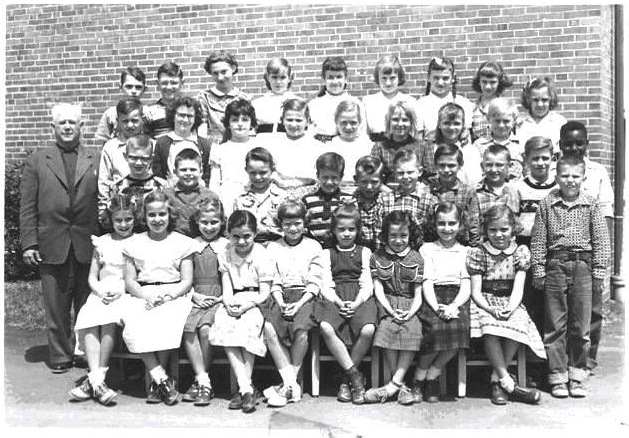
That got me to musing...I know somewhere I have a fourth grade photo.  So I hauled it out.  I have only one such school photo.  Most of my elementary school days were spent in government run schools in then Rhodesia.  I don't think they took class photos there.  At any rate, in the mid-1950s, my parents returned to the U.S. for a furlough (extended vacation time).

Time enough for me to go to part of third grade and fourth grade at the Shepherdstown Elementary School.  My teachers were Mr. Meyers and Mr. Ryder.  How unusual then to have had two men as grade school teachers.  Looking at the photo, I have distinct recollections of most of the students.  One girl, standing right next to me, was named Ginny. 

I suspect every class has someone like her.  You see, her problem was cleanliness.  Or rather lack thereof.  She came to school day after day, frequently in repeat clothing.  Her hair was dishevelled, her face unwashed.  And her body odor was painfully rank.  Poor girl.  No--really.  POOR girl.  I don't know who cared for her, if anyone.  No one in class would tell her she needed to bathe, and use deodorant.  We all steered clear as much as we could.

By the time my family returned to the U.S. in the 1960s, and I finished high school, returning to the same school system, many of those third grade classmates were still there.  But not Ginny. 

Well, Facebook hasn't revealed any Ginnys to me.  I do not recall her family name at all.  And, yes, there are times when I wonder "Where is she now?"

Saturday, September 17, 2011

Knitting at the Guillotine

We are now in the season of vetting candidates for the privilege of running for President of the United States. To that end, the Republicans are holding a series of "debates" (more like sequential staged monologues...but that's another post).

When the first debate was held, hosted by NBC, Brian Williams in his moderator role prefaced a question to Governor Rick Perry. He noted that the governor has presided over more executions than any other governor in a state--whereupon the audience burst into applause and hoots of approval.

While the question and audience response clearly didn't phase Perry, it absolutely took my breath away. The visceral, red meat, blood lust response was repeated in the next Republican debate when the question was posed about someone who does not have health insurance and is diagnosed with a life threatening condition. What should we do--asked moderator Wolf Blitzer--let him die? YEAH, the audience loudly responded.

While some may quarrel with the moderators--did they ask the right question; did they ask the question the right way, etc.--I can't help but wonder: what has happened to the United States? Why such vicious uncaring reactions?

We have become a nation of Madame Defarges, sitting with our knitting at the base of the guillotine, sopping up the blood while we blithely knit away. How did it become so?

There are two thoughtful, yet deeply troubling, pieces that I have read recently. One, recommended to me by our daughter, points out the disparity of Republicans' deep distrust of government--as evidenced by the constant drum beat of every single Republican presidential candidate--EXCEPT when it comes to the death penalty. If government fouls up everything it touches--the current Republican mantra--why can't Governor Perry think, for a second, that maybe, just maybe government also fouls up and sentences an innocent man (or woman) to death? Read the Slate article for yourself
here.

The second article is one written by a long-time Republican staff person who retired after 30 years as a House and Senate staff person. In the article, titled "
Goodbye to All That," the author Mike Lofgren, meticulously catalogues the ways in which the current Republican leaders have intentionally changed the terms of the political debate. He opines that "it should have been evident to clear-eyed observers that the Republican Party is becoming less and less like a traditional political party in a representative democracy and becoming more like an apocalyptic cult."

Lofgren does not extol the virtues of Democrats--he tags them as hapless in the face of the current Republican approach. But his comparison gives one pause: in recounting the recent debt ceiling debate debacle, he notes that "everyone knows that in a hostage situation, the reckless and amoral actor has the negotiating upper hand over the cautious and responsible actor because the latter is actually concerned about the life of the hostage, while the former does not care."


Wow!

I suppose the only cautionary conclusion I can draw from this musing on my part is that, while the guillotine began as an instrument of execution for one intended victim, by the time the revolution ended, those who cheered on the executions eventually became the victims.

Knit one, purl one, repeat...

Saturday, September 10, 2011

The Rule of Threes

We humans are an interesting lot--we note things by number groupings. It is an arbitrary approach to observing things, but we can't help ourselves. The number three is one way we note things. We hear of the death of a famous person, then another--and we wait for the third death. If we try twice at something that doesn't work, we say "third time is a charm."

Well, not sure if nature counts by threes, but this summer has brought three unusual events our way.

The first unexpected event this summer was the earthquake. I grant you, by California standards--or almost anywhere in the world far less tectonic plate stable than the east coast, it wasn't much. Still, since I felt it--and saw the walls move--it was plenty enough for me.

Then, the second event--Hurricane Irene decided to waltz through central Pennsylvania, as well as other parts of the north east U.S. No matter how loudly and heartily I sang "Goodnight, Irene"--she just wouldn't leave. We watched as our lovely tall evergreens in the back yard began falling: one...two...three. Several days later, the tree guys (who were SUPER busy these days) arrived, whipped their noisy saws into action, slung rope and pulley over a neighbor's tree, hoisted, dragged and pushed the downed trees through a large grinder.

That was quite enough for me. But, nature had one more little treat in store--the third event.
Hurricane Irene gave way to Tropical Storm Lee. As rain fell day after day, we watched anxiously to see if our usually dry basement would stay dry. This past Wednesday, both my husband and I had plans to be out of the house for separate lunches. I went to the basement around 9:30 a.m., just in time to see a portion of the basement floor with a slight inch of water creeping in and bubbling up.

We both changed our lunch plans and went to work. While I began syphoning up water with our wet vac, my husband made a quick trip to our friendly Ace is the Place Hardware store to rent an industrial size wet vac.

We worked solidly for five hours--emptying the vacs by lugging buckets up the basement steps. Finally, with the rain continuing, we gave up. We managed to rig up a small pump which normally is used in the winter to keep water off the swimming pool winter cover. By attaching a long garden hose to the pump, and then running that hose up the stairs to the family room level, we were able to have the water run down a drain in the laundry room.

That system ran all night. By morning, small patches of dry floor began to appear. We turned on the dehumidifier, and set up a floor fan. With the rain slowing down, then stopping, we "won" the water battle.

What was ending for us was just beginning for the area. The Susquehanna is a lovely old river--almost a mile wide where Harrisburg, our state capitol, sits--this river can handle a lot of water. But it begins to flood at 17 feet. The original forecasts were for the river to rise to 29 feet.

Suddenly everyone was making the obvious comparison--to
Hurricane Agnes. Hurricane Agnes wasn't much of a hurricane, back in 1972. But this low-level hurricane stalled over Virginia, Pennsylvania and New York. Between June 19 to 24, Agnes dumped upwards to 19 inches of rain in Pennsylvania. Rivers rose, creeks rose, and even long-forgotten canals filled.

In Harrisburg, water backed up the Paxton Creek, which had been channeled into a canal which few people knew even existed. The result was that Harrisburg had water all around it, almost cutting it off.

At the time, my husband and I were living in an apartment outside of Harrisburg. We had recently had our first child, our son--who was six months old. We were not greatly affected, except by the excitement of the news.

So, when the comparisons began this time to Agnes, it brought back memories as well as a frisson of dread--would Lee be as dramatic as Agnes? Well, yes and no. The river level did not break the Agnes record--it crested just over 25 feet. But still, for all the folks who were displaced, who lost homes to the flooding, the height of a flood matters little.

This photo--taken for the Patriot News by Sean Simmers--shows a neighborhood in Harrisburg called Shipoke. We have three friends from church who live in houses facing the Susquehanna. All of them had to evacuate.


Here are some other photos by the same photographer.

Some places that had not been affected by Agnes were flooded--for example HersheyPark, a favorite tourist destination. Both of our children had worked there-so we had a frame of reference as we looked at photos of some of the places we knew. The roller coaster was not designed as a water ride.


Lee has moved on--and, with 15 1/2 inches of rain, it now takes its place as the SECOND wettest tropical system to dump rain on Pennsylvania, right behind Agnes.

Let's just hope that the rule of threes holds--that there are no more unusual events at least for this year.

Monday, September 05, 2011

Places in the Heart

For as long as I can recall, my mother's family has held a family reunion on the Saturday before Labor Day. Rather like salmon returning to the home waters, the offspring from the original grandparents return every year to a small community park in the Morrison's Cove area of Pennsylvania.

So, you can guess where we were this past Saturday. Not that I attend every year, I hasten to add--because we don't. It doesn't take me long to catch up with cousins with whom I have less and less in common as each year passes. Understandably, we have all moved on with our lives. The rough and tumble play of some 30 plus cousins is long past. In its place we find staid, solid folk with greying heads, aging bodies, aching knees, hips and backs. The annual softball game has long ceased

What remains is a fleeting contact, a chance to exchange hugs, eat some food, and then scatter once more.

This year, my husband asked one of the cousins who is older than I am if he could recall when the first such family reunion was. The cousin paused, and finally said that as long as he could recall, they had been holding the annual reunion.


Maybe this photo of my mother's family was taken at just such a reunion. All of my mother's brothers and sisters are there. Mother was one of eight children--from oldest to youngest they were: Ada, Paul, Andrew, Kathryn, Dorcas (my mother), Ezra (also called Fred), Mark and Davey. (My mother is the second one on the right, in the middle row, standing right behind her father.)

Now, the family tree has branched out. The first generation--my grandparents--are long gone. The second generation--the eight sibling--are also all gone. The third generation--me and all my cousins--are now in our autumnal or even winter years. Those of us that remain--that is. Because even in our generation, we have lost some to death. The fourth and fifth generation, as well as a sprinkling of sixth, are spread further and further apart. We no longer know each other by first names, much less which branch of the family we are attached to.


So, we gather, bringing our covered dishes.


We hold an auction of various items to help raise the money to pay for the pavilion in the local community park.


Some cousins, along with their sons or grandsons, get brave and give us a rendition of a song they have been practicing.


We bring cameras and take photos.


And we talk.

After we returned home, I kept thinking about my interaction with these cousins. Many of them grew up together. And I, along with my brother and sister, were miles away--in fact, an ocean away. When we returned home, we would make our way to my mother's home area--she loved it so--and we three alien siblings would be lost in a jumble of faces and names.

When my parents returned to mission work in southern Africa, I stayed here--in fact, in the Morrison's Cove area initially. I lived with Kathryn and her family. Her daughter and I spent a couple of years together--and made promises to be in each other's weddings--promises which we kept. We are not close now, but we share a common bond.

The thought occurred to me that what I hold in my heart are a multitude of memories of a time that is long past. Family members who are now dead still live in my memories. When I see cousins at the family reunion, I link them with their entire family. It makes for a constant bittersweet melange--a sense of what was, and what still is, bound up with joy at remembrance and sorrow at reality.

Places in the heart indeed.

Sunday, August 28, 2011

Only God Can Make a Tree


When my husband and I moved to the house we now live in, the neighborhood was brand new. In fact, my son and I had discovered the house for sale. Our son was eight, at the time, and the two of us had gone out for an afternoon bike ride. We rode from where we lived to a newly developing neighborhood very close by. In fact, our old house and our now house are less than a mile apart.

As we rode into the developing neighborhood, it showed all the signs of being brand new. About a dozen houses had been built, all on speculation. Since it was during a housing slow-down, very few had sold. And there were NO trees anywhere.

Once we had bought the house, and moved in, one of the first things on the list of things to do was to plant trees. The wind came whistling out of the north-west, and smacked our new house, especially in the winter. So, trees to help break that whistling wind were a MUST.

We got about a dozen small evergreens--all bare root stock and each eighteen inches high. And I walked along the back of our lot, with my husband digging holes, as I planted the small trees. Each tree seemed to be pitifully small. The result was that we planted them entirely too close together. As it happened, about every other tree was a Japanese pine. When they got too big, we took them out, leaving the Douglas firs, the Scotch pine, and the Colorado blue spruce, and one lone Austrian pine. Eventually, we added two Engelmann spruce (that had been live trees in front of our church).

This year, we had the Austrian pine taken down. It still had some green at the top, but most of the rest of it was dead. A neighbor thought it might come down in his yard, so we had it removed.

When Hurricane Irene began to blow up the East Coast, it did not even cross my mind that we might have storm damage. This week began with an earthquake in the east--a rare occurrence. So, a hurricane seemed like a fitting second act. But we have had hurricanes blow through central Pennsylvania before. Some do significant damage--mostly from high water.
Hurricane Agnes in 1972 was just such a storm.

But the forecasts showed our town to be just enough to the west of Hurricane Irene that it seemed we might get a dose of rain, some wind, but not much else.

I awakened around 4:30 a.m. to hear the rain and the wind. Things sounded restless enough outside that I did not go back to sleep--more from curiosity than concern. As it began to get more light outside, I could see the trees being whipped around by the wind.

When I looked outside again--I got the first shock. TREE DOWN. This Douglas fir was one that our son had brought home from grade school, which we planted near our pool. And now it was down--just heaved over from the too much rain softened soil, and finished off by the wind.


Then, a bit later--there seemed to be far more light to the north side of our house than usual. Tree 2 down.


And, it continued then when Tree 3 leaned, on its way down, only to be stopped by a neighbor's black cherry tree.


So, now we wait for a tree service to come, clear away, clean up and haul off our lovely 30 plus year old trees.

And, then, we will have to decide--what to plant there next.

Joyce Kilmer's
oft-cited poem came to mind:

I THINK that I shall never see
A poem lovely as a tree. . .

Tuesday, August 23, 2011

YOU ROCK!

After the event this afternoon, my husband remarked with incredible irony that he had thought of the possibility of experiencing an earthquake, but assumed that we'd be in California, if that happened.

With our son and daughter-in-law now living in southern California, we know we will be visiting there more frequently. So that raised the possibility of experiencing an earthquake--not a huge likelihood, true. But we certainly didn't think we'd feel the earth moving here in central Pennsylvania.

Yet, that is precisely what we felt today. Just before 2 p.m. EST, we each felt something a bit unusual--my husband thought the dog had bumped his office chair. I saw the walls seem to move slightly--a disorienting sensation.

I confess, the first place I turned to figure out what had happened was Facebook. It lit up like a switchboard (what a funny comparison). And immediately the USGS confirmed that it was indeed a 5.8 magnitude earthquake centered in Mineral, Virginia, some 90 miles south of Washington, DC.

Here's a USGS map of the places where the earthquake was felt--based on reports people have made.
I can't say that experiencing an earthquake was on any personal experience list that I had--but if this is the only earthquake I experience, I am just fine with that. I recall hearing from an aunt of mine who lived through the great Alaska earthquake of 1964. That event seemed like the end of the world to her.

I am fine with a 5.8 magnitude earthquake almost 200 miles from where I live. I would NOT want to experience a 9.2 magnitude earthquake.

Friday, August 19, 2011

The Writing on the Wall

Well, the local news has done it again.

I know I have railed before, in this venue, about the sad state of news coverage in general in the U.S., and on the woeful
approach to news coverage in local news. I guess I shouldn't be surprised when a local television news station leads off its nightly news with an absurd story.

So, here's what the local CBS affiliate
led with last night: "3 deaths reported from brain-eating water amoeba." (As a side note, when they promo'd the news earlier in the evening, with that headline, they showed a graphic of a euglena! So, big deal, you say--amoeba, euglena, what's the diff?)

Never mind the wrong graphic, I have so many OTHER problems with this story. First, the deaths that were reported occurred in Louisiana, Virginia and Florida. Huh? Three places that are MILES (make that states) away from our city. Second, our city is located along a river--the Susquehanna--and people do use it as an entertainment source--a place to swim if there isn't a community pool nearby...i.e. much of the inner city. And yet, one visual point after another featured our river. In fact, the local reporter was STANDING in the river (wearing waders). I am certain there are some viewers who thought--YIKES, can't swim in the river anymore. Third, the reporter went on to say--the one victim even contracted his amoeba from TAP WATER. Oh, no. Not even tap water is safe.

Fourth, when the local reporter talked to someone knowledgeable in the area--a physician--the physician stated point blank--such a condition is EXTREMELY rare. (Something like 1 chance in 10 million!) Got that--extremely. Yet, the local news led with this story.

Sadly, science knowledge and comprehension continues to decline in the U.S. I suspect too many viewers won't exercise their healthy skepticism. Instead, they will go--oh dear, there's a flesh eating amoeba in our river, and we're all going to die! And even if you do an Internet search on the topic, you don't find much help out there. The first story that popped up in my search was from an
NPR blog. NPR? Really!

SIGH.

What to do? It certainly doesn't help that we have, among the dominant forces in our country, destructive pressures on the reason to have any science knowledge. Of course, it's too simple to blame television, but I can't help but wonder what all the exposure to "reality" shows is doing to our thinking powers. There are many reasons why people might like reality shows: the chance to root for the underdog; the "at least it's not me" syndrome; the freak show appeal. But advancing knowledge is not one of those reasons. And yet, these shows dominate television, driving out quality drama, and killing informative shows in general.

Another culprit to this decline in scientific knowledge, in my opinion, is the disdain that is heaped on long-held scientific views. Take Rick Perry, for example. Seriously, take him. OK-sorry, old joke (thank you, Henny Youngman). Anyway, Perry made news recently when
he opined that evolution is "a theory that's out there...and it has some gaps in it." He went on to say that in Texas (Lord, deliver us from another Texan) they teach both evolution and creationism*, and he guesses the students are smart enough to figure it out.

When I was most recently teaching, I encountered students who had been schooled in a such a way. One earnest young man even brought his science text books in from a private religious school (complete with artistic renderings of Adam and Eve). This dismissive tendency--to say evolution is a theory (implying that as such it is not reliable, much less proven)--in part draws on a common misunderstanding of how science uses the term "theory."
Wikipedia does a nice job of explaining the word's meaning in a scientific context: "A common distinction sometimes made in science is between theories and hypotheses, with the former being considered as satisfactorily tested or proven and the latter used to denote conjectures or proposed descriptions or models which have not yet been tested or proven to the same standard." So, where the average person in public hears "theory," thinks "unproven," the scientist says "theory," and means "demonstrates by data over time."


So, saying something is a theory does not mean it is unproven. It means that it has been satisfactorily tested and proven.

I shudder when I think how the dismissive approach to science is affecting our country. I read a recent
New York Times article that put things into stunning context. Herewith the gist: Grinell College in Iowa markets itself to students in China, which has resulted in 1 in 10 applicants to Grinell come from China (about 200 students). Of those 200 Chinese applicants, half have perfect scores in the math SAT. HALF. Perfect scores.

GULP.

So, while Rick Perry disparages evolution, while local news scares people to death with stories of flesh eating amoebae, while U.S. citizens wile away the hours watching reality shows on TV, the students in China are studying math. I don't know about you--folks--but I see the writing on the wall, and it doesn't say USA.


-----------------
*The
Texas Tribune notes the following:
In 1987, the U.S. Supreme Court ruled that teaching creationism in public schools was unconstitutional. In the case Edwards v. Aguillard, the court ruled that teaching creationism in Louisiana public schools was the equivalent of teaching religion — and violated the Constitution because it advanced a particular religion.

Wednesday, August 10, 2011

A Tale of Two Cities


We have recently returned from visiting our son and daughter-in-law, who recently moved from Pittsburgh to San Diego. We had not seen them since they left the east coast. And now they are living on the west coast.

As ever, the ocean is a marvelous thing to behold. Two things can bear endless watching: a camp fire or fireplace, and the ocean.

We had spectacular weather while we were there--it was wondrous to leave the heat and humidity of a typical Pennsylvania summer, and experience the cool days with breezes blowing.

While we were there, we used Skype to have a sort of family reunion--talking with our daughter and son-in-law who live in London. Yes, that London.

Not long after we returned home, the news began breaking about a sudden up-swell of riots in Tottenham, a section of London. As if someone splashed gasoline on smoldering embers, the riots bloomed and spread through various parts of London. Then it morphed again, and spread to other cities in the UK.


View Initial London riots / UK riots in a larger map

The map above gives some sense of the extent of these riots.

It is always hard to be a parent when your children live at a distance from you. But, it is even harder to have them literally a continent apart and away.

It really struck me that there's a sense of revisiting, in contemporary terms, what Dickens was writing about in his classic A Tale of Two Cities. Of course, then London was the stable city, while Paris was the city on fire.

I am hoping that calm is restored soon. And even though we are thousands of miles from our children, we too can regain our calm. But, as we wait for calm, I also recall the moral of another English novel--The Lord of the Flies: the veneer of civilization is very thin indeed.

Tuesday, August 02, 2011

One Man's Mutilation

An ad I saw the other day in the New York Times sent my mind spinning. And it made me recall what was so much fun about teaching.

There are many things I loved about teaching, but far and away my favorite part has always been having spirited class discussions.

Soon after I returned to teaching, at the local community college, I learned that a new essay text was going to be picked. When the writing coordinator asked if anyone wanted to help select it, I volunteered. We ended up picking a neat text of essays (called Every Day, Everywhere) that included a wide range of delightful readings.

Early in a semester, I would assign Germaine Greer's incisive essay titled "One Man's Mutilation is Another Man's Beautification." You can read it here, if you like.

To get students' minds working, I would show them various photos--here are some samples.


from top left, clockwise: Neck elongation; skin scarification; henna painted hand; lip enlarging using wooden disk; bound foot (pointing straight down); and filed teeth.


Invariably, students would react negatively. The one practice that really seemed to bother them was foot binding. A spirited discussion always followed my showing that photo.

Of course, I was lying in wait for them. After the students got lathered up in discussing the barbarian practice of foot binding, I would ask--you mean you wouldn't submit to such a practice? Of course not, they indignantly replied.


And then I showed them photos such as this.


What's the difference? I asked. And then the discussion really heated up.


I am particularly interested in the answer. Shoes with such a high heel go in and out of style. I remember spike heels. I wore some when I was younger. I do NOT wear anything like that today. I wince and hobble with bad knees, even if I am bare foot, or have my favorite pair of Clark's on my feet. Super high heels? Well, you may as well tell me to have my feet bound.


Of course, what I am tapping into with the discussion is the cultural variations we all exhibit. And that's what Germaine Greer meant by her provocative title.

Bound feet...
Super high heels
Scarification...
Body piercings...
Tattooing...
Teeth filing...
Teeth capping...


Ah, the ad? Well, it was those photos of women's super high heels. Inflicted cruelty in the name of fashion, if you ask me, resulting in long-term mutilation all for the sake of short-term beautification.

One man's (or woman's) mutilation is indeed another man's (or woman's) beautification. OK, class, discuss among yourselves.

Monday, July 25, 2011

That Sinking Feeling

Once again, the Writer's Almanac has inspired the subject of a blog for me. It was on this day that the Italian ocean liner Andrea Doria was struck, off the coast of Nantucket, and eventually sank.

Now, why, you might wonder, is that event of particular note. Well, several reasons. On the larger scale of human events, certainly there were bigger more costly ship sinkings. Obviously, the Titanic is the most famous, at least in terms of lives lost, with 1,517 people perishing. The Andrea Doria had only 46 people die.

Strangely, the Andrea Doria benefited from the lessons learned on the Titanic--to a point. The Andrea Doria was struck by another ship, the Stockholm, in a heavy fog. The impact of the collision resulted in the Andrea Doria listing hard to starboard which rendered the lifeboats on that side unusable. With only half the lifeboats usable, the numbers of passengers who could be rescued using them was greatly diminished. Shamefully, some of the crew fled on the first 3 lifeboats.

However, and here's where the Titanic lessons came into play, there were other ships in the area that immediately set course to assist the crippled ship. These ships included the Ile de France which had passed the site hours earlier. This ship had sufficient capacity to take on the passengers from the stricken ship. The call to abandon ship came 30 minutes into the accident, and the ship sank eleven hours after being struck.

As Wikipedia notes, the sinking of the Andrea Doria was "the last major transatlantic passenger vessel to sink before aircraft became the preferred method of travel."

So what? you might be thinking. When this story was first in the news, I was riveted with the details. Our family was one of those ocean-traveling families. With my parents doing mission work in southern Africa, which they first went to in 1946, we had to get across the Atlantic Ocean, somehow. The very first time, we went by plane which is standard now, but very unusual then. After that trip, we crossed the Atlantic in 1954 to return to the U.S., then again in 1955 to return to Africa.

So, crossing the Atlantic was something with which I had familiarity, when I first learned of the Andrea Doria sinking. It did not instill great confidence in me. The only thing I really feared crossing the ocean was the prospect that the ship could sink. It didn't help matters when on one ocean crossing the ship we were on showed a movie "Run Silent, Run Deep" about submarines preying on ships.

Sure, it was great fun to cross the Atlantic in a huge ship, such as the Queen Elizabeth I (as we did). And the time spent on shipboard was a wonderful way for missionaries heading home to decompress. But, the prospect of another ocean liner striking the ship we were on did not thrill me.

When I returned* to the U.S. for the final time in 1959, we once again crossed by ship--a ship called the African Enterprise. I even found photos of it on the Internet--shown below--which completely matched my memory of the ship. The photo of the ship's main lounge really brought back memories for there was a piano there (seen on the left in the photo) on which the ship's doctor--an Italian opera lover--played the Triumphal March from Aida JUST as we steamed past the Statue of Liberty into New York harbor.


Ah, the days of passengers crossing the Atlantic are long gone--at least in the commercial sense. There are, of course, luxury tour which do take passengers around the world. But, mostly now, people go on short jaunt cruises which are nothing like an ocean crossing.

What has not changed, of course, is the prospect of a ship sinking. Sadly, such catastrophes are still happening (as this summer's news attests), and lives are lost.
--------------
*My parents returned to southern Africa in 1960, while I stayed in the U.S. to continue my high school education.

Monday, July 18, 2011

Revisiting the Classics


Someone recently wrote a comment on my Facebook about recalling the days when I was teaching (in my first college job) and she was a student there. What she indicated was that as she and her fellow classmates reminisce they all recall having to read “the dreaded Young Goodman Brown.” She said she remembered nothing of the story or its meaning, only the dread of having to read the story. And she wondered—should she read the story again, perhaps with the maturity of some life experiences that would make “the dreaded” story more meaningful.

That got me to thinking—there are many classics that we could revisit and appreciate now with some life experience informing us of deeper meaning.

And then I thought—why not help you revisit the classics. Starting with “Young Goodman Brown.” If you still think this story might fall into the dreaded category—go ahead, skip the rest of this post.

“Young Goodman Brown” is one of Nathaniel Hawthorne’s short stories. Written in 1835, it is widely regarded as his best-known short story. The primary characters are Young Goodman Brown himself, his wife Faith, and sundry characters who appear during the course of the story.
A quick interjected comment about the character’s name—Young Goodman Brown. Obviously, young is an adjective describing his youth. The family name of Brown is somewhat universal. And Goodman—well, that’s an honorific title that would have been used during Puritan times, one step below “gentleman.”

The story begins with young Goodman Brown taking leave of his wife to set out on an unspecified errand as night falls. They are newly weds, having only been married three months, and she somewhat petulantly begs him not to go. He tells her he must go—and so he leaves his sweet wife Faith, who is the picture of innocence with pink ribbons in her hair.

Ah—foreshadowing. The wife’s name is Faith.


Not long after setting out, young Goodman Brown encounters an unnamed character who upbraids him for being late. Goodman Brown replies “Faith kept me back a while.” The two begin to walk along, deeper into a darkening woods, and Goodman Brown begins to hang back complaining that his father never went so far into the woods. But, he is urged on by his traveling companion, who tells him:

``Well said, Goodman Brown! I have been as well acquainted with your family as with ever a one among the Puritans; and that's no trifle to say. I helped your grandfather, the constable, when he lashed the Quaker woman so smartly through the streets of Salem; and it was I that brought your father a pitch-pine knot, kindled at my own hearth, to set fire to an Indian village, in King Philip's war. They were my good friends, both; and many a pleasant walk have we had along this path, and returned merrily after midnight. I would fain be friends with you for their sake.''

The traveling companion is now identified as “he of the serpent.” So, clearly young Goodman Brown is on a dodgy errand and has met up with the devil, or at least the devil’s emissary. The quoted speech (above) clearly links historical events within the Puritan community with the forces of evil: the Salem witch trials, and the so-called King Philip’s war, where wholesale slaughter of American Indians was carried out by the settlers.

Young Goodman Brown is astonished to learn that his traveling companion is well acquainted with church leaders, the governor, and members of the council. As he digests this information, he sees a woman ahead of them on the path. She is Goody* Cloyse, who taught him catechism. Not wanting to be seen by her, Goodman Brown ducks into the woods, while his traveling companion stays on the path. When he encounters Goody Cloyse, she screams “the Devil” but they soon fall into friendly banter so it is clear they too are well acquainted. When she disappears, and young Goodman Brown is once again walking with his traveling companion, Brown demurs:
``Friend,'' said he, stubbornly, ``my mind is made up. Not another step will I budge on this errand. What if a wretched old woman do choose to go to the devil when I thought she was going to heaven: is that any reason why I should quit my dear Faith and go after her?''


His traveling companion suddenly disappears, leaving Goodman Brown sitting puzzled and contemplating what to do next. He then hears voices of two approaching travelers, who turn out to be the other people who instructed Brown in catechism—the minister and Deacon Gookin. They too are on their way to the same gathering as the devil, and Goody Cloyse. Goodman Brown cries out: ``With heaven above and Faith below, I will yet stand firm against the devil!''

As he cries out this plaintive declaration, he hears a young woman’s voice. And looking up to the sky, he sees something fluttering down, which catches on a branch—a pink ribbon.

``My Faith is gone!'' cried he, after one stupefied moment. ``There is no good on earth; and sin is but a name. Come, devil; for to thee is this world given.''


He finally gives himself over to the forces of evil, and joins the gathered worshippers. Someone calls for the converts to be brought forward, and Goodman Brown steps forth. He hears the words of welcome:
``Welcome, my children,'' said the dark figure, ``to the communion of your race. Ye have found thus young your nature and your destiny. My children, look behind you!''


Goodman Brown beholds Faith in the gathering, and in a final desperate plea tries to save her: ``Faith! Faith!'' cried the husband, ``look up to heaven, and resist the wicked one.'' The story solemnly informs the reader “whether Faith obeyed he knew not.”

The next morning, young Goodman Brown returns to his village, a changed man. He sees all the familiar loved figures—the minister, Deacon Gookin, Goody Cloyse, and finally his wife Faith who greets him happily.

The story wonders whether or not Brown had fallen asleep and only dreamed the witch-meeting.

Sorry, no answer to that question.

The ending informs us:

“And when he had lived long, and was borne to his grave a hoary corpse, followed by Faith, an aged woman, and children and grandchildren, a goodly procession, besides neighbors not a few, they carved no hopeful verse upon his tombstone, for his dying hour was gloom.”


After that summary, do you really need an interpretation? For myself, I like the thought that what Goodman Brown discovers in the darkened woods is that we are all mortal—we are not perfect, we are flawed. And the knowledge—the coming of age, if you will—overwhelms him. He cannot live a carefree satisfied life with that knowledge.

What do YOU think the story is telling the reader?

Now, I am taking requests. What classic would you like to see revisited? If I have read it, and can remember it, I will “teach” a class on it.

-------------------------------
*Goody—a shortened version of Goodwife, corollary to Goodman

Saturday, July 16, 2011

Rebooting

Several weeks ago, I began to notice that my heartbeat was not all it should be--you know, not nice and regular and steady. Instead, it felt thready and at times weak.

Since I pay attention to little messages from my body, I made an appointment with my family doctor. She too felt my pulse, listened to my heart--and to me as I described what I had been feeling--and then promptly called on the office intercom for an EKG. Once I was hooked up with various little leads, and a read-out of my heartbeat was made, she announced: yes, as I thought, you have atrial fibrillation.

Now, I don't like to hear little words (or actually some long words) such as atrial fibrillation. But not liking to hear something does not make it go away. My doctor referred me to a cardiologist with these words--I don't think you need to go immediately to an emergency department. Well, such a statement focuses the attention when your doctor allows as how you DON'T need to go to the emergency department. I couldn't help but hear an unspoken YET.

A few days later, I did see that cardiologist, and he in turn had another EKG performed--yup, still in atrial fibrillation. He started me on a new blood thinning medicine and recommended scheduling a cardioversion.

Now, cardioversion is the little cousin of that dramatic medical procedure on TV shows, when a patient is in cardiac arrest, and someone grabs two paddles, yells CLEAR--and then zaps the patient. In cardioversion, the paddles are smaller, and the electric charge toned down some, but it still is zapping the heart. (And, I learned the nickname for the doctor who does the cardioversion is Sparky...)

Or, as my cardiologist (who I did like a lot) said--rebooting. HA. Immediately my husband took to referring to the procedure as my rebooting, and that the result would be KGMom 2.0.

Hmmm.

So, I am now at the end of the week which began with my rebooting. Since cardioversion is done under general anesthesia, I felt nothing, and have no negative residuals from the procedure.

What I am hoping is that rebooting is not prelude to more such procedures. And I hope that KGMom 2.0 had all the bugs worked out first. You know, I don't want a constant stream of updates being rolled out, requiring installation etc.

As usual, Shakespeare provides words of wisdom: all's well that ends well.

Here's hoping...

Sunday, July 10, 2011

Remembrance of Things Past

Those readers who know me realize I am a big fan of the Writer's Almanac. I receive it as a daily email, a practice I began when I missed the NPR segment too often. So now every day, I can start out with a literary bon mot to savor.

For example, today is Marcel Proust's birthday--July 10, 1871. And I know that because I read my Writer's Almanac. Two Proustian amusements I enjoy--one is the recurring reference to him in that charming independent movie of a few years back--Little Miss Sunshine. Steve Carell plays a very depressed scholar who fancies himself the number # 1 Proust scholar...until he learns of someone ELSE who is even more the # 1 Proust scholar.

The other is the title of Proust's most famous work--Remembrance of Things Past. At least that's how the title is rendered in English. Apparently, that title, though so well-known by most literature students, should have been rendered as In Search of Lost Time. I like Remembrance of Things Past better--maybe because that's what I feel I frequently do when I set out to write a blog.

For the purists, Proust's title in French is À la recherche du temps perdu. which I confess really does translate better into In Search of Lost Time. OK, whatever.

The other day, on the anniversary of the poet Shelley's birthdate (of which the Writer's Almanac reminded me), I went searching for a suitable Shelley poem to use on Facebook. I found the poem "
When the Lamp is Shattered."

Interesting how the themes in this poem seem to echo that search of lost time, or even remembrance of things past theme.

Herewith the opening stanza--the rest you can read by clicking on the link above:

When the lamp is shattered
The light in the dust lies dead—
When the cloud is scattered
The rainbow's glory is shed.
When the lute is broken,
Sweet tones are remembered not;
When the lips have spoken,
Loved accents are soon forgot.
I heard a successful movie script writer being interviewed by Terry Gross the other day. He made the point that, in his opinion, most movie scripts are really the same story told over and over again. He gave some examples to illustrate his point. I see what he means--and that repetition of theme certainly occurs in literature. Only there--we call them archetypes.


There is that recurring theme of the intransigence of existence--the mutability of all things. Contemplate how an entire play--Hamlet--seems to hang up on that theme. And Hamlet's awareness incapacitates him. He wanders around musing "to be or not to be."

About now, dear reader, you may be wondering--what's gotten into her. Oh, maybe I am just musing. Tempus fugit. Memento mori.

Let's hope that the next Writer's Almanac puts me on the path of a cheerier theme.

Friday, July 01, 2011

Goodbye, Mr. Chips

The other day I was suddenly seized with the urge to clean out my office--not the one in our home, but the one at the community college where I had taught for the last several years. I have not taught a course for three semesters, and I have no thoughts of asking for a course. With my husband retired, my not having a course frees us up to travel. So perhaps my teaching days have drawn to a close.

But, the office that I shared with two full time faculty and one other adjunct still held some of my personal items as well as student information and text books.

I loaded books into boxes, and then went through several file drawers where I had accumulated worksheets, quizzes, exams, and even student papers. With abandon, I tossed the papers into recycle bins. I wondered what to do with some of the textbooks--composition books which I had no use for if I weren't teaching.

As if by design, a man appeared at the door. He was one of those textbook buyers who circulate at the end of each semester, looking for used textbooks for which they pay money. Well--sure, go right ahead, look through my books. And he did, and found a fair number for which he offered me $17 total. Done and done. The first time such a buyer appeared at my door, I agonized over what to do. Many of the books that I had collected had been sent unsolicited as tryout texts. So, I was in a quandary. When I asked a colleague, she was frankly puzzled at my ethical pause.

The task of cleaning out the office was a necessity, but it also set me to musing--and thus the real inspiration for this post. I have loved teaching. Nothing I have done in my varied work career has been so rewarding as teaching. And I am grateful to all the links along the way that led me into teaching.

Fresh out of college, with my degree in English literature in hand, I had no clue what I might do. So, off to grad school for me. I realized that I had been privileged to have excellent professors at my alma mater, so I wrote a note of thanks to one of my favorite profs. He promptly wrote back and asked--did I want to return to my alma mater, after my master's degree program was concluded? It was for a one-year fill in for someone on sabbatical. Did I?

Well, I surely did. So, after one year away for grad school, I returned as a very young newly minted instructor in English. I was all of two or three years older than my students. I had no trouble asserting my classroom authority with students, but some of my former professors, now colleagues, didn't exactly help me. Some students told me that one prof was reminding students that they had to read their assignments if they wanted to discuss intelligently the issues. Only one person that he knew could discuss intelligently without having read the assignment--that was me.

So, I asked my former prof, now colleague--please, don't tell students such stories about me! (I think I might have been secretly pleased at being identified as discussing intelligently.) That was then--now I realize that I no doubt short-changed myself but not reading thoroughly the assignments.

After eight years of teaching, I moved on to other work. Make that three other jobs. The last full time job came to an abrupt end when the company I was with merged with another, and I was "made redundant" (that wonderful British term). Facing the prospect of sudden and unplanned retirement, I wondered what to do. Well, there was teaching. So I applied to our local community college for adjunct status teaching English composition. Thus I returned to teaching to conclude my working career.

As with anyone involved in teaching, I have my cache of student stories. There was one student who was furious at me for "giving" him an F. I calmly informed him that he had earned that F. There was another student who gleefully told me, when I returned a paper to her on which she had earned a B, that she only began writing the paper the night before it was due. My comment to her--imagine if you had done more preparation; you might have gotten an A.

Encountering students after a 20 plus year absence from teaching had a completely different dynamic. Add to the time factor the difference between students attending a four-year residential college and students attending a two year non-residential community college. Students at community colleges frequently carry full class loads and work full-time. That leaves little time for engaging enthusiastically in the academic riches of college education.

At the community college some students' stories nearly broke my heart. I would always give students an initial assignment in class--write a diagnostic essay in response to a prompt. That way, I could see how they wrote and have a base-line sample of their writing skills. Sometimes I used the prompt--what was a problem you had, and a way that you solved it. I had quite a few young women who wrote about getting pregnant while in high school, and their decision to keep and raise the baby as a single mom.

In one class, I had a young woman named Brooke. She sat in the back, and never talked. I could tell she was friends with one of the young men. One day, she missed class. I had a fairly strict attendance policy, so I noted the absence. Then she missed again, and again. I finally asked the young man--and he said he thought she was dropping out. It turns out that she had quarreled with her mother, who turned her out. Brooke, at age 18, was living in her car. She never did return to class, and I often wondered what happened to her.

So, as I cleaned out drawers and files, packed up books and personal items, I thought. I thought back on a career in teaching, and again silently thanked the professor who tossed me a one-year teaching position. Of course, it lasted more than one year. The professor on sabbatical who I replaced never returned.

Thursday, June 23, 2011

The Good, the Bad, and the Ugly (terza parte)

Well, it is time to finish the southern Italian tour series. I admit to a bit of cheating--the ugly in some instances was really ugly, but in other instances it is an effect that ends up being ugly--not so much the sight.

Take for example, Pompeii, pictured below. Probably one of the most famous volcanic eruptions in human history--Vesuvius erupting in AD 79. Three small towns were buried then, of which Pompeii is the most well-known. It is almost an obligatory tourist stop--and a most interesting place to see.


Visiting there solved a puzzlement for me. Why did so many people die in Pompeii? Why hadn't they left? When
Vesuvius began erupting, the residents in the area thought it simply a normal occurrence. Frequent eruptions had lulled them into a kind of complacency. But the mountain continued erupting, for two days. When the wealthier residents became concerned, and left Pompeii, they instructed servants and slaves to remain behind to guard things. These, then, were the people who died. A few of these poor souls can still be seen, in varying poses of death rictus. Ugly.

What is really mystifying is that Vesuvius could erupt again as it has through the centuries--and in its shadow live some 2 million people. The town of Naples is very near Vesuvius. Speaking of ugly--Naples set a new standard. Not that Naples is ugly, but everywhere we encountered mountains, yes mountains, of trash. Trash bags and refuse piled high--going uncollected week in and week out. A host of issues have converged to cause this on-going trash crisis: incompetency, work stoppages, organized crime. The result is an eye-sore and a nose assault. Just ugly.

Near Pompeii, we visited another place I had not heard of before this trip--Matera with its Sassi. Now a picturesque location, with the tangle of pristine white houses you see below, this place was once a site of unimaginable misery. You can read more
here--but the nub of the crisis that what began as houses hewn out of the rocks in pre-historic times continued to be homes into the mid-1900s. Families of 12 or more people would be crowded into two cave rooms, along with farm animals. When the situation came to light, the Italian government eventually solved it by forceably removing all the residents. Today, the authentic cave houses are tourist attractions. And the whole town has become a place where upscale living quarters are being built. Any such building must conform to original appearance to help the place maintain its historic status. It is the sad history of the place that is ugly.


We visited the town of Syracuse, where there is an extensive ruin of what was once a quarry. Now, it appears to be an open pit (see below), but at one time it was really tunnels in the rocks. At the height of its being used, some 30,000 slaves were forced to quarry stone all their lives.

In its heyday, Syracuse was a thriving city-state, dominating the southern end of Sicily. It was allied with Sparta and Corinth. Among the name of great people born there is Archimedes who died during a siege of the city.

There is still a Greek theater which continues to be used, and evidence of a Roman amphitheater. So many places on Sicily experienced multiple waves of invasion--so you see Greek ruins, Roman ruins, as well as other conquering nations.

Almost everywhere we went, along the eastern coast of Sicily, we saw the gentle rise of Mt. Etna. Etna is still a very active volcano--you can see the smoke that is visible almost every day. The sight of it is beautiful--until you consider that Etna regularly spits out lava flows that run down the mountainside. The next photo shows the different colors of the lava--as it ages, it darkens.

So while the view is very pretty, living in the shadow of a mountain that can send down hot lava was potentially ugly--except everyone who lives near Etna is entranced by the physical beauty that results from incredibly fertile soil, made so because of the lava.


The last city we visited was Palermo, Sicily. Now, my advice to tour planners is never end a tour in the least attractive place. Palermo was dirty, dingy, run-down. Scenes such as the one below were fairly common--nothing inherently ugly about seeing street vendors offering their wares--but a large tuna being sliced up, and then left to sit there in the heat, all day--well, that did not appeal to me.

One of the most quixotic things to me was the reaction of many of the people on the tour. My husband and I were among the very few people who had NO Italian, specifically Sicilian, heritage. Everywhere we went, our tour group folks kept warbling--oh, isn't it just so beautiful. Why did our grandparents leave this lovely place. I felt like saying--because they were unemployed, they had no hope in this place. They came to America for opportunity. One of the fellow tour members very tellingly noted: in America, I'm Italian; in Italy, I'm American. Ah, yes.

So, I will leave you with two scenes that did merit that "oh, isn't it lovely" response--the first photo is from Agrigento, the second from Selinunte. While we saw many places with ruins, one of the most unusual was Selinunte. It was a place utterly without tourist crowds. No tour guides. Just a few folk wandering around, soaking up the stunning skies and massive ruins of a temple. This scene was enough to compensate for any ugly, and utterly remove it.