Showing posts with label health. Show all posts

Friday, January 23, 2015

Truth...or Consequences

In the early days of television, there was a popular show called Truth or Consequences.  It was so popular that a town in New Mexico, originally called Hot Springs, changed its name to Truth or Consequences in response to the television show host's offer to air the program from the first town that renamed itself.  

Maybe that fast change of reality was a harbinger of ways in which truth...or consequences (for lack of truth)...would be adjusted in the times ahead.

Recently, the so-called Doomsday clock was readjusted to move the number of minutes to midnight at 3 minutes to midnight.  This "clock" was the product of the scientists on the Manhattan Project as a graphic way to demonstrate how close the earth is to self-destruction.  During its existence, the Doomsday clock has been readjusted 18 times.  Mostly, the clock has been used to indicate the possibility of earth's destruction due to nuclear proliferation.

No doubt the immense over-supply of nuclear weapons still threatens our existence, but this most readjustment included another threat to our planet--"unchecked climate change."

Truth...or consequences...BIG TIME.

Stephen Colbert introduced us to the concept of "truthiness"--which is in HUGE supply today.  In Colbert's brilliance, he staked out ground that it is his right to say what is true because "I don't trust books; they're all fact and no heart."  **

With the recent national election in the U.S., the Senate is now in control with the Republican majority.  That means committee chairs have changed--and the new chair of the Senate Environment and Public Works Committee is Senator James Inhofe.  As recently as 2012, Inhofe argued, citing Genesis 8:22, that “God’s still up there. The arrogance of people to think that we, human beings, would be able to change what He is doing in the climate is to me outrageous.”

I don't even know where to begin with that kind of reasoning.  It is indeed frightening that an elected official who has a major say in what the U.S. policy is in relation to controlling the negative effects of climate change can decide that we don't need to change because whatever is happening with the climate is God's doing.  

In other news, we are experiencing another example of "Truth or Consequences." After years of decline due to near universal immunization against measles, the U.S. is experiencing a startling resurgence of this disease.  The initial outbreak has been pinned to Disneyland where many people intermingle, and measles--a HIGHLY contagious disease--has spread through workers and visitors there. In turn, these people have infected other people, so that now an epidemic of measles is emerging.

Who are the people GETTING measles?--those who are under-immunized or NOT immunized. The main contributor to this outbreak are parents who refuse to have their children immunized. They have decided, using "truthiness", that--even though the facts are that immunizations save lives and immunizations do NOT cause autism--it is their right as parents to deny their children the protection of immunization.  They base their decision, in part, on a doctor from England who in 1998 published a paper that claimed to link the MMR (measles/mumps/rubella) vaccine with autism.  Since that paper was published, we have learned that the doctor MADE UP his data, and he was a complete fraud.


(Source of Graphic: http://www.cbsnews.com/news/just-how-contagious-are-the-measles-anyway/)

So now children suffer, and could die, because someone made up his own facts and asserted a relationship where none existed.

The saddest part of this tendency in humans--to make up their own facts or to deny facts that they wish not to acknowledge--is that SOMEONE suffers.  Children who get measles suffer, people living in areas threatened by rising sea levels suffer, animals faced with loss of habitat and extinction suffer.

It is time to face TRUTH...or suffer the CONSEQUENCES.
---------------------------
** I was tempted to comment on how Fox News has changed people's perception of reality...you know, make the charge and find the facts (if they exist) later...but that's for another time in this blog.

Thursday, August 21, 2014

Matters of the Heart

Of late, I have been ruminating on the nature of the human heart.  More about the reason in a minute.  One of the things I think about is the way in which humans are generally binary—most of us are born with two of everything: two eyes, two ears, two arms, two legs, two lungs, two kidneys, etc.  When we get to some parts of us, we are born with one—one brain, one heart, one liver.  These one of a kind parts of our bodies are, understandably, mostly indispensable.

For centuries, humans thought of the heart as the center of human life—kind of a brain, seat of wisdom and knowledge and moral judgment, as well as of all life.  Understandably, when you consider how indispensable the heart is.  Oh, I know other organs are indispensable—your brain, for example.  But there is something about how we view the heart that is just...well...different.

So, why this rumination?  Well, as I have previously written, I had experienced over the past several years bouts of atrial fibrillation.  That essentially occurs when the heart begins to put out conflicting signals as to when to beat.  The heart functions on its own electrical system—the S-A node setting the pace, and the A-V node bridging the atria and the ventricles.  In atrial fibrillation, another area sends out a rogue signal to beat, somewhere in the atrium, so the atrium beats, and then the S-A node sends out its signal, so the heart beats again.  Chaos—yup, that’s what it is.  A good description of what it feels like is a fish out of water flopping around on the deck.

And that’s what I have experienced.  The immediate correction is to shock the heart back into regular rhythm—which I have had done several times.  The first time the “cure” lasted for a year and a half.  Then the interval shortened to a year, then less, and finally to several weeks.  So it was time to consider another option, if there were one.

Well, TA DA, there was one.  It’s called cardiac ablation.  I’ll let you go here to see what that entails.  It is not a simple procedure.  The doctor advised my husband and me it could take 4 to 5 hours. Mine took a bit over 6 hours—so, I am told.  I don’t recall any of that, of course.

Before I went into the hospital, I told very few people.  No need to parade my medical history around and share it with the world.  Naturally, my husband knew, and our children with their spouses.  My father, and siblings knew.  Also a handful of friends.  That was it—no posting on Facebook or any such public place.

The day before I went into the hospital, one friend called and asked if I was nervous.  Well, I pondered a bit—and said, no, not really.  Then my dad asked how serious the procedure was—could it result in death?  Well, the answer is it could—rarely does, though.  But, the same can be said about getting in a car and driving down the highway. 

Did I think about death?  Naturally.  I think about death from time to time.  I am not immortal. The bargain of life is we are born, and we die.  I also like the opening words from my denomination’s Brief Statement of Faith:  “In life and in death we belong to God.”

So, while I think about death, it holds no fear for me. In fact, I have mused that dying during surgery would be an “easy” death compared to what some people go through.  It is for the living that death is hard.

Oh, please don’t think me morbid—this blog is, after all, about “matters of the heart”—both in the sense of what our hearts mean to us as living biologic creatures, and also what our hearts mean to us in those that we love.

Perhaps a brief poem by X. J. Kennedy (whose birthday is today, August 21, as I write this) speaks words I would say--

“In Faith of Rising”
When all my dust lies strewn
Over the roundbrinked ramparts of the world
I can be gathered , sinew and bone
Out of the past hurled
Delaylessly as I
Flick thoughts back that replace
Lash by dropped lid, lid to eye
Eye to disbanded face.
No task to His strength, for He
Is my Head—Him I trust
To stray the presence of His mind to me
Then cast down again
Or recollect my dust.

And then these words, from Sir Walter Raleigh, who penned them the night before his execution.

"Epitaph"
Even such is time, that takes on trust
Our youth, our joys, our all we have,
And pays us but with earth and dust;
Who, in the dark and silent grave,
When we have wandered all our ways,
Shuts up the story of our days;
But from this earth, this grave, this dust
My God shall raise me up, I trust!


In matters of the heart, I trust.

Monday, May 27, 2013

Life Lessons on a CPM* Machine

Time to pick up the proverbial pen and resume blogging.  Well, you and I know that it's not really a pen I'm picking up, but I am setting fingers to the keyboard.

When last I blogged, I announced this anticipated break necessitated by upcoming surgery.  Surgery has "come and gone" and I now have a new knee.  Tomorrow, I return to the orthopedic surgeon to have my staples removed.  Then the day after, I begin out-patient physical therapy.

But, I have NOT been idle.  Oh, no--I am spending a good part of my waking day doing the requisite exercises to get the new knee to flex and bend, and also being strapped into a CPM machine (*Continuous Passive Motion) which, slowly over time, increases the angle of the bend of my knee, all the while flexing my leg up and down, back and forth.


So, I have time to .... read (but I get bored); watch TV (oh, previous reaction ten times over); play some games on my Kindle Fire (only lasts so long); nap (yes, I have succumbed); and think--ah, think.

What I have been thinking is the life lessons learned on the CPM machine.

Lesson 1--It's you or no one.
You are the one who has to commit to doing whatever work there is to keep yourself healthy.  There's no one else who can be put on the machine, and have the results work out for you.  

Lesson 2--Give in to the pressure as it increases.
The first several times I notched up the machine a degree or so, I felt myself inadvertently resisting the machine.  I quickly learned that as the machine moved, and the pressure bending my knee increased, it worked better if I gave in to the pressure.  Instead of pushing back, I went with the bend.  Thus, the machine could work its magic and I didn't experience pain by pushing back.

Lesson 3--You have to commit to the time that is needed.
Since I use the machine three times a day, each time preceded by about a half an hour of assigned muscle strengthening exercises, it is OH SO TEMPTING to cut corners.  But, the whole point of the exercise regimen is to help me regain full control and use of my leg with its new knee.  So, cutting corners only spites myself.

Lesson 4--Stay the course.
Since the exercises start out slowly, the improvement is incremental, even seemingly non-existent...at first.  But then after two days, four days, seven days--with each passing day change occurs.  And "suddenly" I realize, hey, I can bend my knee much further than when I first came home. 

Lesson 5--Chill.
Sometimes, when my knee is feeling pressure, the best way to handle it is to use a little ice.  So, chill.

Lesson 6--Up with Good, Down with Bad.
My surgeon gave me this little mnemonic device as a way to remember which leg to use when going up or down stairs--"up with the good, down with the bad."  In general, not bad advice! 

Lesson 7--Accept the Love.
My recovery has been quick and steady.  And in great part I owe that to the wonderful help from my loving husband who is doing double duty--his usual work and mine as well.  In addition to his love, the dog has been very sweet in checking on me periodically.  And the three cats have taken turns snuggling up next to me as I spend hours on the CPM machine.  Top off this love with phone calls and emails from family, and cards from friends--well, all I can do is just accept the love.

No doubt, I will learn a few more lessons.  Maybe that's why you only have the machine on loan for 3 weeks--if you had it longer, you'd figure out how the universe works, or maybe come up with a unified theory of everything.

Gotta go....time to get back on the machine.

Saturday, October 20, 2012

What A Difference a Day Makes

Well, could you make that a year.  No, how about a decade.  Or two decades--minus one year.

Nineteen years ago, when I was having trouble with my left knee, I had arthroscopic surgery.  I have inherited one of those lovely family genes (from my mother's side) which makes knees (and hips too, I fear) susceptible to extra wear and tear.  As years go by, the grinding increases along with the pain.

Nineteen years ago, my knee decided--yes, it does seem to have a mind of its own--that bending beyond a 90 degree angle was something it would not do.  So, I sought medical help from an orthopedic surgeon.  First stop was an X-ray.  The tech told me to lie on my stomach, and bend my leg as far as I could, so she could take an X-ray pointing down at my recalcitrant knee.  I bent it as far as I could--only to hear her say: can't you bend it more No, I muttered--that's why I am here.

Anyway, the verdict (I suppose I should say diagnosis) was Chondromalacia patella.  It sounds a lot fancier than it is.  In short, it means kneecap pain, which can be caused by wear and tear, torn cartilage, or misalignment of the knee.  Uh huh--I felt like I had all those. 

Eventually, the treatment was an arthroscopic procedure to "clean things out."  I don't know--but there is nothing particularly comforting to me about hearing a doctor say he (or she--but in this case, he) wants to clean things out.  Makes me feel as if I have been an untidy housekeeper of my own self. 

But, I had the procedure.  And, sure enough, I was able to bend my knee more than a 90 degree angle after that.  In my renewed vigor, I thought--well, I can run, and do those wonderful aerobic exercises that help one trim down.  Alas--running caused my knee to balloon in size.  So I stopped that. 

I resigned myself to bad genes and sore knees.  As if I needed final proof, while rummaging through photos in our basement, I came upon a college photo of me in basketball uniform (ooh, remember those cute little basketball pinnies?) and--lo, and behold--I had a brace on my left knee.

Fast forward to 2012.  This year, in a once-again renewed resolve to drop a few pounds, I began cycling (on a stationary bike) as well as continuing my walking of our dog.  I confess, my husband has been walking the dog more than I have, but I do try to get in one walk a day with the dog.  Anyway, the stationary biking turned out to be a bad idea--knee puff again.

So, once again, off to an orthopedic surgeon.  This time, I was less passive--maybe a bit more assertive--and I announced that if I needed a knee replacement, I was ready.  Well, the surgeon said--let's try this.  So first, a cortisone injection, which got me one week of relief.  Not long enough, he admitted, so the next step was an MRI (didn't have that 19 years ago), and arthroscopic surgery.  The MRI showed a torn medial meniscus, hence the anterior pain.

Well, I am now three days post-surgery.  And let's just say--the body doesn't bounce back nearly as fast as it did when I was in my 40s.  And, on top of that, the verdict is:  knee replacement sometime in the future.  How soon?  I will just have to let pain be my guide.

Oh, goody.

Saturday, February 25, 2012

After the Fall

Well, I did it again.  I fell.  And, since I indicated "again" obviously it's not the first time.


I should interrupt myself briefly to explain that I am not talking about the usual falls a person can take--growing up, learning to ride a bike, roller-skating or ice-skating, playing sports, climbing trees.  Those falls can, of course, be dangerous and result in broken bones.  What I am referring to is falling as an adult who is not growing any younger.


The first time I fell, I mean really fell, was a number of  years ago during our first visit to Paris.  My husband and I were out walking around.  I am an inveterate map-reader, and that's what I was doing.  I was reading a map of Paris' convoluted streets trying to get us back to our hotel.  In my preoccupation, I did not see that I had just stepped off a curb.  I knew I had fallen only after I was once again upright, sitting on my butt on a Paris sidewalk.  My husband, who witnessed the whole graceless event, said I bounced.  And what I bounced on was my right shoulder.


Over the next several days, my upper arm began to discolor until it was an amazing array of colors that resembled a piece of modern art--all shades dissolving into each other.  I found out in short order how incredibly dependent we are on having two working arms.  Small tasks were now almost impossible:  I needed help getting in and out of a bath, help fastening my bra, help pulling a shirt on and off, help doing so many things.


When we got home, I decided against seeing a doctor, as clearly nothing was broken.  But over the next several weeks, I favored my right arm so much that I began to lose range of motion.  Finally, I showed a doctor friend of ours how I was not really able to raise my arm much beyond straight out from my side.  He practically ordered me to see an orthopedic doctor, which I did.  True, nothing was broken, but the severely injured shoulder and my favoring it was likely to lead to long-term inability.  He marched me off to a physical therapist and several weeks of restorative exercises.


So, with the announcement that I did  it "again" you guessed it.  I fell.  This time, I was out walking our dog who, in her rambunctious spring fever, pulled so hard on her leash that I tripped and went down splat on the sidewalk.  I did a great three point landing--left knee, left palm and right elbow. When I returned home, my husband immediately rigged up two ice-bags that he strapped to my knee and my elbow.  His quick response helped ameliorate excess swelling.  Also mindful of my  prior experience, I keep moving my right arm, raising it over my head and forcing the muscles to expand as much as possible.


Of course, I was embarrassed to go splat on the sidewalk, but even more I am concerned to remember to walk as carefully as I can.


Falls are serious business.  Many a senior has begun a health decline following a fall.  Now, maybe I am not quite yet to that age, but I don't want to be fool-hardy and ignore the consequences of a fall.  According to the CDC, the LEADING cause of unintentional injury in the U.S. for all age groups is falling.  Imagine that--for every age group, falls cause the moist unintentional injuries.  Ahead of vehicle accidents.  Ahead of insect bites and stings.  Ahead of poisoning, cutting, dog bites, fires, and all the other calamities out there.  


So, I will redouble my efforts to walk carefully.  

Sunday, January 01, 2012

The Last Report

Forgive my silence, dear reader, and the rather extended pause in the on-going saga of hospital care in the U.S.  I have been away--but my absence is testament to the fact that the recently inflicted treatment must have worked.


When my doctor said he wanted to try a new prescription for atrial fibrillation, he also noted there was something I wouldn't like: a hospital stay.  At the time, my only response was--no problem.  I just have two trips that I am planning to make, and, if I can fit in the hospital stay between those two trips--well, fine.


So, at the beginning of December we went to San Diego to see our son and daughter-in-law, then over Christmas we traveled to South Africa and met up with our daughter and son-in-law. The doctor didn't blink at my schedule caveat--so I am guessing he hears such conditions frequently.   His response--I think we can work something out.  And work it out we did.  Trip 1, hospital stay, and then trip 2.


As anyone who watches the myriad of health shows that have been televised knows, hospitals are places of great drama.  There are daily mini-dramas.  My two roommates are illustrative.


The first roommate came in very shortly after I was admitted.  She was wheeled in, and transferred to her bed. With her came a retinue of family--sons, daughters, spouses. Who knows who all was there?  All I could tell was that there was a hub-bub of activity on the other side of the room.  Since my husband was with me, I just rolled my eyes to indicate my puzzlement--and, yes, maybe intolerance.


But over the next two days, this family showed warmth and support.  You see, the woman was in her 80s.  She had been, until a few weeks before, a picture of health, quite independent and most certainly stubborn.  Then, she had a fall, and a subsequent stroke that leveled her.  She was hospitalized, and then a heart condition became apparent--she had multiple blocked coronary arteries.  


Her family members buzzed about her, trying to make her comfortable, tut-tutting if she tried to move or do something.  Even though the curtain was drawn, I could hear them saying "Mom, you can't do that" or "Call the nurse for that."  It seemed a bit over-done to me, but she was clearly the glue in that family's fabric--a true matriarch.


When no one was there, I went to her bed and said hi, and introduced myself.  I asked if she needed anything, and she managed a very weak hello followed by a demurring of help.


As it turned out, that seemingly overwhelming family was really tremendously supportive.  At one point, I heard the older son say to his sleeping mother--Oh, Mom.  It was a heart-felt cry.  Later, he came over to my side of the room and sat down and visited for quite a while.  Another son also made a point of introducing himself to both my husband and me.  For a brief two days, I almost seemed to be included in that expansive family.

When the mother went in to surgery, one son stopped by to see me, just to see how I was doing.


And, then, there was my second roommate.  With the matriarch in surgery, and being returned to a more intensive care room, the bed next to me was empty.  Soon, a second post-surgery patient was wheeled in.


What ensued was a circus.  First, with new patient in the room, all the staff departed.  Then the phone rang.  And rang.  And rang.  So , I said--through the curtain--just push the red button.  Meaning, of course, on the phone.  But new patient thought I meant on the device to call a nurse.  She kept saying, loudly, HELLO, HELLO.  Then she said GEORGE?  I finally got out of bed, went over to her side of the room and pointed out the telephone.  Of course, she had NO idea who I was, and gave me a wild-eyed look.


Then, a nurse came in (maybe in response to the call button) and said--Barbara, don't move around so much; you have to stay still.  As soon as the nurse left, Barbara tried to get out of bed.  That set off a loud beeping alarm which produced several staff members.   This happened multiple times, each time with an accompanying loud beeping alarm.  Every time they came into the room, they said (quite loudly)--Barbara, what are you trying to do?


Soon, another staff member came in, and began to ask Barbara some questions.  Herewith the conversation:


Q--do you know where you are?  A--I am at So-and-so's house.
Q--why are you there?  A--I am at a party.
Q--do you know what year it is?  A--(pause) 1998.
Q--do you know who is President?  A--Al Gore.
Q--aren't you in a hospital now?  A--(most indignantly) NO.


Oh, my.  Other than the startling news that Al Gore actually won the election (well, he did--but that's another story altogether), the whole conversation was most bizarre.  But, I recognized the questions as standard ones asked to ascertain whether or not someone has dementia.  Oh, and Barbara most certainly did.


Layer dementia on top of the disorienting experience of being in a hospital, and no wonder Barbara looked at me with wild eyes.


Most annoying of all, each time a staff member came in to see Barbara, they asked if she wanted her television on, and then JUST turned it on.  And turned up the volume.  I told my husband--I can't stay here another night if Barbara is my roommate.


Thankfully, when the doctor came in (finally), after initially saying I had to stay one more day so that I would have the requisite number of doses of the new medicine--and after being informed that in fact I had HAD the correct number, he agreed to discharge me.


Hospitals--places where life's dramas, both tragedy and comedy, play out.  I promise--this the last report on my hospital stay.


Next up, the trip to South Africa.

Thursday, December 15, 2011

Hospitals--Not for the Faint Hearted

So, I just returned home last evening from spending three days in the hospital.  Never fear, it was an entirely planned hospital stay--in fact, wedged in between a trip to San Diego to visit our son and daughter-in-law and another upcoming trip to see our daughter and son-in-law.

I am a Type A personality (if such labels still exist).  Patience is NOT one of my virtues, and anything annoying....well, it annoys me.  So, when the doctor announced that my recalcitrant blood pressure, that just would not come down, despite adding new medicines, needed yet another new medicine, he also announced--and you're not going to like this.  What? I asked innocently.  Well, you need to have it administered in the hospital.  All for to monitor my heart rate.  I mentioned a while back that I was rebooted and regained my sinus rhythm.  Premature announcement, as it turned out--even though it was true at the time.  Because, dear readers, I lost my rhythm.  Humph.

New med is designed to bring down BP and to help a heartbeat stay regular.  But, every now and then, it actually causes the heartbeat to go all wonky.  Hence, the need to wear a 24 hour monitor for several days. 

Hang in there with me: I am just getting to the good part.

Hospitals, I have decided, are not places for the faint hearted, especially not if one is NOT really sick.  For three days, I felt a bit as if I had wandered into the set of making of the movie "One Flew Over the Cuckoo's Nest."

Herewith some random observations.

  • Check your modesty and need for privacy at the registration desk.  You will not need it.  You get poked, prodded, pummeled...well, maybe pummeled is a bit of exaggeration.  You have your "vitals" checked endlessly.  Even all through the night.  I would be in a sound sleep, only to hear a chirpy voice saying "Just checking your vitals" as I felt an ear probe measure temp, blood pressure, pulse.  Thank goodness that's where the vitals check stopped.  And privacy?  Nope--with a roommate (which I had) there were family visitors coming in at all times, along with a seemingly endless parade of hospital staff: RNs, nurses' aids, housekeeping, food services, social workers, the occasional chaplain, and -- is it?  It just might be a DOCTOR!  Woo hoo. 
  • Forget efficiency and speed.  Things move at a glacial pace (pre-global warming) in the hospital.  I arrived, as ordered, late morning on Monday.  Not until three, almost four hours later was my medication regimen begun.  And, since it necessitated 48 plus hours of continuous cardiac monitoring, that time made a difference.  It was not until the second day of being in the hospital that someone from the cardiac practice came to see me, and then only because my husband called a number the practice had given us.  When the doctor did arrive, he pointed out to me that "this is a hospital and there are emergencies that we have to deal with; people arriving in the emergency department, with heart attacks, etc."  I meekly accepted it, thinking all the while--that my husband's call was the proverbial squeak that garnered the dollop of grease the doctor's visit represented.
  • If you are interested in a retreat-like pace, slow deliberative moving toward an unknown goal, then the hospital is the place for you...except it's not a silent retreat.  More on that in the next post. 

Saturday, July 16, 2011

Rebooting

Several weeks ago, I began to notice that my heartbeat was not all it should be--you know, not nice and regular and steady. Instead, it felt thready and at times weak.

Since I pay attention to little messages from my body, I made an appointment with my family doctor. She too felt my pulse, listened to my heart--and to me as I described what I had been feeling--and then promptly called on the office intercom for an EKG. Once I was hooked up with various little leads, and a read-out of my heartbeat was made, she announced: yes, as I thought, you have atrial fibrillation.

Now, I don't like to hear little words (or actually some long words) such as atrial fibrillation. But not liking to hear something does not make it go away. My doctor referred me to a cardiologist with these words--I don't think you need to go immediately to an emergency department. Well, such a statement focuses the attention when your doctor allows as how you DON'T need to go to the emergency department. I couldn't help but hear an unspoken YET.

A few days later, I did see that cardiologist, and he in turn had another EKG performed--yup, still in atrial fibrillation. He started me on a new blood thinning medicine and recommended scheduling a cardioversion.

Now, cardioversion is the little cousin of that dramatic medical procedure on TV shows, when a patient is in cardiac arrest, and someone grabs two paddles, yells CLEAR--and then zaps the patient. In cardioversion, the paddles are smaller, and the electric charge toned down some, but it still is zapping the heart. (And, I learned the nickname for the doctor who does the cardioversion is Sparky...)

Or, as my cardiologist (who I did like a lot) said--rebooting. HA. Immediately my husband took to referring to the procedure as my rebooting, and that the result would be KGMom 2.0.

Hmmm.

So, I am now at the end of the week which began with my rebooting. Since cardioversion is done under general anesthesia, I felt nothing, and have no negative residuals from the procedure.

What I am hoping is that rebooting is not prelude to more such procedures. And I hope that KGMom 2.0 had all the bugs worked out first. You know, I don't want a constant stream of updates being rolled out, requiring installation etc.

As usual, Shakespeare provides words of wisdom: all's well that ends well.

Here's hoping...

Monday, November 22, 2010

Let's Face It

So, I had a follow-up appointment today with a plastic surgeon. No, no, dear reader--I am not one of those vain folk who seek to alter their appearance. I am what I am--as Popeye said. But part of what I am is fair-skinned. German genes and all, I have red hair, blue eyes, and pale skin that only freckles (and burns if I am not careful).

That makes me obsessive about taking care of unexplained spots that appear and refuse to go away. I am careful to go to a dermatologist annually. A couple of years ago, I had a small spot under my right eye--I asked the dermatologist about it. He was dismissive--oh, it's nothing. But it stayed. I persisted, asking my family doctor about it. Eventually, when I got to a specialist who paid attention to my concern, it turned out to be a basal cell carcinoma, which had to be excised. So, obsessiveness pays off.

BUT, it can also be a bit embarrassing. Recently, I noticed two small spots on my face. Hmmm, could these be nascent basal cells again? So, I quickly made an appointment with a plastic surgeon. Last week, he did a punch biopsy (giving my husband endless amusement just to get me to say PUNCH biopsy). Today, I got the results.

A keratosis and a plain old flat wart. A wart? Really? It certainly did not look like any wart I had ever seen. But, it did embarrass me. Taking up the time of a plastic surgeon just to find out I had a wart.

Harrumph! And, embarrassed. But, but, but--I am very careful about not neglecting a budding skin cancer.

Sigh. . .

Oh, well--at least it gives me something to say at the Thanksgiving table--I am thankful that I don't have skin cancer.

Wednesday, October 27, 2010

Annus Horribilis

No, the year is not yet over, and in no way do I intend this post to be a reflection on the year as a whole. I am enough of an optimist to continue to view each year as good. However, here in this humble household, we are having a run of ill health.

Perhaps it is the rapidity of repetition of ill health that has me reeling, just a bit. Back in June, we very suddenly lost our sweet dog Tipper. I am one of those folks who reckon that the animals in our lives are part of what connects us to that great mystery of life. Tipper's sudden decline into deteriorating health came almost without warning. True, she was an older dog, but I thought she might be with us longer.

We are currently experiencing a similar surprise of declining health with our one dear cat, Cassidy. He was one of a pair of kittens my daughter and I picked out fifteen years ago. When we first saw him, Cassidy and his brother Sundance were playing animatedly in a small cage at the local humane society. My daughter and I were walking around in the "cat room" looking at kittens. Some looked positively ill, others were so inanimate that, save for the rise and fall of their tiny sides evidencing breathing, it wasn't certain they were in fact alive.

And then there were these two oblivious kittens. They tumbled, and played, stopping only briefly to come to the front of the cage, paw at us, then resume playing. We picked them out right away. There was a bit of a disagreement between my daughter and me as to what to name them, but suddenly Cassidy and Sundance seemed like the RIGHT names.

Sundance was a gorgeous cat, but he succumbed at age three to renal failure. And now Cassidy is showing signs of kidney failure. He has almost stopped eating, is losing weight, and generally declining including sudden blindness from retinal detachment. I am savoring each day with him, knowing the days are coming to an end.

(Kitten Sundance at left)

So, back to this ANNUS MIRABILIS. The phrase has been variously used, but really came to public prominence when Queen Elizabeth II used it in her annual address to her nation in 1992. Herewith her opening sentence:

1992 is not a year on which I shall look back with undiluted pleasure. In the words of one of my more sympathetic correspondents, it has turned out to be an Annus Horribilis.
True, the queen's troubles far exceeded mine. She had experienced the break-up and divorce of her second son's marriage; her first son and his wife (Diana) had separated and their sordid conversations were being aired in the British press, and her daughter Anne divorced her husband. Then, one of the queen's favorite residences, Windsor Castle, caught fire. No wonder, it was an annus horribilis for her.

For me, it has been a run of family ills. My father fell, developed a hematoma and was hospitalized. My aunt fell, broke her hip, and is slowly on the way to recovery. Then my sister's daughter required near-emergency surgery, and just last week, our daughter-in-law had a health emergency that required her to have surgery, followed by several weeks of recovey.

I almost hesitate to turn the calendar over to the next month in a couple of days. I will strive to adopt the attitude of the poet John Dryden who wrote the poem Annus Mirabilis from which the term Annus Horribilis was derived. Dryden's year of wonders was 1665-1666, which ended with the great fire of London. Dryden was comforted by the fact that the fire eventually stopped and London was rebuilt.

Ah--time to resurrect a favorite expression that I have been known to use: this, too, shall pass.

Friday, October 15, 2010

Flattened and Impaled

Certainly the title of this post sounds dire, no? Well, it's a brief health report. . .of sorts.

One of the joys of womanhood is the periodic demand to get flattened. By that I mean the annual (or biennial, depending upon whose advice you are heeding) mammogram. I am somewhat remiss--sometimes I let more than two years go by. I am not unmindful of the benefits of screening tests, but I follow medical studies, and the evidence is still coming in as to whether or not screening mammograms do more than BSE (breast self-exam) in discovering early cancers.

However, October is Breast Cancer Awareness month, and my husband kept reminding me to schedule my mammogram. So, I did--finally. And earlier this week, I trundled off to be flattened. I am always completely relaxed for my mammograms, even though I am not wild about the whole process. I amiably chatted with the radiology tech as she turned me this way and that. I noticed two ammonia ampules taped to the side of the mammogram machine. I asked--do people sometimes faint? Oh yes, she replied, we have a fair number of women who collapse as soon as the machine releases. I tried to envision that--being flattened, then released, then fainting dead (only temporarily) away.

The report--all is well; free from flattening for another year (or two).

The impaling part of this report, thankfully, had NOTHING to do with the mammogram. My husband and I were working around our house the other day, gathering up various yard items and storing them for the winter. We also refurbished and refilled the bird feeders. On a whim, I decided to reposition an iron tripod plant holder. It was wobbly, so I thought--why not move it.

When I got it in its new location, I decided to step on the lower brace to push the tripod stakes into the ground. I was wearing my wonderful Privo sandals, and gave no thought to the suitability for use as a sledge hammer.

The next thing I knew, a part of the iron ornamental stand poked through the bottom of my sandal, completing impaling my shoes but--thankfully, going right between my big toe and the next toe. It did whack the side of the nail on my big toe, knocking it lose like a child's tooth.

I could not pull my sandal up, being entirely captive to the iron spoke sticking through my shoe sole. For a second or two, I tottered trying to balance and then fell backwards, landing FLAT on my back. And I mean flat. Flatter than a mammogram, I might say.

It reminded me very much of the time our son took judo lessons. He was in his early teens and thought judo would be a fun thing to do. He spent hours in our back yard practicing falling. He would fall straight back, landing on his back. He flung his arms out to the side to dissipate the energy along his arms, and protect himself from being hurt. It worked.

I wasn't feeling very judo-like, but I really didn't hurt anything other than my pride and dignity. I must have looked ridiculous. My husband was momentarily horrified. Right before I fell, I had hollered that I couldn't move my foot--he thought that meant the iron spoke has gone through my foot! No, no--I reassured him--just my shoe.

Well, the end of the story is that I was sternly admonished to stand there, while my husband went and got a real hammer, and a board, which he used to hammer the stand into place.

Monday, June 22, 2009

Open Wide

. . .and say -- arrggggghhh!!

Today, I go for round 2 of periodontal surgery. You know, when the dentist stuck that little probe in next to my gums, and began calling out random numbers--3, 5, 6, 9, 7, 8 etc.--I had no idea it would mean hours of jaw-cracking pain. Not really pain, but just aching.

Sit with your mouth open for about 2 hours, all the while half of it is completely numbed, and you feel like the village idiot drooling uncontrollably, and you get a whiff of what lies before me this afternoon.

I tried Googling some images of periodontal surgery and thought better of it. It is enough to know that half of my face will feel like it doesn't belong to me without having to look at photos of someone else's gums being worked on.

Am I going for the pity factor. Hmmm--me? Do I want pity? I will settle for mercy.

Oh, did I mention that this wonderful procedure is followed by TWO weeks of eating nothing solid, and also NO brushing teeth. WHA. . .?

Be back when the numbness subsides.

Wednesday, March 28, 2007

Happy Trails to You!

I have a file on my computer where I store blogs that I am writing, or have written. As I get ideas, I jot down the basics of what I might want to write about, or maybe even begin writing a few sentences. I am very serious about blogging--perhaps as serious as I would be if I were a writer earning my livelihood from writing. So, trying to hold on to ideas (which usually occur to me when I am nowhere near paper or a computer) is essential.

So, I was reading through this file tonight, and up came something I had written over a year ago. What prompted this tirade was a story in our local newspaper where they interviewed drivers standing by the gasoline pump complaining about the rising price of gas.

How is it that the "man on the street" is deemed an expert on anything? But there was the reporter, talking to Joe Average who was filling his truck at the gas station.

So, here's what I wrote:

How predictable. Another story about the high price of gasoline! And no mention of the one thing we Americans COULD do: learn to conserve. Most people exhibit a bumper sticker attitude: how did our oil get under their land?

Oil is a worldwide precious commodity, and yet, we continue to act as though it is OUR gas as we drive gas guzzling behemoth vehicles. For entertainment, we watch drivers race endlessly around race tracks, consuming who knows how much fuel. For shopping, we go to malls where we DRIVE from one store to another, instead of walking. Is it any wonder oil prices keep rising?

Beyond our wasteful use, there are many reasons why oil prices are rising. For example, there is the growing economy in China and the sudden rise in personal automobile ownership among China’s 1.3 billion people. Increasing competition from other countries will continue to play a role in long-term oil distribution. So, we must stop acting as though it is our oil.

Perhaps, next time you do a story on the rising cost of gas, you could identify what TYPE of vehicle the person on the street whom you quote is driving? One man you quoted (in the July 6 story) was interviewed while filling his truck. Really?


Until we switch to, no, demand that all vehicles be fuel efficient, and until we buy these vehicles and don’t buy the Hummer 2, we have no grounds on which to complain about the high price of gasoline.


I was fired up enough that I sent this off to the local newspaper and they published it as a letter to the editor. The next day, I saw a colleague at a meeting, and he asked if I wanted to go for a ride in his Hummer. I stood there with my mouth open--then realized he was twitting me!

Recently I read a study of the healthiest cities to live in--I wish I remembered who did the study, but I don't. One of the cities that ranked high was New York City, and part of the reason was the amount people walk there. When we have visited our daughter there, we walk a lot. Most New Yorkers do walk a lot, every day.

When we have visited Europe, we are struck with how conserving people are in using personal vehicles, how much they depend on mass transportation and how much they walk.

My husband's workplace has recently undertaken a simple effort--each division is engaged in friendly competition with all other divisions by simply counting the number of steps they walk every day. All employees taking part in this competition got basic pedometers so they can see how much they walk. The goal is to walk 10,000 steps a day, or the rough equivalent of three miles.

This last Christmas, I asked for a pedometer as one of my gifts. When my husband got me one (a nifty high tech model), I began wearing it each day. There are some days when I walk 10,000 steps, but most days I am down around 7,000. The pedometer helps to spur me on to more walking.

Sorry for this loose connection of thoughts--now I have to try to see what LABELS I can put on this post! While I think, why don't you slip on your walking shoes and hit the trails?

Friday, February 09, 2007

A View from the Window

Dr. Virginia Kauffman died today.

Now, that may be a strange way to start a blog, but she was a remarkable woman and certainly merits the attention of one of my blogs. I knew her when she was a missionary doctor in then Northern and Southern Rhodesia (the countries are now called Zambia and Zimbabwe, respectively).

While there were other mission doctors from time to time, she was the one I remember the most because she cared for me through a childhood illness. When I was 12 years old, home from school on holidays, I complained to my parents that my arm felt funny, that I couldn't always control it. At first, since this was the mid-1950s, my parents were very concerned that I might have contracted polio.

So, Dr. Kauffman was contacted, and she came, did a thorough physical exam and took a blood sample. The diagnosis--rheumatic fever. Of course, I couldn't have the usual symptoms--I had to develop St. Vitus' Dance, a spastic condition that renders a limb or limbs uncontrollable. That explained my quirky gait and the fact that my left arm would suddenly fly out to the side.

I have written before, in My Sibling Stories entry, about some of the things I did during that illness. I was confined to bed with complete restriction on any movement, excepting to get out of bed to use the toilet. What I did during that time I remember somewhat. Since my mother was pregnant with my sister, I was cared for by one of the missionary women who was a nurse. And weekly, Dr. Kauffman would come to see me, and draw blood. What she was doing with the blood was allowing the blood to settle to see how quickly it would separate into liquid and sediment. Frankly, I don't know why. Caused by A Streptococcus bacteria, rheumatic fever is nothing to be messed with, as it can leave residual heart valve damage.


Photo from http://www.anbg.gov.au/gnp/gnp7/eucalyptus-mannifera.html


One of the things I did during that time was look out the window. From my bed, I could see a stand of tall eucalyptus trees that was on the mission station. When the wind caught the leaves, they moved gracefully dancing and flashing. I stared out the window alot. So, when I heard that Dr. Kauffman had died, I looked out my study window. Not quite the same view, but evocative nevertheless.


Obviously, I was very grateful to Dr. Kauffman for the care she gave me. In addition to the weekly visits, she started me on penicillin and instructed me to continue it until past my teen years. I did, and whether from that, or good fortune, or her care, I rebounded with no residual cardiac damage at all.

For a while, during high school and my first year in college, I thought I wanted to be a doctor. No doubt I was influenced by the fine example of Dr. Kauffman. But, then in my freshmen year, I ran head long into chemistry--two semesters of it. And once I got a C the first semester, and a D the second, I determined that maybe I wasn't meant to be a doctor after all.

TGIF

Normally, Friday is a day where most of us say--Yippee! Made it through another week; weekend is ahead, etc.

Well, not me, not today.

Here I sit in my nightgown, with long silk underwear, and socks (all in white, so I look like a ghost). I am sick. Blecccchhhhh! I am always so careful about taking care of my health. In fact, on Wednesday I went for my annual physical--everything pronounced A-okay. Then on Wednesday evening, my throat started hurting. That night, I kept waking up with my feet freezing. Understand, I am normally a high heat burning machine. Not just now. I am full in the grip of chills and fever.

THE FLU! Has to be. What irony. I get flu shots faithfully every year. Of course, when CDC decides which flu strain to use for the development of the flu vaccine, they are playing the odds. Which of the viruses emerging in Asia (where many flu viruses seem to emerge) will travel around the globe and eventually hit America. Of course, I get a strain that was not what my flu vaccination guarded against!

I know that as someone who teaches college freshmen who are, let's face it, less than healthy, I have to be careful. I get papers handed in by students, grade them, and return them. I always try to wash my hands after grading papers. But, maybe I forgot.

Or I didn't wash my hands after we had "Passing of the Peace" on Sunday morning. Our church has a wonderful ritual of pausing during the service to "Pass the Peace." You shake your neighbor's hand and say "The peace of God be with you" and respond "And also with you." Immediately after this ritual, some of the congregants break out the liquid hand santizer. That always seems ingracious, but I do try to remember to wash my hands when I get home. Maybe I forgot.

Who knows--all I know is that I woke up shivering, with a sore throat, dry cough, mucho body aches and pains, and a headache--classis flu symptoms. It will pass, of course.
Tipper doesn't look too alert, now, does she?
Allie, likewise, not exactly on the spot.
Thank goodness, Cassidy is alert--however, he is saying--DON'T even think about taking my picture.

Until then, I will drink hot tea, bundle up, read a good novel, play with my new camera, and rely on my faithful pet buddies, until my husband gets home.

Friday, January 12, 2007

Testing, testing. . .

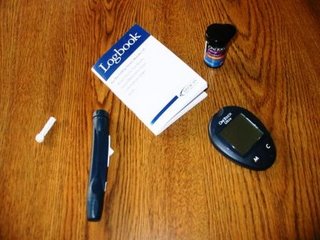
Today, I finally got back on schedule of testing my blood sugar. A couple years ago, on my annual visit to my family doctor, she said--hmmmm, your blood test results show that your sugar levels are a little high. I thought, of course, I am always sweet. Oh, not that?

Anyway, what followed was testing six months apart to see how high the sugar level in my blood really was. Testing not only after eating but also after fasting.

When the levels came back three times in a row at over 100, she said--time to do some preventive medicine. It seems that
type II diabetes (formerly old-age onset--thank God they changed the term!) was once determined when a person had repeated blood sugar values of over 120. But, medicine marching along as it does, the determination now is made to begin to W-A-T-C-H things and take interventive action when the level is repeatedly over 100. That way, maybe, just maybe you can head off the eventuality of type II diabetes.

With this determination, my life as a free-range eating whatever I wanted human came to an end. The consequences of my not changing habits is that. . .well, isn't it obvious? I could come to an end, prematurely.

On my doctor's orders, off I trundled to a local hospital with a diabetes education clinic. I learned from a diabetes nurse how to test my blood (just a little finger prick with a fancy do-dad machine and a strip to suck up my blood and then display the magic number).


I learned from a dietician what foods are and are not high in carbohydrates. Oh, there's the problem: carbs. So, now I am on a low-carb diet and have become an exceedingly boring person. I can spout off the carb value of almost any food you can name. And I can tell you how much of that food to eat, before you bankrupt the carb level. The goal is for me to eat no more than 30 grams of carbs at a meal, and 15 grams at a mid-morning and mid-afternoon snack. Hey, I am liking this idea--snacks? I never used to get those. But, wait. 30 grams--do you know how little that is?

First thing to go, almost any kind of starch. One half cup of mashed potatoes? There's your 30 grams. Now, I challenge you--can you eat ONE HALF cup and then quit? I mean, your clenched fist is a decent way to judge ONE CUP. So, half a fist of mashed potatoes. OK. How about rice? Nope--40 grams of carbs in a cup. And on it goes--almost any form of starch--potatoes, rice, pasta (whimper), bread--all too high in carbs. So portions must be small.
And forget muffins and bagels. Bagels? Really high.

So what can I eat? Well, proteins in all forms. Meats, cheeses, even beans because they are high in fiber. Fiber is good; carbs are bad. I have become a food mathematician--take the carb value of a portion of food, subtract the fiber grams and you have roughly (no pun intended) the overall carb value.

Beer? Nope.

Milk? Skimmed milk? Well, no. Counter-intuitively. I discovered that skimmed milk is HIGHER in carbs than 1% or 2% milk. Oh, hurrah. I can justify my penchant for higher fat content milk.

Fruits? Well, many of them reek of sugar. Juices, especially.

Vegetables? There you go. You can eat all you want. Oh, right, who wants all the vegetables they can eat?

But diabetes is a nasty disease, and its effects got my attention. Sugar molecules that are not broken down by insulin (that's the missing ingredient in a diabetic's system) go floating around in your blood. And since they are bigger than most other molecules floating in your blood, they tend to get down into the smallest parts of your circulatory system--those itty bitty
capillaries--and get stuck. That's what does the harm--cell necrosis, which results in limb loss, blindness, heart attack--OK, OK. You got my attention. I will watch my carbs. And test my blood. Good results today--102 before eating. I will test in two hours after eating, and hope that the level is below 100, after my body kicks in a little insulin and brings the sugar level down.

Of course, now the problem is my cholesterol level!