Monday, September 25, 2006

Traveling Mercies

A fair bit of my life has been spent traveling. No doubt, that is either predictable (considering my parents were missionaries in Africa) or unavoidable (reference prior parenthetic comment).

Sometimes I enjoy traveling and sometimes dread it. I have been reflecting of late on several times when traveling was a somewhat terrifying experience.

When our son was born in January, I was teaching at a local college at the time. I had arranged to take off one month following his birth, and then planned to return to full time work to finish out the semester. So for one month, I was away from campus and had not picked up my mail. (Understand, this is in the days before email!) Not long before I was scheduled to return to work, my husband said “Let’s go over to the campus and get your mail.” A seemingly innocuous suggestion. BUT—(buts are always followed by music—dunh, dunh DUNH!) but it had snowed the night before. So now the roads between our house and campus were completely snowed covered, and in fact barely passable.

Anyway, I agreed. So we bundled up our son, put him in the back seat of the car in an infant bed (again, in the days before infant carriers) and off we went. Just as we approached the first intersection on the interstate route we were traveling, I had this flash—WE ARE ALL GOING TO BE KILLED! For the rest of the half hour journey, I was terrified. I should have relaxed; my husband is an excellent snow driver, having “practiced” doing donuts as a kid in the parking lot of his school. Suffice it to say, we all survived. And that trip, though vivid in memory, is now some 34 years ago.

Flash backward some eight years. When my parents returned to Africa for their final term as missionaries, I stayed behind to finish high school and begin college. We were apart for five years, so understandably I eagerly anticipated their return home. Just about the time they were due back, I was called into the office of the president of the college I was attending. He informed me that an unknown benefactor had paid for me to fly to London to meet my parents so we could be reunited more privately. That is the subject of this flashback.

I distinctly recall that journey. First, I took the train from Harrisburg to New York City. I had made plans to meet some local church workers there (who knew my parents) and they would transport me to JFK. Well, we were
meeting in Grand Central Station (I think) and somehow I waited at one kiosk while they waited at another. We never did link up. So I made a mad dash outside, corralled a taxi and in a panic asked him to drive me to JFK. He turned out to be a kindly (and VERY chatty) driver. By the time I got to the airport I had calmed down—some. Now for the flight. I was flying on then BOAC, at night. I recall looking out the plane window as we flew along, and it was full moon. The moon seemed to be right next to the plane. I kept thinking—if I die now, I will never see my parents again. Then, we landed, and my parents, siblings, and I were reunited. We spent several days in London, then flew to Amsterdam for a bit more sight-seeing. On that flight, I thought—now I have seen my parents, so whatever happens makes no difference.

So, why the reverie on traveling? Perhaps, because I am mid-process planning another trip. This time to Ghana. I am mostly through with all the
immunizations that are required, or suggested. I am booking a plane ticket, and making all the other plans that need to be in place. And this time, I will be visiting my daughter. I have no trepidation about this upcoming trip, although the list of required and recommended immunizations is intimidating.

It is no wonder that many writers have used the metaphor of a journey to describe a character’s moving through life transitions. My trips have not really marked passages from one stage of life to another, but I recall each and use them almost like a jeweler’s loupe to view closely a facet of my life.

Thursday, September 21, 2006

There's a Nip in the Air

I love autumn!

So these last few mornings, when I get up and feel the nippy air, I am exhilirated. While I do love all the changing seasons, autumn has always been my favorite time of year.

I recall one time during a discussion, someone asked what time of day I liked best, and what time of year. Well, the time of day I love is sunset; and the time of year autumn. That response prompted the questionner to raise an eyebrow and ask: why do you like the two times that are symbolic of things drawing to a close? Short answer--I don't know.

Maybe it has something to do with good things happening in autumn: my daughter was born in October!

Maybe it has something to do with color. I love autumnal shades: vermillions, deep purples, yellows--all the colors.

Maybe it has something to do with football--a game I do love to watch, especially if it is
Penn State football. For more almost 30 years, my husband and I have gone to many of Penn State's home games. The drive to State College is wondrous, (if you can ignore the awful traffic jams) particularly when the trees that cover Pennsylvania's rolling hills begin to turn color.

Maybe it has something to do with the crispness in the air. As I walk, I sometimes catch a drift of a wood burning fire, somewhere. That smell alone transports me to childhood days where the air frequently hung heavy with wood burning. (Scientists have demonstrated that the sense of smell is the most evocative sense we have--it can trigger memories like no other sense! Check out
this site for info.)

Well, back to autumn. One poem captures the aspects of autumn that resonate with me--a sense that time is fleeting, but, oh so sweet in the present. Shakespeare (you knew it was coming, didn't you?) wrote Sonnet 73 which I have included as the fitting conclusion to this reverie on autumn.

SONNET 73
That time of year thou mayst in me behold
When yellow leaves, or none, or few, do hang
Upon those boughs which shake against the cold,
Bare ruin'd choirs, where late the sweet birds sang.
In me thou seest the twilight of such day
As after sunset fadeth in the west,
Which by and by black night doth take away,
Death's second self, that seals up all in rest.
In me thou see'st the glowing of such fire
That on the ashes of his youth doth lie,
As the death-bed whereon it must expire
Consumed with that which it was nourish'd by.
This thou perceivest, which makes thy love more strong,
To love that well which thou must leave ere long.

Friday, September 08, 2006

Ahh--aging!

When my daughter was a little girl, I took her with me to the nursing home where my grandmother lived. While we usually visited my grandmother in her room, on this particular day she wasn't there, so we went looking for her. As we walked around the halls of the nursing home, we encountered one old woman who, while seated in a wheelchair, pulled herself along with her foot. You read correctly--foot. She had apparently had one leg amputated at some point, so her remaining leg and foot was all she had to propel herself.

As she pulled herself along, she kept repeating in a most plaintive voice: "Help! I've lost myself." Repeating this plea over and over again. We hurried on by her, still looking for my grandmother. Just as we got out of her earshot, my 4 year old daughter whispered loudly to me--"Do you think she lost her leg, too?"

At the time, it was wonderfully funny. But some twenty years later, I think about those folks that I encountered when I went to visit my grandmother. And, I also do much thinking about my own aging.

I am of two minds: in one mind, I am quite proud of being in relatively good health and physical shape (for, as they say, a woman of my age); in the other mind, I resent every creak I feel. I also find myself noting the ages of people I know who have died (or even the ages of those listed in the local obituaries). Then, I instantly do the math--that person was 72; well, that's 11 more years than I; or that one was 50, ha! I've got that beat.

There is a story that
Ingrid Bergman was asked, on the occasion of her birthday, how she felt now that she had reached the advanced age of 60. She reportedly responded: "I like it just fine, considering the alternative." Perhaps the story is apocryphal, but I like it. It captures exactly my feelings. While I can wish that aging weren't accompanied by aches and pains, or by some of the alarming physical changes one experiences, I still like it just fine considering the alternative.

Wednesday, August 30, 2006

Sibling Stories II

I can’t write only about my brother. I have a sister, twelve years my junior. And I have stories about her, too, although they have a difference cast than the ones about my brother. Since my sister is more than a decade younger than I, and since I stayed in the United States when my parents, along with my brother and sister, returned to Zimbabwe, distance separated us. Subsequently, many of my stories have that quality—sweet stories that are made more poignant by the distance that separated us.

My sister’s arrival is the first specific instance I have of having my prayers answered. I don’t remember exactly why, but I became obsessed, at age twelve, with having a sister. As I alluded to in a previous post, I had a sister, three years my junior, who died. Since I had a living breathing brother, I guess I must have thought I needed a sister to complete my sibling portfolio. Anyway, I began praying. Fervently. Please, Lord, give me a sister. Imagine my absolute delight when my parents picked me up from boarding school at the end of term, and my brother blurted out—“Guess what, Mommy’s going to have a baby!” As I recall, he got punished for that premature announcement. I suppose my parents wanted to tell me. Of course, I was absolutely convinced that prayers are answered.

While my mother was pregnant, I developed
rheumatic fever. Because I required intensive nursing care, and because my mother did not have the energy to provide it, I temporarily moved in with one of the missionary women who was a trained nurse. (She remains one of my hero role models—a strong independent single woman who, in my child’s eyes, could do everything!) In due course, my mother went to the nearest town, Bulawayo, to have the baby. When she returned home, to the mission station, she brought along my sister—a wizened, wrinkled, red-faced baby. I was crushed. This is what I prayed for? Really!

Well, it didn’t take long for her to turn into a very cute toddler. When she was three, and I was fifteen, my parents returned home (that is, the United States) and when they left to go back to Africa, I stayed behind. Thus began my long distance relationship with my sister.

My parents would periodically make tape recordings that they sent to me, to keep us in touch. My brother would dutifully and breathlessly report on the goings-on at school. When it came time for my sister to contribute, Mother would prompt: “Say hello to Donna.” My sister Denise would balk. NO! Then she would query in this small tremulous voice—is Donna inside that machine? My mother, with clear amusement in her voice, would say—no, but if you talk, she will hear you. PAUSE. NO, Denise would say. And so the conversation went, back and forth. Mother cajoling, Denise resisting. She never did say anything directly to me. Of course, the whole conversation was caught on tape.

I heard stories about my sister, of course without witnessing them. She was, as they say, “a pistol.” She crawled out of her bedroom window, while she was supposed to be napping. When my father caught her, and brought her back to the bedroom, he cautioned her. If she did it again, he would punish her. Well, of course, she did it again. And when Daddy retrieved (from across the busy street they lived on, no less), he began to spank her. NOTHING. No crying, nothing. When he investigated, he found she had prepared herself for the inevitable punishment by putting on multiple pairs of training pants, thereby padding her bottom.

When my parents returned home, and we all lived together again, I was twenty, Denise eight. The house we lived in had three bedrooms. So, Denise and I shared a room and a double bed. I was not prepared for a kicking restless pre-teen sister thrashing around the bed. I complained to Mother, but the sleeping arrangements were unchanged.

Now we are older (much!). And the age distance between us seems insignificant. As for the geographic distance, half a continent, we can overcome that through email!

Thursday, August 24, 2006

Mowing

I mowed today. After weeks with no rain—I mean NO rain—the grass is downright crunchy. However, there are pesky weeds that insist on rising above the downtrodden grass. So I mowed.

It was difficult to see the stripes of the mowing pattern marking where I had already been. And given the lack of growth, shorn grass was no help. That got me to thinking—there’s almost a metaphor of life in that. Without growth, finding the track of where we have been is difficult.

What can I say. . .mowing is an inherently boring task, so thinking helps pass the time. That’s not to say that I resent mowing—I really don’t. There’s a sense of accomplishment that comes anytime I throw myself into a manual task. Plus I reap the benefit of the physical exercise (and then can skip my personal pledge to do a half hour of exercise each day).

A month ago, I wrote a poem about mowing, inspired by another trek back and forth across the yard. Herewith:


Mowing

Heading out to mow
I trace the pattern
Of my long worn habits
Criss crossing then diagonal
Varying nary an inch
Concentric circles round the trees
Reveal faint tracks from former tire treads
Always around—sometimes clockwise
Sometimes counter
Someday I should reverse the pattern
Back to front then side to side
Mercy!—would the task get done
Or would the newness distract
And divert me into new paths?

By Donna F. W.
© July 2006

Monday, August 21, 2006

Surviving Unintended Retirement

In the fall of 2001, I began a personal journey that I call “Surviving Unintended Retirement.”
Along with many people around the world, I know exactly what I was doing when I first learned that two planes had flown into the
World Trade Center. I had just left an internal meeting in the health insurance company where I worked at the time. I visited the small gift shop in my workplace, and heard the radio talking about this catastrophe. I rushed back to my office, and began obsessively checking CNN for updated stories on the unfolding events.

OK—how does anything to do with this event in the world’s history relate to my retiring. While there was no direct cause and effect, because of contiguous timing I link the attack on the World Trade Center with my unintended retirement. The next month, October, my boss called me into his office to review my annual performance evaluation. Having gone through this ritual many times, I expected little difficulty. He began by complimenting me on my work over that past year, indicating no problems. But, all that, he said, is moot as your job has been eliminated. To say I was stunned is to understate my reaction.

Thereby was launched my unintended retirement. At first, technically, I was unemployed, seeking future employment. But the truth was retirement was two years away in my personal planning anyway. So I call it unintended retirement. The suddenness of being launched into retirement meant I began retirement without all my plans in place.

The transition was not easy. Through that first year, I had to figure out how to survive unintended retirement. I have come up with several guidelines.

First, don’t rush. The boon of not having to go to work gave me time to do those myriad projects I had squirreled away in my mind, for some future time. The temptation of having so much personal time was to try to do everything the first week. I quickly realized that I needed to pace myself. I have recorded all the projects I want to do, and select one or two a week to work on.

Second, keep in touch. I decided to try to arrange one or two lunches a month with friends and former colleagues. What a treat to be able to go out to lunch, catch up on work gossip, and then when lunch is over, go back to my leisure as my friends go back to WORK!

Third, look to the future. My first ever full time job upon college graduation was teaching college. I love teaching, and had often wondered if I would ever get back to it. In November, two months after learning my job was being eliminated, I responded to an ad for adjunct professors at the local community college. I spruced up my resume, emphasizing my teaching background and educational connections, and presented it to the dean. Without any fanfare, he said, “Oh, yes, you’re qualified.” Then within several weeks, I got a call and my retirement career began.

I teach writing at
HACC, anywhere from one to three courses any given semester. Now, my unintended retirement is becoming so busy that I constantly wonder—is it time to retire, again?

Tuesday, August 15, 2006

The Power of Stories

Sometimes stories stay with us for a long time, and with their magical power weave a spell over our psyches.

As a child of missionaries, I remember being transfixed with
the story of Jim Elliott, and the other men with him, who died in the Amazon jungle. I don’t recall the precise year—probably late 1950s. For reasons completely unfathomable to me, I suddenly began thinking of him several months ago. (As I write this, I realize a possible reason—these events occurred in January, 1956, 50 years ago.)

Truth is, I couldn’t recall his name. But with the Internet, ferreting out such information takes just a few clicks of the mouse combined with a little savvy intuition.


It did not take me long to find several sites that recounted the story. The bare bones details—eager young college student burning with zeal—at Wheaton, no less—exhibits early some of the leadership qualities he will display later in his life. He meets and marries a young woman named Elisabeth and soon they are off to the Amazon jungle to carry God’s word to those indigenous people who have not experienced civilization much less hear God’s word.

Jim and Elisabeth team up with several other couples, young husbands and wives equally eager for the spreading of the gospel. They have, among their number, at least one experienced pilot. So for a few weeks after they reach Ecuador, they fly up and down a portion of the Amazon River. They have selected the particular target tribe precisely because that tribe had so little contact with the outside world.

The missionaries are powerfully motivated by the ringing words of Christ’s so-named Great Commission—“Go into all the world.” Well, this is certainly part of “all the world.”

It is equally clear they are mindful of the incredible danger involved in forcing contact with native tribes untouched by outside forces. So Jim puts a pistol handgun in his pocket. The plan is—if anything begins to go wrong, he can fire over the heads of the natives and scare them.

Having spent a couple weeks buzzing the natives and dropping gifts from on high, the men—for that is who is going to make the first contact—decide it is time for a face-to-face meeting. No more
deus ex machine.

They land, and soon a few native men emerge from the jungle. It seems there may have been some initial pleasantries exchanged. But then, suddenly and without warning, arrows and spears fly. One after another the five missionary men die.

And never a shot is fired. The pistol stays dormant in Jim’s pocket. By the time I read this detail from the laudatory Internet account, revelation hits me full force. He wanted to die! Why else fail to carry out the pre-planned warning shot?

This belief of mine is like a thunderbolt. When I first heard this story, as a child living in Africa with my missionary parents, I thrilled to the details, even as I was horrified at the possibilities. Of course, I romanticized the story. Might I lose my parents to belligerent natives?

I have a mind’s eye picture of the photographs that appeared in a contemporaneous Life magazine—the smiling men alive, the small insignificant plane, the placid imperious Amazon, the bodies strewn along the banks or floating in the river.

For weeks, I fixated on the story, struck by the unnecessary tragedy of it all. I mouthed the names of the men. I noted the coincidence of family details—that Jim and Elisabeth’s baby girl was born in the mid-1950s, making her close to my sister’s age. I grieved as though these were lost family members.

So resurrecting the story recently renewed my old fascinations. And then I came upon that one unrevealed detail—Jim Elliott had a pistol in his pocket that he never fired.

Perhaps he was right to want to die. I doubt that he really sought to leave this life—to leave behind Elisabeth and their daughter. But, deep down, he may have sensed the consequences of his death. When the wives waiting back at camp did not hear the planned-for radio contact, they knew something was wrong. They tried to no avail to raise the men. Then a search party headed out, and soon the grim scene was discovered. All dead—all young men gone. Eventually, after the bodies had been retrieved, other missionaries did contact the natives. They even determined who had shot the fatal arrows—and redoubled their conversion efforts and succeeded.

While a student at Wheaton, Jim Elliott had written: “He is no fool who gives what he cannot keep to gain that which he cannot lose.” Could it be that is why he wanted to die?

As I said at the outset, stories stay with us a long time. This particular one has held me in its thrall since I was a child and even today I am both attracted to and repelled by the details.

Monday, August 14, 2006

Sibling Stories

I am blessed to have two siblings—a brother and a sister. And, in my view, I am blessed to be the eldest, which means I have accumulated “the stories” of the doings of these siblings. I thought about holding this post until May or June (when, respectively, my brother’s and sister’s birthdays are) but that is WAY too long considering the urge I have to recount a few stories.

Let’s concentrate on brother stories. My brother, Daryl, is five years my junior. (It should be noted that between us was a sister, Dorothy, who died at age 7 months as the result of malaria fever. I think most kindly of Bill Gates and
his efforts to eradicate malaria. Also, of marvelous researchers like Dr. Phil Thuma who is working in Zambia toward that same end.)

Perhaps like any older sib, I somewhat resented my brother’s arrival in this world. I tend to think that it had much to do with the manner of his arrival. My parents were missionaries in
Zambia (then called Northern Rhodesia) at the time, and since the mission station (Sikalongo) was some distance from the nearest hospital, at Victoria Falls, my mother and another missionary woman, went to Vic Falls some days in advance of the expected birth date. Of course, I was along “for the ride.” When my mother went into labor, it was sometime during the night, so the other missionary woman and Mother bundled into the mission truck, with me, and drove off to the hospital. Both women went in to check my mother in, leaving me, sleeping, in the truck. You guessed it. . .while they were gone, I awoke and freaked. At least, that’s what my memory tells me. Then, when presented with a brother as a reason for my having been abandoned, I wasn’t quite mollified.

Fast forward three years, and picture my brother, now a toddling three year old, on the mission station. One day, I was sent off to find him, which I did. He was squatting under the mission bell, a large bell elevated on a tower. There was Daryl hunkered down, with a small stick which he was poking at a baby snake. Daryl urged the snake on saying “Go, snaky, go!” Rule of thumb, all snakes should be considered poisonous until otherwise determined.

Fast forward a few more years, and we are now living in Zimbabwe (then called Southern Rhodesia). I am attending Eveline High School, an all girls' school in Bulawayo. Daryl is a new boarder attending Hillside Elementary School, on the other side of town. Sundays was free time for us high schoolers, so I rode the bus across town to get to Daryl’s school in time for visiting hours. We played together, for however long the visiting time lasted, and then I would have to leave to get the bus back to my school. Daryl was always loathe to part, so he would take a ball we had been playing with, and chuck it some distance, and then say plaintively (yes, that’s how I recall it)—“Fetch the ball, Donna; fetch the ball!”

My goodness, the world of blogging enables one to recall for all the world (or at the least few readers of a blog) the quaint stories of one’s brother. But, just in case you missed it, I do love him! Next time on siblings stories—my sister.

Thursday, August 10, 2006

In Praise of Writing

One of the things I like to do best is organize. I just love to start cleaning out closets, drawers, shelves, whatever, wherever "stuff" is stored. This has been a week for cleaning out. Today it was the kitchen, but yesterday it was the study closet.

I have accumulated several generations of purses and decided it was time to
freecycle a half of dozen. So, prudent person that I am, I first went through each purse looking in all the nooks and crannies for left-over whatevers. Mostly cough drops or emery boards. But, in one purse--EUREKA--I found my Cross fountain pen that I had not been able to locate for years--I mean literally years.

Now, I love writing with a fountain pen. Oh, sure, I get blue ink all over my fingers. My pens, regardless of brand, never fail to leak on me. I take it as a sign of reciprocated love. There is something about holding a fountain pen, and writing with it. No other writing instrument adapts so thoroughly to the writer holding it. If you own a fountain pen, you know that you alone are the writer who can write with that pen.

Have you ever tried writing with someone else's fountain pen? If she has owned it for a while, you will find you cannot write well with that pen. The angle of writing, the pressure applied to the nib, all combine to shape the nib in such a way that the owner is the one who can coax the fountain pen to write.
All of which leads me to write in praise of writing. Not just the act of writing, not just capturing one's thoughts with writing, but the actual method of writing--thank goodness for fountain pens. Especially found ones!
------
P.S. note the link on "stuff"--George Carlin does an absolutely brilliant routine on stuff--how we tend to collect stuff; how we can't live without our stuff; and how we have this pathological need to take our stuff with us. Of course, fountain pens do NOT fit into the category of stuff.

Thursday, August 03, 2006

Academic Freedom

The recent case of Kevin Barrett, an adjunct faculty at U. of Wisconsin/Madison raises some challenging questions about academic freedom. Apparently, Barrett, who lectures on a part time basis on the subject of Islam, has given talks (outside the classroom) in which he sets forth his theories that two airplanes crashing into the World Trade Center, and the resultant fires, could not have caused the buildings to collapse. He believes that actually controlled explosions did the fatal damage. Further, he holds that the Pentagon was not hit by a plane, since it is one of best protected buildings in the country in terms.
OK--so his views aside, predictably, pundits and politicians are now falling all over themselves calling for him to be relieved of his teaching a course on Islam. So much for academic freedom.
Whether the events of 9/11 were in fact
"an inside job," as Kevin Barrett claims, or whether the events are as the 9/11 Commission found, one thing is certain. If we bridle people who express their views, we have already become a totalitarian state and whether we win the "war on terror" or not, we have lost what it means to be a free nation.

Monday, July 31, 2006

Recreations of a Past

From time to time, I write poetry. Whether or not I write well is immaterial to me--I write poetry because I like the economy of form that poetry requires. A poet must select words just so--choosing the most evocative word to describe the subject.
I wrote the poem that follows in 1981 as an attempt to understand my childhood.
-------
Recreations of a past

Always when in my eye
I see Africa
I see greygreentan
Khaki tinged
Garnished with a
Splash of brilliant red
A fireball rainborn from cracked ground?
A bleeding sunset?
Or Zulu life
Slow seeping out for white supremacy?

The fringings of that recollected picture
Strobe flashes of landscape
Africa—seen through jeep window—
Trees that some god
With artistic hand drew
In quick horizontal strokes
Glimpses of kudu
And delicate duiker leaping
(As my heart now in remembrance)

i

They say
“So, you grew up in Africa
What was it like?”
As though in one word
The whole essence of
A place is caught

ii

Why did they go?
Those straight backed missionaries
With dark flowing clothes
Pith helmets, Bibles, soap & monogamy
(To cement my heritage—
Third generation in an alien land?)

iii

The caught time is Zambia
In the afternoon
Stretched eternally over that sky—
Unworldly blue with flicked
White clouds—
Same sky reaching down into the hills
Which fall away from the mission station
A manufactured point of civilization
Whitewashed and dropped
Into that infinitude.

iv

(Why did I not learn
That Tonga lesson
Exorcizing the demons
But I—I cannot
Rid my soul of the demon
Of Africa)
What happened in eight short years
To rivet me?

v

This past is mine
Going back I touch,
Make links with things I cannot see

How did is feel
Standing by the grave of the sister you never saw
Born and died
Before you were conceived
How did it look
That strange small clump of African earth
Heaped over her bones
In sweet repose
Dead fingers still clutching
One moldy rose
What communion with your past
Transpires when you honor
Her whom you never knew?

vi

And it was the rich rain
Which destroyed the beauty of
The parched earth
Ah—the rainy season
We said
As we sat on our veranda
Bouganvillia-fringed
And watched
The torrents draw
Needle curtains across the sky
(How could they know—
Those missionaries—
The delicate balance
Of parched earth and rain?
One more drop drowns)

vii

I smooth the dark auburn earth
With my child hand
Clearing it for my imprint.
But no sketching follows
Only filigreed tracings of a past
All woven up with the solemn
Morbidity of self-introspection.

viii

It does no good to wonder
Or listen—earcupped—for the rumblings
Of the gods bouncing around granite hills
Like the howling of baboons
Uttering the oracular deliverance of truth.
Here
There is only the rush of a curved question
Marking the edge of the world.

By Donna F. W.
© 1981

Sunday, July 23, 2006

Iberian Adventures come to an end


DAY 11--4 July 2006 Tues

Today we drive to Granada—quite a different trip from our prior visit there (by train). As we approached Granada, I kept looking for something familiar, but to no avail.

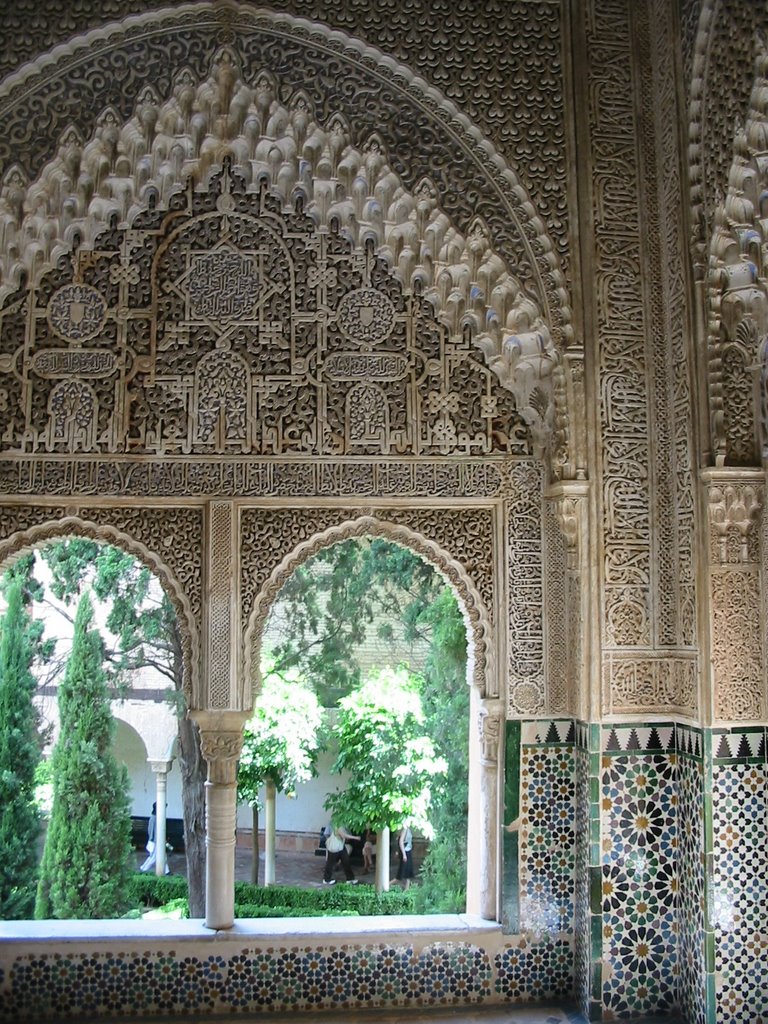
We went straight to the
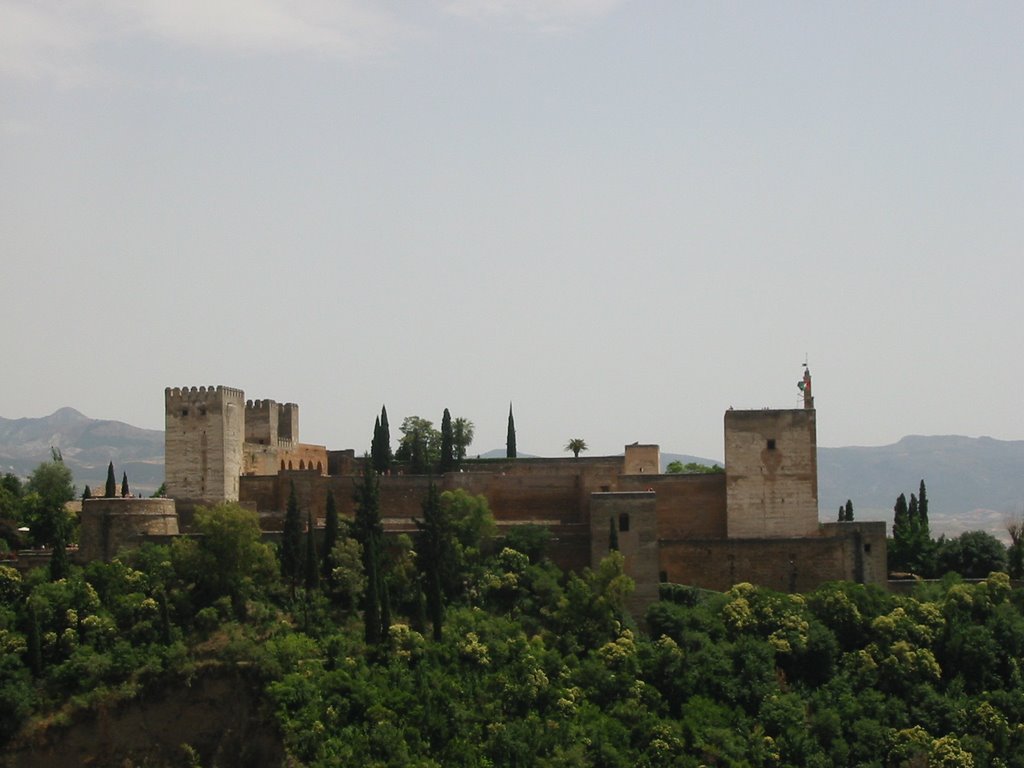
Alhambra for our guided tour. I was glad we had been there before because we saw far less than our prior visit there. We toured the old palace, and the Generalife, but did not go up in the towers in the Alcazar at all.

After the Alhambra visit, we went directly to our hotel and checked in, then out to get some lunch.
At 3 p.m. (the temp outside was the hottest day we had—37 o C) we went to the Albaicin for a walking tour—
much the same as we had 3 yrs ago only then it was at night and in winter.
Next we toured the Carthusian Monks Monastery—an example of Spanish baroque. Sadly no photos allowed inside—there was stunning variegated red marble and lots of gold. Stunning carved ornate altars.

Last we went to the cathedral where los Reyes Catolicas are buried. We walked back to the hotel afterwards through the twisting alleys with little shops. A bit of disorienting, but we found our way back.

After a so-so dinner in the hotel, we watched World Cup semi-final (Italy vs. Germany—Italy won).
--------------------------------------------

DAY 12--5 July 2006 Wed

Our last day of vacation—we left Granada to return to Madrid by way of a stop in Toledo.
Our first stop was for lunch in a small village in La Mancha with a small farmhouse converted into a restaurant. We had pepper stew!

Then to Toledo driving past some of the millions of olive trees in Spain. We stopped first at the Damascene Steel works where we bought some gifts for home. In Toledo we went on a walking tour where we saw: first, Toledo Cathedral, a fine example of Gothic architecture—88 interior columns, 4 rose windows, 20 + cardinals buried there (their red hats are hanging over the burial spots), and 3 organs.

Second, the church of St. Thomas which has an el Greco painting: the
Burial of Count Orgaz. Again no photos. A quick stop to be told that along with the Mona Lisa and the Last Supper, this is the best painting in the world! I can just hear Kristen now.

Third, after a walk through the old Jewish quarter (Toledo had a large Jewish population during the Middle Ages) to see the older synagogue in Toledo, which is now a church.


Fourth, as we left Toledo we crossed a 900 yr. old bridge—the Tagus River surround ¾ of Toledo and walls guard the remaining ¼.


Back in Madrid, we had our farewell dinner in a restaurant in a cave. Carlin had lamb, and I had suckling pig. Excellent meal complete with musicians—supposed university students. Our group is exceptionally bonded, so as we drove for one last sight of Madrid at night, we said goodbyes. Back at the hotel, more farewells and goodbyes hugs.

Tomorrow—HOME!

Saturday, July 22, 2006

Iberian Adventures Part IV

DAY 9--2 July 2006 Sun
Images of Morocco:
*People walking everywhere
*Herds of animals—sheep, goats, cows—always with a herder
*Casbah—fortified part of town
*Medina—part of town not fortified
*Morocco—population predominantly Berber
*Doctor monthly salary: $900/ teacher $450
*Tangier at one time was an international city

Our morning began with a brief bus tour of
Tangier. For many years, the city was an international zone run by 9 foreign governors + 1 Jewish and 1 Muslim. Morocco gained independence in 1955.

We then took a walking tour of the Casbah—as soon as we entered the walled area, we were besieged by vendors, peddlers & hawkers of various wares—jewelry, clothing, leather goods, carvings. The streets were incredibly narrow, winding around (sense a theme here?) going off in all sorts of angles, up stairs, down stairs, but mostly narrow. We were heading to a government regulated bazaar—but the vendors stayed with us. Finally, one who had been trailing me trying to sell 5 copper bracelets for 20 €—I kept saying no; then he said 15 €, I said 5; he said 10; I held at 5 and started to walk away. So he quickly said—OK 5 for 5 AND my Pilot gel pen. SOLD.

Inside the carpet bazaar, we were first given a demonstration showing levels of quality, how carpets are tied, etc. Good carpets can be shown on both sides. With each new level, a man came out carrying a carpet that he unrolled in front of us. After the demonstration, suddenly a whole group of men appeared, seemingly from nowhere to herd each of us around trying to make sales. There were carpets, brass ware, ceramics, clothing—two women in our tour group had asked Carlin to help them bargain: one had picked a blouse, the other two caftans. As it turned out they did their own bargaining without help (except, I suppose, the moral support).


As soon as we left—once again, the street vendors swarmed. One picked out Carlin, offering a djellaba. Carlin kept saying no, and when we went into an herbalist shop, the street vendors left. The herbalist showed us all sorts of homeopathic items—sort of bizarre—very showman in his presentation. There was a cream or a powder for every ailment: acne, snoring, weight reduction, and asthma. The minute we left the shop, the same street vendor appeared to continue his sale to Carlin. Just when we were ready to leave the casbah and get on the bus, he suddenly agreed to a price, about $20.


Leaving Tangier, we drove slowing past all the new hotels, then drove back to the ferry connection to go to Terifa—back through customs. The bus then began our drive to Torremolinos on the Costa del Sol. We first passed the Rock of Gibraltar where we made a photo stop.


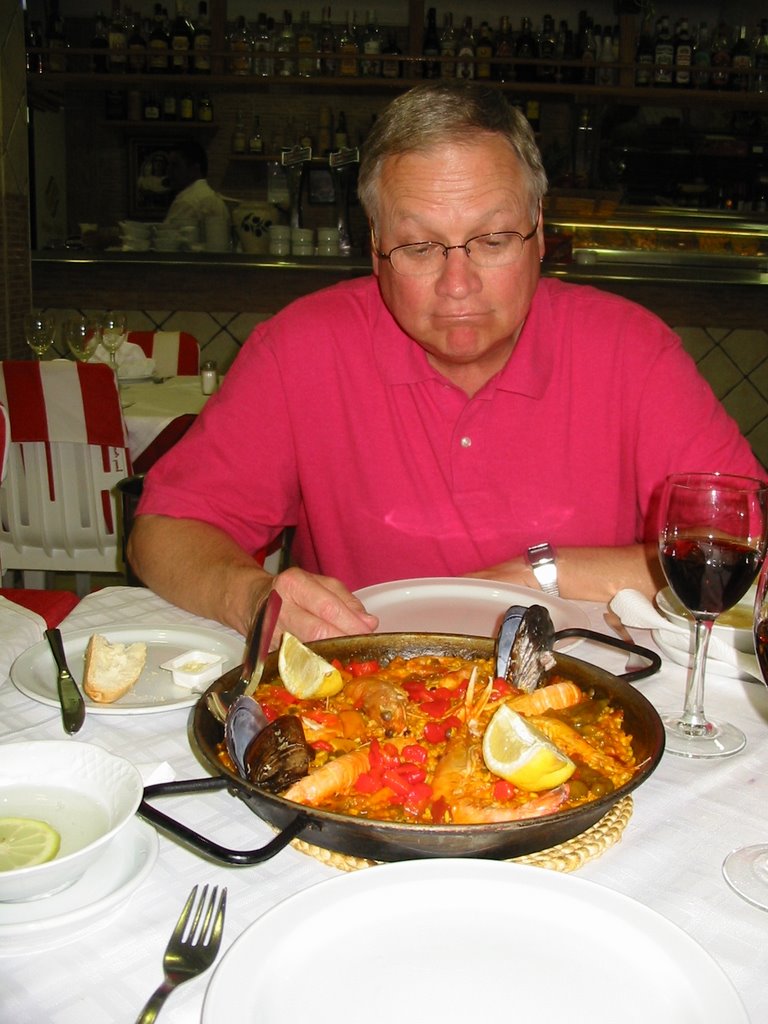
The drive to Torremolinos was a 2 ½ drive, all along the Mediterranean coast. The amount of construction is unbelievable—an explosion of growth. Once at the hotel, we had supper on our own for the evening, so we linked up with a couple from NYC (Lee & Barbara) and two teachers from California (Lucille & Kim). We walked along the beach until we picked out a restaurant. Carlin and I got paella and red wine. A Spanish treat!

----------------------------------------------------------

DAY 10--3 July 2006 Mon
We had today at leisure, so we slept until we awoke (i.e. no alarm)—after breakfast, we went walking through a shopping area: part NJ shore and part class jewelry stores. I got a white cotton skirt, and we also got various items for gifts.
We stopped for beer, and people watching. We also went looking for a local bank to break a 500 € note.


Once back in hotel, around 2:30 (all the stores closed at 2 for siesta) we relaxed, had a bottle of green wine, and got ready for dinner.


Our tour group went first to Mijas—a charming mountainside village with white washed houses and donkey carts and a spectacular view of the Mediterranean.
Then we drove to Carihuela, a former fishing village, for dinner. We had various fish dishes—clams, sardines, grouper, and calamari as appetizers; then sea bass baked in rock salt.


Carihuela is right next to Torremolinos, so we walked back to the hotel—a 10 minute walk, while the bus took about 20 minutes, since it couldn’t go straight down the beach. I did a quick detour to dip my toes in the Mediterranean.

Friday, July 21, 2006

Iberian Adventures Part III

DAY 6--29 June 2006 Thurs
For today’s journey to Seville, we took a newly opened super highway that reduced the time of the trip, so we were able to do the city tour of Seville upon arrival.
The result was an uneventful drive through unappealing countryside. We did see many oak cork trees—they harvest cork by removing the outer layer from the bottom of the tree every 9 years.
We crossed back into Spain just after our lunch. Now in Andalusia. We saw many olive trees—our guide says there are 260 million olive trees in Spain!
We arrived in Seville about 3:30 and began city tour immediately. We went first to cathedral—said to be 3rd largest in Europe after St. Peter’s in Rome & St. Paul’s in London. Where the cathedral stands was once the site of a mosque—so the bell tower replaced a minaret. In the church, the altar is a huge gold one. The cathedral houses the tomb of Christopher Columbus. There are also several paintings there by the Spanish artist Murillo, who was born in Seville.
We then went to the old Jewish quarter with tiny winding streets and shops & restaurants.
From there we went to the Parque Maria Luisa which has buildings from a World Exhibition held in Seville in 1929. The primary building there is at the Plaza de España, which was Spain’s building.
On the drive back to the hotel, we passed the university , with one building which had been a factory, the setting for the fictional story of Carmen.

------------------------------------------------------
DAY 7--30 June 2006 Fri
All day in Seville—a group of us had signed up for a trip to Carmona, a nearby town with extensive Roman ruins.
The first stop was at a necropolis where had been excavated. In the distance, we could also see an amphitheater outline, apparently not yet excavated. The necropolis was quite open for us to walk around. Two large chambers—the Elephant Grave (so called from a figure of an elephant that had been unearthed) and the Servilia tomb complete with a small temple. The remains of those who died would be cremated then the ashes buried in small niches.
We drove to the Parador, a government built and run hotel (these are all over Spain, existing in old castles, etc. to preserve the buildings). It blends in with the overall architecture of the fortress at Carmona. The bus had a time driving through the narrow winding streets. We went into the Parador, had a refreshing drink, and did a bit of shopping at a very nice little gift shop. We then went back to the town, and continued a walk around, past unique doors, hallways tiled covered, narrow streets with awnings drawn across for shade. We ended at the fortress at the far end of town where we climbed the Torre de Oro.
Once back in Seville, we had tapas for lunch, shopped at El Cortes de Ingles, then returned to our hotel to watch a bit of world cup soccer (Germany vs. Argentina). Our evening entertainment was flamenco dancing and dinner. Watched more world cup (Italy vs. Ukraine).

------------------------------------------------------
DAY 8--
1 July 2006 Sat
Today we go to Morocco—we need to catch a fast ferry across the Straits of Gibraltar at 2 p.m. We arrived at Algeciras with time to buy lunch. As it is the beginning of July, and Moroccans head home from jobs in Europe, we expected many other travelers. The ferry was full, with many family groups. With birth rates so high, poor countries’ populations will pass European countries easily.
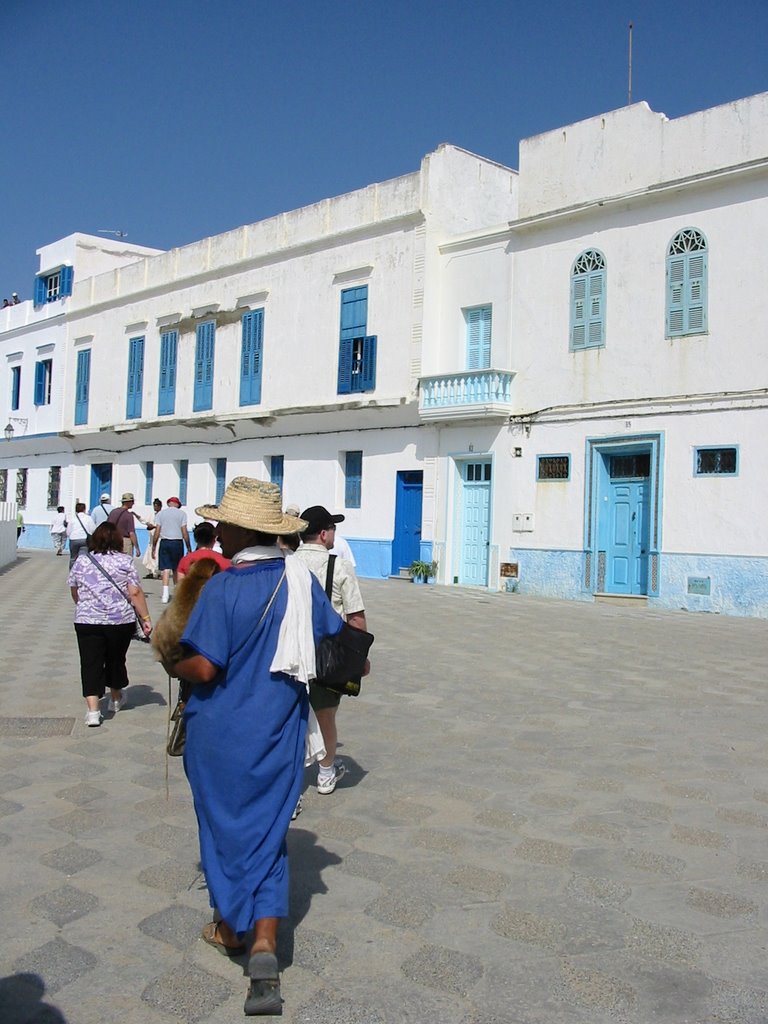
The ferry also took cars—each car was LOADED to the hilt with possessions! The overall ride took 2 hrs., sailing right past the Rock of Gibraltar. When we landed, we all went through a very brief security check. Our tour guide had given all our passports while we were on the ship for entry stamping. We met up with our local guide—Rashid—and the local driver Mohammed (we had left our bus in Spain). We drove first to a small village called Asilah—again narrow winding streets. There were vendors of many kinds following us and trying to persuade us to buy brass, copper, red coral. Carlin finally bought a flask made of brass & copper.
We then drove along the coast to Cap Spartel. We passed some lovely homes along the coast, side by side with absolute squalor. On the way, we stopped by some camels and some in the tour group decided to go for a ride, with the camels protesting all the while. We went to a hotel where we were served hot mint tea and cookies. I bought a silk caftan there and two stone carvings, a camel and an egg.
Delicious dinner tonight of lamb, prunes and almonds all baked together.

Thursday, July 20, 2006

More Iberian Adventures


DAY 3--26 June 2006 Mon

Left Madrid traveling first to Segovia where there is a 2000 yr old aqueduct. Then we drove to Avila where the town wall still stands with 88 towers intact. The town was an important stop on the medieval pilgrim routes—so one of the photos I took is of the four posts & cross, to mark the pilgrim’s way. The pilgrims were going to Santiago de Compostela (Santiago meaning James in Spanish).
By afternoon we arrived in Salamanca, which has a marvelous series of medieval vintage buildings. There was an old (vieja) and new (nueva) cathedral. Carlin & I walked from the hotel (a lovely hotel named Alameda Palace) to old quarters. The whole area has been declared a World Heritage site. We ate lunch along the way, then walked all through the university buildings. Salamanca was a famous university in medieval days.
Once back at the hotel, we had a group dinner. It turns out we have many teachers in our group—2nd, 3rd, and 5th grades, also kindergarten and a speech therapist. These folks are in addition to the university professors!
Tomorrow—Carlin’s long held dream of visiting Portugal will come true!
-------------------
DAY 4--27 June 2006 Tues

We left straight after breakfast and drove for Portugal. On the way, we stopped at
Fatima to see the place where the shepherd children had a vision of the Virgin Mary & subsequently received 3 prophecies. Hard to get into the scene as a Protestant. But there were some petitioners there going on knees to the chapel to pray to Mary. There is a long shiny sidewalk that on holy days is filled with people, all going on their knees to the chapel. Mass is constantly being said—or at least Hail Mary in whatever language. I am too Protestant.
From there we drove to Lisbon. Amazingly, it is wonderfully cool here right now, some 22 o C. We got to our hotel—a Marriott which is another lovely facility.
This eve, we went across the Tagus River (major river on the Iberian Peninsula, beginning in Spain and continuing for some 625 miles, emptying into Lisbon harbor) for dinner. We had a wonderful meal, described as “typically Portuguese” food—mostly seafood based. Big hit of the evening—green wine. Also Carlin bought roses for all women at the dinner. What a guy!
-----------------

DAY 5 28 June 2006 Wed

We began the day with a city tour of Lisbon—or Lisboa as it is written in Portuguese. Our city guide, Helena, was excellent. She pointed out that Portugal is the oldest country in Europe, having consolidated into a single nation long before other European countries. The Romans were in Portugal, then barbarians, then the Moors, who were finally expelled in 1136.
We went first to Alfama, an old section of Lisbon that still has tiny winding streets and old houses close together. The whole area is gradually undergoing renovation with outside walls being retiled. Depressing amount of graffiti everywhere.
Our guide told us that any words in Portuguese or Spanish with AL as a prefix come from Arabic, so Alfama was where the Moors first settled. Also many towns have an old section called the Alfama.
We then went to see the Torre (Tower) de Belen—it was originally a fortress along the Tagus which is so wide at Lisbon it appears to be a sea. This tower was also the place where explorers sailed from as they launched out into the world. Nearby the tower is a monument, modern vintage, to Prince Henry the Navigator, with portraits of various explorers such as Vasco de Gama.
We next visited the Monastery of St. Jerome (Jeronimo) where Vasco de Gama’s tomb is. The architectural style is uniquely Portuguese—called Manueline. Among its features—rope, carved in stone.
The big historical event in Lisbon was an
earthquake in 1755 on Nov. 1 which destroyed much of Lisbon—either the earthquake itself or the resulting tsunami which killed thousands.
When Lisbon was rebuilt, then Prime Minister Marques de Pombal took charge and required wide avenues to be built. Lisbon’s appearance reflects his design.
In the afternoon, we went to Cascais, a sea resort. What a lovely place. We had lunch, walked around a bit. The weather is cool & breezy, atypical.
Then we drove to Sintra, a World Heritage site—it is a valley in the granite Serra Hills. The location protects it & gives it a cooler climate than Lisbon. We shopped buying some pottery to take home.
On our way back, we stopped at the Palace of Queluz (pronounced Kay-loosh), the “Versailles” or Portugal. We walked through the whole palace and exited into the gardens. Ahead of us was a group of school children with one little boy who had slipped away from his classmates to urinate in the garden. Surprise to him—he was in FULL view of our group as we all walked toward him. He beat a hasty retreat.
Tonight we went to a restaurant where Fado singing is held, along with folk dancing. A bit of local culture. Tomorrow we leave Portugal to go to Seville, Spain.

Iberian Adventure June/July 2006

And so it begins. . .I join the world of bloggers. For now, I will use the space to report on our most recent vacation.
---------------------------------------------------------------
NOTE: accompanying photos available at Kodakgallery.com (send me an email if you want an invitation to see them)
DAY 1--23 June—24 June 2006 Fri/Sat
Our flight for our 2006 vacation leaves at 8:10 p.m., so Carlin went to work for ½ day while I worked to prep our home—changing sheets, putting out cat food, etc.
We left at 1:30 p.m. to drive to Newark. Once there we encountered a LONG line at the Continental desk—Newark is a main hub for Continental, but when we got to the front of the line, we had a most helpful agent. We had tried to pick seats online, and kept being told that seats would be assigned when we checked in.
Flight itself was fine although thunderstorms in the Newark area delayed us about 45 min. on take-off.
Arrived in Madrid; another long line at customs. Once at our hotel (Agumar near Atocha Train Station), we went for a quick stroll. We stopped at a local café for beer and pizza. Seemed to be all locals eating there—no one speaking English at all.
Back at hotel, we took a 3 hr. nap, then showered & dressed for evening meeting with tour group. 35 on tour—met a most interesting couple, Janis Stout & Loren Lutes, both had taught at Texas A & M, now retired. He taught civil engineering, and she American Lit. Turns out she is a Willa Cather scholar.
Tomorrow—day tour of Madrid.
--------------------------------------------------------------------------------------
DAY 2--25 June 2006 Sun

Today—we toured Madrid, stopping at Cervantes Park with a monument of Don Quixote and Sancho Panza. Sadly, strong smell of urine & lots of trash; also a bratty kid crawling all over the statue, egged on by (presumably) his grandfather.
We drove by many buildings and squares—things being pointed out briefly. Thankfully, when we were here in 2002 we saw more.
Only stop—the Prado where we had 2 hrs. to stroll through the gallery. We headed for Bosch’s Garden of Earthly Delight—a pleasure to see it again. Worked our way through museum. We were most happy the city guide did not try to take us around. Some guides warble on about this or that painting as THE BEST—that’s a decision each of us likes to make.
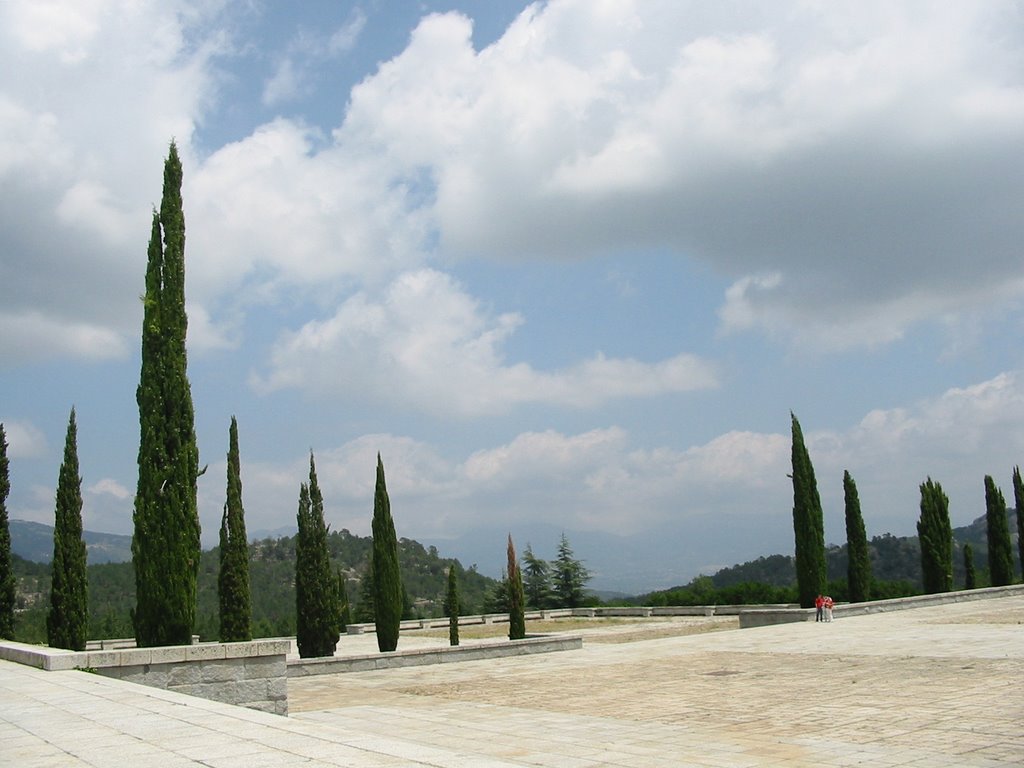
In the afternoon, we went to the Valley of the Fallen and el Escorial. The city tour guide gave her version of the history of Franco—he just wanted to restore democracy in Spain! The monument at the Valley of the Fallen is where those who died on both sides of Spanish Civil War are buried, including Franco and Jose Antonio.
El Escorial was built as a summer palace for Spanish monarchy and is also the place where many monarchs are buried in the mausoleum.
Once back at hotel, we rested and watched World Cup Soccer (Eng 1/ Ecuador 0). We then went out for dinner, walking past Atocha Train Station (site of the
11 March 2004 Madrid train bombings) to the T/B museum square and ate in a little restaurant there.