Last week, I selected the topic of reunions as the subject for blog writing. And, frankly, my first intent was to write about family reunions. I come from a family where reunions have been a many decade tradition--at least on my mother's side of the family.
But then, I turned my attention to a non-family reunion. See, I was about to return to my college alma mater and celebrate with fellow graduates our 50th college graduation! Golden Grads! Yup, that's us.
Oh, there are so many advantages (disadvantages?) to returning to the college where you began your adult life. Good memories, bad memories. Recognizing college friends, not recognizing college friends. Seeing old professors, not seeing departed professors.
Any reunion is a mixture of joy and sadness. Of sweet memories and bittersweet memories.
Our mortality is ever present--classmates who joined us for the 40th reunion now gone; classmates who were hale and hearty now wheel-chair bound, classmates who were dear friends and now barely remember you.
My recollections focus both on the personal--things we did in college--and the universal--things that happened to our country while we were in college.
So, walk down memory lane with me for a short while as I revisit a major event from the four years of my college days.
1962-63: no sooner had we begun our freshmen year than the world plunged into threats of war. It began on October 22 with the start of the Cuban Missile crisis. What I recall is the terror we felt as we lived through during those 7 days in October, from October 22 to October 28. Frankly, we thought we were living on the brink of a nuclear war. From the beginning of the crisis when our spy satellites saw the build-up of nuclear missiles in Cuba, to the response of President Kennedy to place a blockade around Cuba, to the Soviets insistence that they would send their ships anyway, running through the blockade to the final stand-down resolution--I can say we lived through days of terror.
Particularly visit it the time I was riding along with some girlfriends in a car, as we listened to the radio coverage of the U.N. debate. We waited to see if there was the launching of a nuclear war between the U.S and Russia.
I do not want to live through such an event again--the world hovering on the brink of nuclear war.
1963-64: our sophomore year began...calmly. Oh, there was the traditional reconnecting of couples or uncoupling as the case may have been. There were higher level classes we were taking, with the attendant increase in academic rigor. But what dominated that year was the assassination of President John F. Kennedy. The news came over the loud speakers in Old Main. I was on the college debate team and we had assembled, preparing to debate for a weekend tournament at Fordham University. Suddenly the news "President Kennedy has died" came over the loud speakers.
The nation plunged into mourning--a president so young, so full of bright promise, a widow only 33 years old, two photogenic children, a nation stunned.
Some of the members of our class, particularly those who had access to cars (a rarity in those days) traveled the hundred plus miles to Washington, D.C. to attend the funeral.
I do not want to live through the collective grief ever again--a nation mourning a leader struck down by a soul-less assassin.
1964-65: our junior year--now we were taking upper level course and choosing majors (if we hadn't already)--once again national events dominated our thinking. It was an election year. The candidates, Barry Goldwater and Lyndon Johnson, presented two vastly different world views. Goldwater wanted to use "low-level" atomic weapons in north Vietnam. Johnson ran a political ad which showed a sweet child pulling petals off a daisy counting. Her little voice then morphed into a countdown voice--10-9-8-7-6-5-4-3-2-1. And then a mushroom cloud. At no time was Goldwater's named used, but the implication was clear.
I recall being on a debate team for an all-college debate: I along with a partner arguing for Johnson, and two other students arguing for Goldwater. The only other thing I remember about that election campaign is that Goldwater made a stop in Harrisburg. He came into town on a train, which stopped on a bridge over Market Street. The crowd gathered below to hear him. At the time, I was so struck at how mob psychology worked--people who may not have been his supporters being swept up into the crowd chant. (Shades of a future campaign!) Well, we know how that race turned out: Johnson won having partly campaigned on not expanding the war in Vietnam.
I do not want to live through another populist candidate fanning the populist sentiment with dangerous and impossible ideas.
1965-66: President Johnson's promise to not expand the war in Vietnam was quickly broken. Retaliatory strikes had begun in late 1964 after reports of an attack on U.S. ships in the Gulf of Tonkin. The Congress quickly passed the Gulf of Tonkin Resolution which effectively gave the president authority to expand the military effort in Vietnam. And with his election secure, President Johnson did exactly that.
When we graduated in 1966, several of our classmates were drafted or volunteered and were deployed to Vietnam. Within one year of our graduating, one of these young men--Larry Houck, who had been our class president one year--was killed. That experience of loss was repeated in town after town, in school after school, in college after college. It is something that I still grieve today, as do many of my generation who began the 1960s with such a hope of a new order--the age of Aquarius.
I do not want to continue to see bright men and women with their lives ended prematurely because of ill-advised wars.
Of course--if you look over all the things in this post that I said I do not want to live through again, you may note that in fact we HAVE lived through all of these again.
Reunions? A time for reconnecting, for regretting, and for remembering.
Showing posts with label remembrances. Show all posts
Showing posts with label remembrances. Show all posts
Saturday, October 22, 2016

Saturday, September 17, 2016
So, You Want to be a Doctor?
When I was 12 years old, and at boarding school in Bulawayo (now Zimbabwe, then Rhodesia), my parents came to collect me for one of the regular holiday breaks. One of the school officials took them aside, and suggested that I see a doctor. Apparently, I had been showing signs of occasional uncontrolled spasticity. My left arm would suddenly flail out, with no warning.
Once we reached the mission station, the missionary doctor was contacted. She came from a nearby mission and examined me. The diagnosis: rheumatic fever. And the symptom, commonly called St. Vitus Dance, was medically called Sydenham's chorea.
What causes rheumatic fever and Sydenham's chorea is a streptococcal A bacteria. The treatment then was complete bed rest and penicillin. Thus began my six weeks stay in bed. I have written about this event before and particularly focusing on the doctor who treated me.
I so admired this doctor. She was a very good doctor, and maybe more importantly to me at the time: she was a WOMAN. No doubt during the time I spent convalescing, I developed an idea--I could be a doctor.
So, that's where my career was headed. I recall a conversation with my father where I told him I wanted to be a doctor. I also recall his response--he affirmed that he and Mother would help me in whatever way they could.
What they couldn't help me with was Chemistry. Once in college, I took the requisite Chemistry course and promptly began to have doubts about my future career. I limped through the first semester of Chemistry, getting a C in the course. And then, with the second semester, I realized that my career goal of becoming a doctor was simply not going to happen. I got a D in the second semester, and immediately began to redirect my career goals.
I settled on being an English major, and not only earned my bachelor's degree in English but also a Master's degree. And then, by a fortuitous interaction with a favorite former professor, I ended returning to my alma mater to teach English.
But this change--from pre-medical to English--was not the only career change I experienced. After I had been teaching for 8 years, I needed to seek other employment. I had been full-time, then part-time when our son was born. When I wanted to return to full-time, the college dean informed me there were no positions for an indefinite time. So I went to work in a professional association representing doctors! Yes, I was finally working every day with doctors.
Along the way, I picked up much medical knowledge. From that professional association, I went to work for the State Health Department, and from there to one of the Blue Cross/Blue Shield organizations in the country.
Along the way, as I have interacted with people, I am sometimes asked--are you a doctor? The question makes me smile. But I answer--no--I just work with a lot of them. I don't even bother to say--but I wanted to be a doctor. Truth is, I am much happier having been an English major.
You see, after my sojourn in medical organizations was over, I returned to college level teaching--English.
Once we reached the mission station, the missionary doctor was contacted. She came from a nearby mission and examined me. The diagnosis: rheumatic fever. And the symptom, commonly called St. Vitus Dance, was medically called Sydenham's chorea.
What causes rheumatic fever and Sydenham's chorea is a streptococcal A bacteria. The treatment then was complete bed rest and penicillin. Thus began my six weeks stay in bed. I have written about this event before and particularly focusing on the doctor who treated me.
I so admired this doctor. She was a very good doctor, and maybe more importantly to me at the time: she was a WOMAN. No doubt during the time I spent convalescing, I developed an idea--I could be a doctor.
So, that's where my career was headed. I recall a conversation with my father where I told him I wanted to be a doctor. I also recall his response--he affirmed that he and Mother would help me in whatever way they could.
What they couldn't help me with was Chemistry. Once in college, I took the requisite Chemistry course and promptly began to have doubts about my future career. I limped through the first semester of Chemistry, getting a C in the course. And then, with the second semester, I realized that my career goal of becoming a doctor was simply not going to happen. I got a D in the second semester, and immediately began to redirect my career goals.
I settled on being an English major, and not only earned my bachelor's degree in English but also a Master's degree. And then, by a fortuitous interaction with a favorite former professor, I ended returning to my alma mater to teach English.
But this change--from pre-medical to English--was not the only career change I experienced. After I had been teaching for 8 years, I needed to seek other employment. I had been full-time, then part-time when our son was born. When I wanted to return to full-time, the college dean informed me there were no positions for an indefinite time. So I went to work in a professional association representing doctors! Yes, I was finally working every day with doctors.
Along the way, I picked up much medical knowledge. From that professional association, I went to work for the State Health Department, and from there to one of the Blue Cross/Blue Shield organizations in the country.
Along the way, as I have interacted with people, I am sometimes asked--are you a doctor? The question makes me smile. But I answer--no--I just work with a lot of them. I don't even bother to say--but I wanted to be a doctor. Truth is, I am much happier having been an English major.
You see, after my sojourn in medical organizations was over, I returned to college level teaching--English.
Monday, May 23, 2016
(...take a deep breath) AH! Smell that?
Herewith three vignettes about memories evoked by a smell.
--------
I am in 10th grade in high school. This school is new to me, having recently been in a school system in another country. I have never been in an American high school before.
 As best I can, I settle into the routine. First, the relatively long bus ride. Just enough time to check out a couple of guys who get on the bus after me. They're cute.
Then school. We all hurry inside. And make our way to lockers, then homerooms. Soon the school bell sounds and we dutifully rise and "pledge allegiance to the flag." This is new to me, but I get the hang of it. And now classes begin. I have the usual round of classes--English, history (Pennsylvania history, I think), math (I get a pass on algebra having taken that in my prior school--not that it did any good--so business math for me), phys ed, and Latin. Of course, Latin. I don't remember much from that year but I remember Latin--oh, I suppose a bit of the language seeped through to me (I know many of the Latin words that helped shape the English language). But I do remember how to wolf whistle. Yup--learned that in Latin.
The one break during the day is lunch. And with it, foods that, though not unfamiliar, were not the common fare I had eaten in boarding school. You could tell by the smell what was for lunch that day. Barbecue sandwiches, pork and sauerkraut, hot dogs. I don't recall all, but even now--the smell of barbecue or sauerkraut transports me back to 10th grade.
----------------------------
As I enter the large room, I can immediately smell the touch of mold, mingled with lingering bath soap, laundry soap, perfume. And occasionally a whiff of food--probably from a covered dish supper. There is also the smell of books, and well-worn wood. The whole room is over-heated but that gives it a welcoming feel--like being enfolded in the arms of a grandparent who loves you and hugs you tight.
The room is dimly lit, and very quiet. There is a light buzz of voices, but mostly whispering. As I sit down, I look around. There are some of my uncles and aunts, and my cousins. Probably my Pappap as well. Grandma must have been there, but I don't remember that.
I am in the small church where my mother grew up. And now today, when I enter a small country church, all those smells hit me, and I am once again in that church from my childhood.
------------------------------
Late at night the plane landed. I had flown from the U.S. to London, then had a long lay-over at Heathrow (I over-estimated how much time I would need to connect planes). Since the plane departed a bit later than scheduled, I missed the opportunity to see the sun set over the Sahara.
With the usual delay in deplaning, my anticipation builds. I am going to see my daughter who is in a four month internship working on an art project. The coolness of the airplane begins to dissipate. And as the cabin door opens, it becomes clear that the weather is not the same as Pennsylvania in November (from where I had departed), nor London. In fact, it is down-right steamy.
As I step off the plane, and down the ladder (no connecting tunnels at this airport), I am immediately hit with a wave of intense humidity. And that smell.
I breathe deeply--wood fire smoke mingled with sweat of humanity. I take another deep breath--hold it, and then say (in my mind at least) -- AFRICA. After a more than 40 year absence, I am back.
-------------------------------
--------
I am in 10th grade in high school. This school is new to me, having recently been in a school system in another country. I have never been in an American high school before.

Then school. We all hurry inside. And make our way to lockers, then homerooms. Soon the school bell sounds and we dutifully rise and "pledge allegiance to the flag." This is new to me, but I get the hang of it. And now classes begin. I have the usual round of classes--English, history (Pennsylvania history, I think), math (I get a pass on algebra having taken that in my prior school--not that it did any good--so business math for me), phys ed, and Latin. Of course, Latin. I don't remember much from that year but I remember Latin--oh, I suppose a bit of the language seeped through to me (I know many of the Latin words that helped shape the English language). But I do remember how to wolf whistle. Yup--learned that in Latin.
The one break during the day is lunch. And with it, foods that, though not unfamiliar, were not the common fare I had eaten in boarding school. You could tell by the smell what was for lunch that day. Barbecue sandwiches, pork and sauerkraut, hot dogs. I don't recall all, but even now--the smell of barbecue or sauerkraut transports me back to 10th grade.
----------------------------
As I enter the large room, I can immediately smell the touch of mold, mingled with lingering bath soap, laundry soap, perfume. And occasionally a whiff of food--probably from a covered dish supper. There is also the smell of books, and well-worn wood. The whole room is over-heated but that gives it a welcoming feel--like being enfolded in the arms of a grandparent who loves you and hugs you tight.
The room is dimly lit, and very quiet. There is a light buzz of voices, but mostly whispering. As I sit down, I look around. There are some of my uncles and aunts, and my cousins. Probably my Pappap as well. Grandma must have been there, but I don't remember that.
I am in the small church where my mother grew up. And now today, when I enter a small country church, all those smells hit me, and I am once again in that church from my childhood.
------------------------------
Late at night the plane landed. I had flown from the U.S. to London, then had a long lay-over at Heathrow (I over-estimated how much time I would need to connect planes). Since the plane departed a bit later than scheduled, I missed the opportunity to see the sun set over the Sahara.
With the usual delay in deplaning, my anticipation builds. I am going to see my daughter who is in a four month internship working on an art project. The coolness of the airplane begins to dissipate. And as the cabin door opens, it becomes clear that the weather is not the same as Pennsylvania in November (from where I had departed), nor London. In fact, it is down-right steamy.
As I step off the plane, and down the ladder (no connecting tunnels at this airport), I am immediately hit with a wave of intense humidity. And that smell.
I breathe deeply--wood fire smoke mingled with sweat of humanity. I take another deep breath--hold it, and then say (in my mind at least) -- AFRICA. After a more than 40 year absence, I am back.
-------------------------------
Saturday, June 20, 2015
Portrait of a Man

In recognition of Father's Day--I offer this brief portrait of the life of a man--he is my father, David.
David was born in 1919, and is the baby in this photo. While he was born in Pennsylvania, when he was less than 2 years old, his parents, along with him and his older brother, went as missionaries to southern Africa.
The family lived there for 10 years, returning to the United States in 1929. While they were there, the third son was born, as you can see in the photo below--the three sons: Arthur, David, and Joel.
 Since the formative years of his growing up were spent in a place with a sub-tropical climate, he felt somewhat out of place in the eastern United States. Maybe the clothing in the photo--which was taken in southern Africa before they returned to the U.S.-- also helps explain why he felt out of place. The life he was accustomed to was not what he experienced upon the family's return. Not until his family moved to southern California in 1933 did he feel connected to where he lived. He loved southern California which reminded him of the climate and scenery in southern Africa.
The next photo shows my father as a young man--he is 18 years old. It was the summer of 1937, and he had just finished high school. Since his family was not rich, and since after returning to the U.S. his parents had two more children, daughters, they informed him that he needed to make his own way in the world.
 It was a hard decision--but he did it--found work, saved money, and made plans to go to college . And then he met my mother at a church revival meeting in Pennsylvania.
Of course, the tidy way in which I present this information lacks nuance and detail--of which there is much nuance and many details. These few details are only to give you a sense of a young man growing up.
Once my father had sufficient funds to go to college, he chose a college in California. My mother, soon after they became engaged, joined him there. And in October, 1942 they were married.
When my father graduated from college, he got a job teaching in central California. Because of that, he had a deferment from military service. I was born in 1945, just before the end of World War II.
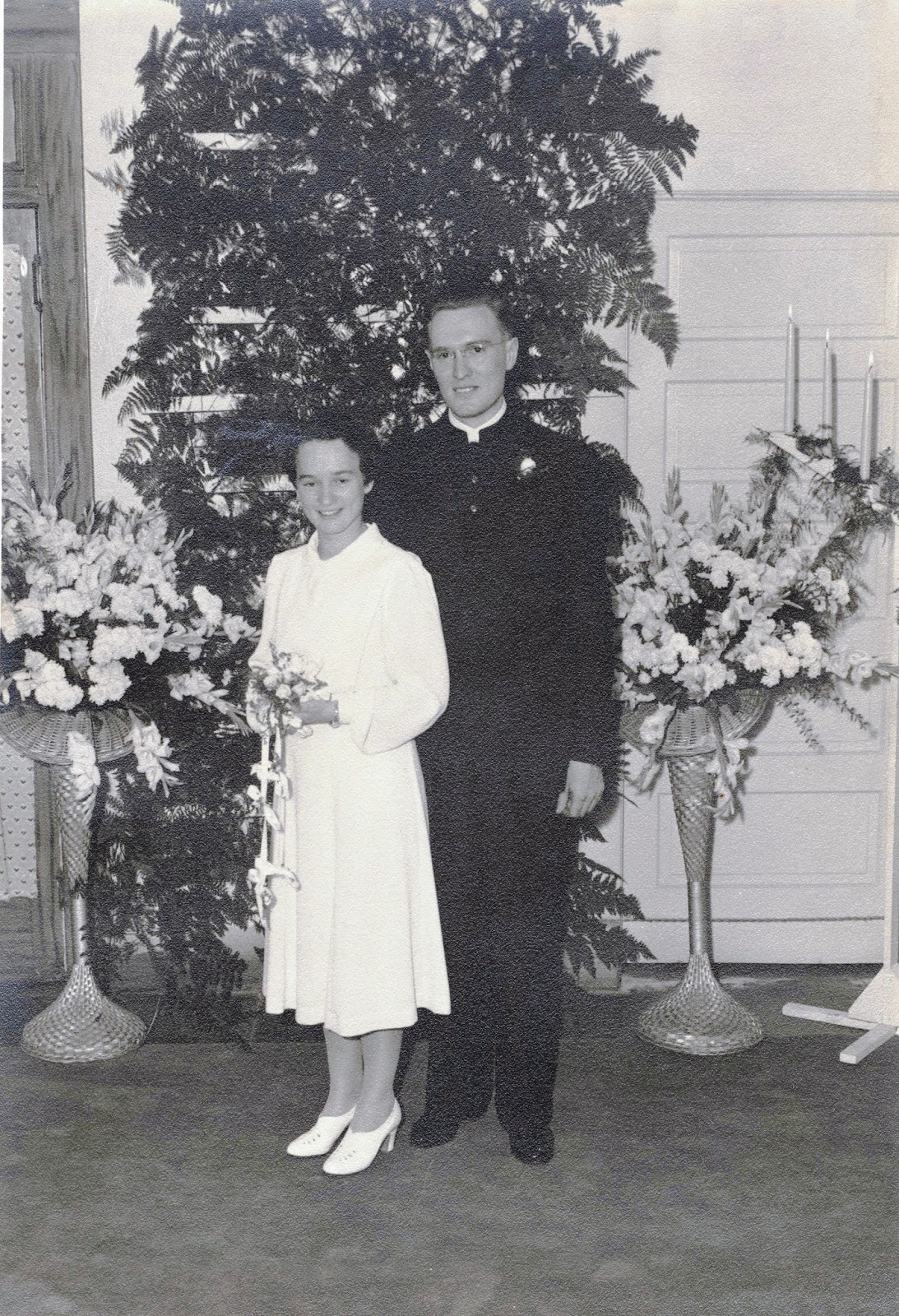 Although my father was teaching, he had a sense of calling to be a missionary, as his parents had been. Happily, my mother had the same sense. When they were accepted by the mission board of their church, they were sent to what was then Northern Rhodesia (now Zambia).
At the very young age of 27 my father was assigned as superintendent of a mission station near the Zambezi River in southern Zambia. The conditions then were somewhat primitive--no electricity, no indoor plumbing for example.
Over the next 19 years, my parents served in various capacities in both Northern and Southern Rhodesia. He was superintendent of another mission station, this time in Rhodesia (now Zimbabwe), and eventually bishop of all the mission work for his church in southern Africa. During those years, my parents also had an infant daughter die (of malaria), had a son born and another daughter born.
In 1965, my parents returned to the U.S. for good. I had been in the U.S. from 1960 to 1965, and through the generosity of a benefactor was able to meet my parents after that 5 year absence in London.
My father, who is now 96, has a prodigious memory and from reading his autobiography, which he has worked on for some 20 plus years, I have learned many tales about his time in mission and church work.
Of course, I have my own stories to tell about my father. But I would rather turn your attention to a post I wrote on a prior Father's Day--here are the things I learned from my father.
So HAPPY FATHER'S DAY, Dad.

Thursday, December 18, 2014
It's Christmas! And it's summer!
A recent blog by a childhood friend of mine (read it here) set me to thinking about my earliest memories of Christmas.
Long time readers of this blog will know that I grew up in southern Africa (what was Northern & Southern Rhodesia, now Zambia and Zimbabwe respectively)--so no Victorian snowy Christmas memories*. Instead, my Christmas memories are of summertime celebrations, with Christmas and summer holidays all being wrapped into one time off from school. School in this case also meant boarding school (as the mission station where my parents were was at least a half a day's travel from the nearest government school). With a school year that ran from January to December, the summer break fell in December. So of course that meant the boarding school closing, and my coming home.
It is difficult to convey to someone who has never boarded away from home for any length of time what coming home means. Off and on, in this blog I have written about boarding school--mostly my memories are pleasant. I recall one or two friends' names. I recall good times with school activities--participating in sports, drama productions, as well as classroom work. But what I most remember is how Christmas festivities in the city of Bulawayo helped set the mood for Christmas. I particularly recall the carol singing that was held in a municipal stadium--all of which helped me amass a vast repertoire of Christmas carols. One of my favorites was "Good King Wenceslas" with men and women singing alternate verses--men taking the parts of the king, and women the parts of the page. Oh, my--memories flood back. But, I digress somewhat.
When Christmas holiday and summer vacation began, all boarders returned to their homes for a 6 week vacation. That time was filled with many little bits of activity that still resonate in my mind. I previously wrote about the Christmas picnic adventure--of course, Christmas in the summer means picnic.
Caroling was not confined to the Bulawayo municipal carol sing. Many missionaries were quite good singers, and of course we sang in four part harmony (still my favorite way to sing...). I do recall getting up early in the morning, on Christmas Day, and going out caroling singing "Christians Awake! Salute the Happy Morn). As a young adolescent, I found it highly amusing to be serenading with a Christmas hymn early on Christmas morning.
Christmas also meant that missionaries from nearby missions would gather at one of the missions. The emphasis was not so much on exchanging gifts as enjoying time together. However, there was one year when some missionary (I don't know who, but it sounds as though my mother--who could be mischievous--had a hand in it) decided to give everyone a gag gift. Now, I acknowledge you would need to know the missionaries in question to appreciate the humor. But here are some of the gifts given. One was a small planter with a bean plant sprouting in it, along with ceramic PIG salt and pepper shakers. The missionary receiving this had frequently lamented the blasted pigs who always got into the garden and consumed the beans, or at least broke the budding plants. Another gift was a straw man--a shirt stuffed with straw, and trousers likewise, with a cloth head and a placard that read "a good man." That was given to an unmarried missionary woman who kept hoping--and expressing that hope--for a husband. At least that's what my childhood memories say we did.
This time of year does prompt us all to reflect and revel in memories. If those memories--and certainly my hope for you is that they are--then we return to them again and again. I am reminded of that fact when I realize how many times I have written about Christmas here, even repeating some of the same stories. But that's what we do, isn't it? We recall and share.
*Oh, my little opening comment about no snowy Victorian memories--I have a theory that many of "our" Christmas memories are shaped by "A Christmas Carol" or by Currier and Ives prints. We see gaily decorated Christmas trees, complete with "candles" which Prince Albert from Germany helped popularize in England. And we talk about a white Christmas. When it snows, it immediately kicks us in celebratory gear. But these associations do NOT happen when it's Christmas and it's summertime.

Long time readers of this blog will know that I grew up in southern Africa (what was Northern & Southern Rhodesia, now Zambia and Zimbabwe respectively)--so no Victorian snowy Christmas memories*. Instead, my Christmas memories are of summertime celebrations, with Christmas and summer holidays all being wrapped into one time off from school. School in this case also meant boarding school (as the mission station where my parents were was at least a half a day's travel from the nearest government school). With a school year that ran from January to December, the summer break fell in December. So of course that meant the boarding school closing, and my coming home.
It is difficult to convey to someone who has never boarded away from home for any length of time what coming home means. Off and on, in this blog I have written about boarding school--mostly my memories are pleasant. I recall one or two friends' names. I recall good times with school activities--participating in sports, drama productions, as well as classroom work. But what I most remember is how Christmas festivities in the city of Bulawayo helped set the mood for Christmas. I particularly recall the carol singing that was held in a municipal stadium--all of which helped me amass a vast repertoire of Christmas carols. One of my favorites was "Good King Wenceslas" with men and women singing alternate verses--men taking the parts of the king, and women the parts of the page. Oh, my--memories flood back. But, I digress somewhat.
When Christmas holiday and summer vacation began, all boarders returned to their homes for a 6 week vacation. That time was filled with many little bits of activity that still resonate in my mind. I previously wrote about the Christmas picnic adventure--of course, Christmas in the summer means picnic.
Caroling was not confined to the Bulawayo municipal carol sing. Many missionaries were quite good singers, and of course we sang in four part harmony (still my favorite way to sing...). I do recall getting up early in the morning, on Christmas Day, and going out caroling singing "Christians Awake! Salute the Happy Morn). As a young adolescent, I found it highly amusing to be serenading with a Christmas hymn early on Christmas morning.
Christmas also meant that missionaries from nearby missions would gather at one of the missions. The emphasis was not so much on exchanging gifts as enjoying time together. However, there was one year when some missionary (I don't know who, but it sounds as though my mother--who could be mischievous--had a hand in it) decided to give everyone a gag gift. Now, I acknowledge you would need to know the missionaries in question to appreciate the humor. But here are some of the gifts given. One was a small planter with a bean plant sprouting in it, along with ceramic PIG salt and pepper shakers. The missionary receiving this had frequently lamented the blasted pigs who always got into the garden and consumed the beans, or at least broke the budding plants. Another gift was a straw man--a shirt stuffed with straw, and trousers likewise, with a cloth head and a placard that read "a good man." That was given to an unmarried missionary woman who kept hoping--and expressing that hope--for a husband. At least that's what my childhood memories say we did.
This time of year does prompt us all to reflect and revel in memories. If those memories--and certainly my hope for you is that they are--then we return to them again and again. I am reminded of that fact when I realize how many times I have written about Christmas here, even repeating some of the same stories. But that's what we do, isn't it? We recall and share.
*Oh, my little opening comment about no snowy Victorian memories--I have a theory that many of "our" Christmas memories are shaped by "A Christmas Carol" or by Currier and Ives prints. We see gaily decorated Christmas trees, complete with "candles" which Prince Albert from Germany helped popularize in England. And we talk about a white Christmas. When it snows, it immediately kicks us in celebratory gear. But these associations do NOT happen when it's Christmas and it's summertime.
Merry Christmas to all--whether near or far, whether north, south, east or west.
Friday, March 28, 2014
I Survived TMI
Today is the 35th anniversary of an event that once was understood by simply saying three letters: T - M - I. If you said those letters, anyone living in Pennsylvania, certainly the East Coast of the U.S. and maybe the entire U.S. knew what you meant--THREE MILE ISLAND. In fact, when we traveled overseas in the 1980s, if people asked where we were from , we could answer "near TMI" and the listener knew where you came from.
Now, with 35 years between that event and now, people may not remember so clearly. They will have their own current sense of the potential dangers of living near a nuclear power plant--say Fukushima and everyone knows where that is and what happened.
But for me, TMI was a defining moment--herewith, my thoughts on the 30th anniversary.
------------------
Memory is a blessing and a curse.
Thirty years ago on this day a series of occurrences began a chain reaction that almost resulted in a nuclear plant melting down. At the time, the location was unknown to much of the country. In central Pennsylvania, we all knew the familiar sight of the cooling towers--the most recognizable feature of a nuclear power plant. In fact, the power plant at TMI is located very near the runways of the Harrisburg International Airport (no, I am not making up the "international" part). When I flew home last week, our plane came in right over the cooling towers. The sight whisked me back some 30 years, as I recalled the several days of absolute panic wondering what would happen next. I survived TMI.

March 28, 1979 was a Wednesday. The specific details of what happened at TMI to set the accident in motion are well-known*. Early in the morning, a valve failed and all the water that cooled the fuel rods drained, leaving them exposed. The emergency back-up cooling system kicked in, but technicians--not understanding what they were seeing on the gages--turned it off. Even though the reactor itself shut down, heat kept building up which resulted in one half the core melting down.
News of what was happening at TMI did not immediately get picked up. If I recall correctly, the first person to break the story was a radio show host. There was no intent to keep things quiet; it was simply a matter of near mass confusion, and many aspects of the situation being unknown. Was the core intact? Had the core melted down at all? If so, how much? Would there be a release of radiation, or not? The local press did not begin covering the news until well into the first day.
By the second day, the news of "an event" at TMI really began to hit the news. At the time, I was working for the Pennsylvania Medical Society. One of my responsibilities was to staff committees--and on Thursday the Commission on Therapeutics had a meeting. The chairman was a physician named Arthur Hayes who was a physician pharmacologist working at the Hershey Medical Center. The meeting was set to begin at 10 a.m. Just as we went into the meeting, word came that the nuclear incident at Three Mile Island was very serious. Since Hershey Medical Center was about 5 miles from the nuclear power plant, Dr. Hayes decided to cancel the meeting and head back to the medical center. It would be a receiving facility if there were any nuclear contamination of people.
When the doctor who chaired the committee decided to cancel the meeting, I knew something BIG was happening. Understandably, news sources did not know the scope of what was going on. I decided to head for home, since my work place was on the west side of the Susquehanna River, and our home was on the east side. If road traffic was going to be restricted, I wanted to be on the same side of the river as our son, who was then 7 years old. I drove from my work place to the elementary school where he was, and gathered him up and went home.
Meltdown is NOT something you want a nuclear power plant to do. A popular movie at the time was The China Syndrome which featured a nuclear power plant accident and an attempted cover-up of the information. Needless to say, for all of us within a ten mile radius of TMI our adrenaline pumps kicked into overdrive.

When day 3--Friday--began, the news at TMI had gotten worse. While the plant had not melted down, a hydrogen bubble had been discovered. The fear was that this bubble could cause the plant to explode which would spew radioactive material over a wide area. While the experts did their best to first understand the situation, and then give advice based on their understanding, the public was genuinely confused. Should we stay or go?
As it happened, my husband was set to go out of town for a training workshop. He left on Friday to go to West Virginia. A family friend of ours had a vacation home in the Poconos that his family was evacuating to, and he offered the place for me and my son to stay. With my husband away, the decision to leave the area was largely up to me. So, I gathered up our son, our dog and cat, a bit of clothing--and drove to the Poconos. As we left our house, our son said plaintively--what about the goldfish? I recall my reaction--the goldfish will have to fend for itself for however long.
By the end of the weekend, the situation was better understood, and it was clear the nuclear event was not going to become any worse. I returned home. No meltdown. No core breach. No hydrogen bubble explosion. No mass radioactive release. But great damage had been done and the plant at TMI remained out of commission until 1985.
So, I survived TMI. Now 30 years later, it is hard to reconstruct the exact sequence of events. My husband was away, so his memories differ from mine. The friend who offered his house has been dead for more than 10 years. My son was far too young to remember. I have my own memories, but I am not tempted to rely on them for unadulterated recollection.
Memory is a blessing and a curse.
*To learn more about TMI, you can go to these two websites: http://www.threemileisland.org/virtual_museum/march28_1979.html or http://www.nrc.gov/reading-rm/doc-collections/fact-sheets/3mile-isle.html
Now, with 35 years between that event and now, people may not remember so clearly. They will have their own current sense of the potential dangers of living near a nuclear power plant--say Fukushima and everyone knows where that is and what happened.
But for me, TMI was a defining moment--herewith, my thoughts on the 30th anniversary.
------------------
Memory is a blessing and a curse.
Thirty years ago on this day a series of occurrences began a chain reaction that almost resulted in a nuclear plant melting down. At the time, the location was unknown to much of the country. In central Pennsylvania, we all knew the familiar sight of the cooling towers--the most recognizable feature of a nuclear power plant. In fact, the power plant at TMI is located very near the runways of the Harrisburg International Airport (no, I am not making up the "international" part). When I flew home last week, our plane came in right over the cooling towers. The sight whisked me back some 30 years, as I recalled the several days of absolute panic wondering what would happen next. I survived TMI.
contemporaneous photo of TMI in 1979
March 28, 1979 was a Wednesday. The specific details of what happened at TMI to set the accident in motion are well-known*. Early in the morning, a valve failed and all the water that cooled the fuel rods drained, leaving them exposed. The emergency back-up cooling system kicked in, but technicians--not understanding what they were seeing on the gages--turned it off. Even though the reactor itself shut down, heat kept building up which resulted in one half the core melting down.
News of what was happening at TMI did not immediately get picked up. If I recall correctly, the first person to break the story was a radio show host. There was no intent to keep things quiet; it was simply a matter of near mass confusion, and many aspects of the situation being unknown. Was the core intact? Had the core melted down at all? If so, how much? Would there be a release of radiation, or not? The local press did not begin covering the news until well into the first day.
By the second day, the news of "an event" at TMI really began to hit the news. At the time, I was working for the Pennsylvania Medical Society. One of my responsibilities was to staff committees--and on Thursday the Commission on Therapeutics had a meeting. The chairman was a physician named Arthur Hayes who was a physician pharmacologist working at the Hershey Medical Center. The meeting was set to begin at 10 a.m. Just as we went into the meeting, word came that the nuclear incident at Three Mile Island was very serious. Since Hershey Medical Center was about 5 miles from the nuclear power plant, Dr. Hayes decided to cancel the meeting and head back to the medical center. It would be a receiving facility if there were any nuclear contamination of people.
When the doctor who chaired the committee decided to cancel the meeting, I knew something BIG was happening. Understandably, news sources did not know the scope of what was going on. I decided to head for home, since my work place was on the west side of the Susquehanna River, and our home was on the east side. If road traffic was going to be restricted, I wanted to be on the same side of the river as our son, who was then 7 years old. I drove from my work place to the elementary school where he was, and gathered him up and went home.
Meltdown is NOT something you want a nuclear power plant to do. A popular movie at the time was The China Syndrome which featured a nuclear power plant accident and an attempted cover-up of the information. Needless to say, for all of us within a ten mile radius of TMI our adrenaline pumps kicked into overdrive.
When day 3--Friday--began, the news at TMI had gotten worse. While the plant had not melted down, a hydrogen bubble had been discovered. The fear was that this bubble could cause the plant to explode which would spew radioactive material over a wide area. While the experts did their best to first understand the situation, and then give advice based on their understanding, the public was genuinely confused. Should we stay or go?
As it happened, my husband was set to go out of town for a training workshop. He left on Friday to go to West Virginia. A family friend of ours had a vacation home in the Poconos that his family was evacuating to, and he offered the place for me and my son to stay. With my husband away, the decision to leave the area was largely up to me. So, I gathered up our son, our dog and cat, a bit of clothing--and drove to the Poconos. As we left our house, our son said plaintively--what about the goldfish? I recall my reaction--the goldfish will have to fend for itself for however long.
By the end of the weekend, the situation was better understood, and it was clear the nuclear event was not going to become any worse. I returned home. No meltdown. No core breach. No hydrogen bubble explosion. No mass radioactive release. But great damage had been done and the plant at TMI remained out of commission until 1985.
So, I survived TMI. Now 30 years later, it is hard to reconstruct the exact sequence of events. My husband was away, so his memories differ from mine. The friend who offered his house has been dead for more than 10 years. My son was far too young to remember. I have my own memories, but I am not tempted to rely on them for unadulterated recollection.
Memory is a blessing and a curse.

-------------------------------------------
*To learn more about TMI, you can go to these two websites: http://www.threemileisland.org/virtual_museum/march28_1979.html or http://www.nrc.gov/reading-rm/doc-collections/fact-sheets/3mile-isle.html
Friday, November 22, 2013
November 22, 1963
I am 18 years old. My sophomore year in college has just begun in the small college I attend. Friday afternoon, our college debate team of which I am a member will be leaving some time mid-afternoon to go to Fordham University for a debate tournament.
I am standing in Old Main, on a small flight of stairs leading to some classrooms. Suddenly, the news comes flashing through--whether a student or staff member had heard it on the radio, I do not know. But the word comes and it is shocking, earth-shattering. President Kennedy has been shot and killed.
That breathless moment when everything seemed to cease. Our world suspended. What to do? Not just what to do personally. But what to do for the whole country, maybe even the whole world.
Television was still in a kind of infancy--even though President Kennedy's appointee as chair of the Federal Communication Commission Newton Minow had pronounced its being "a vast wasteland." Our small college had only ONE television set available for public viewing. That television was in the Commons area of Old Main.
For the next few days, while the country plunged into inarticulate mourning, we students gathered around that television. CBS had made the decision to begin broadcasting and continue until the president had been buried. So we watched while Walter Cronkite led the country in an extended wake.
We students did not spend the entire next four days in front of the lone television. We went on with our student lives. The debate team missed any Saturday news--we had agonized over whether or not to go to the Fordham tournament but in the end we went. On Sunday, the college choir had a church service to attend, and so we were in the house of one of the church parishioners to have Sunday dinner when we saw on that television a man, named Jack Ruby, step up to Lee Harvey Oswald and shoot him. The dissolution of any meaning in our world seemed complete.
On Monday, when the President was going to be buried, some students with cars drove to Washington, DC. Most of us stayed on campus and continued our television vigil.
This 50th anniversary--November 22, 2013--also a Friday. As the grainy black and white footage from those four days of continuous broadcasting, sometimes interrupted by a few splashes of color footage from film, are replayed--I am transported back. I am once again a college sophomore, standing on the steps in Old Main, conversing with fellow students on the Debate Team--the President has been assassinated.
Now, fifty years later, I know how very young eighteen is. How very innocent. Yet on that day, November 22, 1963, our world changed. And we were suddenly older--not old, maybe--but the brightness of life had been dimmed in an inexpressible way. Things would never be the same.
And, of course, we were right--we still had so many fresh tragedies to go through--Vietnam, more assassinations including Jack Kennedy's brother Bobby, civil rights struggles, dogs lunging at people trying to secure the right to vote, Kent State, Watergate...
On and on. What was lost that day was bright-eyed innocence.
November 22, 1963.
I am standing in Old Main, on a small flight of stairs leading to some classrooms. Suddenly, the news comes flashing through--whether a student or staff member had heard it on the radio, I do not know. But the word comes and it is shocking, earth-shattering. President Kennedy has been shot and killed.
That breathless moment when everything seemed to cease. Our world suspended. What to do? Not just what to do personally. But what to do for the whole country, maybe even the whole world.
Television was still in a kind of infancy--even though President Kennedy's appointee as chair of the Federal Communication Commission Newton Minow had pronounced its being "a vast wasteland." Our small college had only ONE television set available for public viewing. That television was in the Commons area of Old Main.
For the next few days, while the country plunged into inarticulate mourning, we students gathered around that television. CBS had made the decision to begin broadcasting and continue until the president had been buried. So we watched while Walter Cronkite led the country in an extended wake.
We students did not spend the entire next four days in front of the lone television. We went on with our student lives. The debate team missed any Saturday news--we had agonized over whether or not to go to the Fordham tournament but in the end we went. On Sunday, the college choir had a church service to attend, and so we were in the house of one of the church parishioners to have Sunday dinner when we saw on that television a man, named Jack Ruby, step up to Lee Harvey Oswald and shoot him. The dissolution of any meaning in our world seemed complete.
On Monday, when the President was going to be buried, some students with cars drove to Washington, DC. Most of us stayed on campus and continued our television vigil.
This 50th anniversary--November 22, 2013--also a Friday. As the grainy black and white footage from those four days of continuous broadcasting, sometimes interrupted by a few splashes of color footage from film, are replayed--I am transported back. I am once again a college sophomore, standing on the steps in Old Main, conversing with fellow students on the Debate Team--the President has been assassinated.
Now, fifty years later, I know how very young eighteen is. How very innocent. Yet on that day, November 22, 1963, our world changed. And we were suddenly older--not old, maybe--but the brightness of life had been dimmed in an inexpressible way. Things would never be the same.
And, of course, we were right--we still had so many fresh tragedies to go through--Vietnam, more assassinations including Jack Kennedy's brother Bobby, civil rights struggles, dogs lunging at people trying to secure the right to vote, Kent State, Watergate...
On and on. What was lost that day was bright-eyed innocence.
November 22, 1963.
Monday, November 11, 2013
Remembering...

The Allied Cemetery in Luxembourg (World War II)
But, there are parts of Europe where this day is not remembered--oh, perhaps remembered but not celebrated.
Several years ago, when we were on a trip through Germany, we visited Cologne. This lovely city had been heavily bombed by the Allies during World War II. It is now rebuilt, and even restored in many parts to its medieval heritage. The famous cathedral stands again in all its imposing glory.

As we walked around town, we passed a store front which was filled with costumes--you know, as in Hallowe'en type costumes. We asked our city guide if Hallowe'en was popular. He looked a bit puzzled and then replied--oh no, these are for Martinstag.
Martinstag?--now we were puzzled.
Well, he explained--it's like Hallowe'en and harvest festival or Thanksgiving combined. We accepted that--adding a new celebration to our store of knowledge. And when, we asked, is it celebrated? He replied--on November 11.
Now, it was our turn to be puzzled. November 11? But, that's Remembrance Day, or Veterans' Day, or...Armistice Day.
Once again our guide looked puzzled--so we explained--the end of World War I, the treaty which took effect on the 11th hour of the 11th day of the 11th month.
But, of course, by now it dawned on us that it shouldn't be surprising that the defeated would not celebrate a day when victory came, but so did defeat.
Some people win and some people lose. On this day, I always remember the sacrifices--those who fight have a cause they believe is right; they have countries they love and die for; and sometimes they are on the winning side, and sometimes the losing side.
Herewith John McCrae's poem "In Flanders Field"
In Flanders Field
In Flanders fields the poppies blow
Between the crosses, row on row,
That mark our place; and in the sky
The larks, still bravely singing, fly
Scarce heard amid the guns below.
We are the Dead. Short days ago
We lived, felt dawn, saw sunset glow,
Loved and were loved, and now we lie,
In Flanders fields.
Take up our quarrel with the foe:
To you from failing hands we throw
The torch; be yours to hold it high.
If ye break faith with us who die
We shall not sleep, though poppies grow
In Flanders fields.
Between the crosses, row on row,
That mark our place; and in the sky
The larks, still bravely singing, fly
Scarce heard amid the guns below.
We are the Dead. Short days ago
We lived, felt dawn, saw sunset glow,
Loved and were loved, and now we lie,
In Flanders fields.
Take up our quarrel with the foe:
To you from failing hands we throw
The torch; be yours to hold it high.
If ye break faith with us who die
We shall not sleep, though poppies grow
In Flanders fields.
John McCrae, written 1915

The German Cemetery in Luxembourg (World War II)
Tuesday, March 26, 2013
The View in the Rear Mirror
Just the other day, the high school classmate who has taken on the task of keeping all the members of our class in touch informed us that a classmate had died. Now, this is not the first death, by any means. As a class that graduated in the 1960s, we had a smattering of classmates lost to combat deaths. And we have also had classmates who disease has over-taken.
This particular death notice did not really affect me much--frankly, I pulled up the wrong face from my mental file. So, when I went to a yearbook to confirm my presumed image, I saw another face there. So much for the accuracy of memory.
I find myself musing on the lives of both high school and college classmates. Most of them I have lost touch with. I have only attended one high school reunion--more on that in a bit--and two college reunions. I confess, the first thing I did at all of these reunions is take furtive glances at the faces of these classmates, and wonder. Those who I had envied most seemed not to have fared so well. And, there were one or two whose now faces did NOT match up with my mental image, nor with their high school or college photos. In fact, at one college reunion, I had someone come up to me and say--Remember me? And I did not. Then, when he told me his name, it was all I could do to refrain from saying--No, you're not.
I was only in the high school from which I graduated for two years--having moved around and attended various schools through my elementary schooling. So, it was with some longing that I watched other students who had grown up together, and been pals since kindergarten. I felt like an outsider. But, I tried to compensate, and threw myself into various activities. I tried out for sports--unsuccessfully. I tried out for the school play--and did win a part...cast as the mother! I was more successful in school chorus--a large enough group that my non-solo voice didn't matter. I can definitely carry a tune, and I am a fairly decent alto. The coup for me was getting admitted to National Honor Society, no mean feat considering my short tenure in high school. So, it was the popular kids that I really wanted to see at the reunion. And, therein, I found vindication. Time had marched all over them, just as it does us all.
College was better, more rewarding, more welcoming. And I find myself thinking about those classmates. The reunions I attended there were not so much occasions for gloating, or grimacing--but more for commiserating. We shared career and family news. We traded maladies. And we just enjoyed, for an afternoon, basking in the glow of remembering a time long ago.
Not long after the last reunion, where I had learned of the serious and life-threatening illnesses two college friends had suffered, I got news that the classmate who had organized the reunion had triple by-pass surgery. Time keeps marching.
There's no great revelation in all this musing. It just occurs to me that though we have to live our lives going forward, we only really understand in reverse. So, the view on the rear mirror lingers. I find myself glancing backwards, almost as much as forwards. But, I wonder--does the caution printed on the mirror apply? Objects in the mirror are closer than they appear? Or should that be further?
This particular death notice did not really affect me much--frankly, I pulled up the wrong face from my mental file. So, when I went to a yearbook to confirm my presumed image, I saw another face there. So much for the accuracy of memory.
I find myself musing on the lives of both high school and college classmates. Most of them I have lost touch with. I have only attended one high school reunion--more on that in a bit--and two college reunions. I confess, the first thing I did at all of these reunions is take furtive glances at the faces of these classmates, and wonder. Those who I had envied most seemed not to have fared so well. And, there were one or two whose now faces did NOT match up with my mental image, nor with their high school or college photos. In fact, at one college reunion, I had someone come up to me and say--Remember me? And I did not. Then, when he told me his name, it was all I could do to refrain from saying--No, you're not.
I was only in the high school from which I graduated for two years--having moved around and attended various schools through my elementary schooling. So, it was with some longing that I watched other students who had grown up together, and been pals since kindergarten. I felt like an outsider. But, I tried to compensate, and threw myself into various activities. I tried out for sports--unsuccessfully. I tried out for the school play--and did win a part...cast as the mother! I was more successful in school chorus--a large enough group that my non-solo voice didn't matter. I can definitely carry a tune, and I am a fairly decent alto. The coup for me was getting admitted to National Honor Society, no mean feat considering my short tenure in high school. So, it was the popular kids that I really wanted to see at the reunion. And, therein, I found vindication. Time had marched all over them, just as it does us all.
College was better, more rewarding, more welcoming. And I find myself thinking about those classmates. The reunions I attended there were not so much occasions for gloating, or grimacing--but more for commiserating. We shared career and family news. We traded maladies. And we just enjoyed, for an afternoon, basking in the glow of remembering a time long ago.
Not long after the last reunion, where I had learned of the serious and life-threatening illnesses two college friends had suffered, I got news that the classmate who had organized the reunion had triple by-pass surgery. Time keeps marching.
There's no great revelation in all this musing. It just occurs to me that though we have to live our lives going forward, we only really understand in reverse. So, the view on the rear mirror lingers. I find myself glancing backwards, almost as much as forwards. But, I wonder--does the caution printed on the mirror apply? Objects in the mirror are closer than they appear? Or should that be further?
Tuesday, April 17, 2012
Those Who Do Not Remember the Past
It was the philosopher George Santayana who was credited with the saying: those who do not remember the past are condemned to repeat it.
That sobering thought haunted me as we spent a day in Nuremberg. This city's name is now associated with the aftermath of World War II, and the Allies' efforts to hold the Nazis responsible for their horrific "crimes against humanity." It was here that the Nuremberg trials were held--the first time that the conduct of a war was put on trial. Twenty four major leaders of the Nazi war effort were tried, with many of them being convicted and some being sentenced to death by hanging. Some, such as Field Marshall Göring, the most prominent Nazi to be tried and convicted, requested the honorable death by firing squad. That request was denied, so Göring cheated the Allies anyway when he procured an ampule of cyanide which he bit into and died.

Nuremberg was chosen as the site for these trials precisely because of Hitler's having used the city as a staging location for his huge Nazi rallies. We visited two sites where these rallies took place--Zeppelin Field and Congress Hall.


That sobering thought haunted me as we spent a day in Nuremberg. This city's name is now associated with the aftermath of World War II, and the Allies' efforts to hold the Nazis responsible for their horrific "crimes against humanity." It was here that the Nuremberg trials were held--the first time that the conduct of a war was put on trial. Twenty four major leaders of the Nazi war effort were tried, with many of them being convicted and some being sentenced to death by hanging. Some, such as Field Marshall Göring, the most prominent Nazi to be tried and convicted, requested the honorable death by firing squad. That request was denied, so Göring cheated the Allies anyway when he procured an ampule of cyanide which he bit into and died.

The windows of Court Room 600 where the Nuremberg Trials were held
Nuremberg was chosen as the site for these trials precisely because of Hitler's having used the city as a staging location for his huge Nazi rallies. We visited two sites where these rallies took place--Zeppelin Field and Congress Hall.

The interior of Zeppelin Field

A photo of the projected appearance of Congress Hall

The interior of Congress Hall today, a deteriorating shell of a building that was never completed
These two huge structures were planned for construction. Hitler had designed an 11 acre site with a wide sweeping avenue, a huge field (Zeppelin Field) for assembling the thousands of Nazi party faithful and Hitler Youth along with members of the SS, and Congress Hall where rallies would be held. Zeppelin Field is the site made famous in Leni Riefenstahl's "Triumph of the Will". For these Nazi rallies, the field was decorated with Nazi flags, and featured row upon row of gathered Nazi faithfuls, all held in the thrall of Adolph Hitler who emerged from the center of the stage. Congress Hall was designed and building was begun but never fully completed. The architect for this grand project was Albert Speer, one of those also tried and convicted during the Nuremberg Trials.
What is so sobering about this visit to Nuremberg? Well, I kept having two thoughts: first, what happened in Germany that led up to the atrocities committed? and how could an entire nation be pulled into seemingly blind compliance. Second, can it happen again?
Historians have written tomes pondering the first question. Germany too has begun to come to grips with this question. For a time, immediately following the war, a kind of national shame gripped the country and people did not want to talk about what happened. Denial was in surplus supply. Now, Germany has begun serious efforts to face its own past. Now housed within the Congress Hall is a museum called the Documentation Center Nazi Party Rally Grounds. We spent a portion of one morning there--and could really have spent much more time there. It is an overwhelming experience. The rise, expansion, domination and eventual fall of the Nazi party is the central focus of this museum.
As we moved from one display to the next, we could barely absorb the enormity and horror of all the information. Frankly, it becomes mind-numbing. And, the temptation is great to just turn away. But we kept moving along, reading the descriptions, looking at the video clips, trying to take it all in.
It is, of course, the second question that really troubles me. Because, I think those of us who are citizens of the United States have been honing our forgetting skills. We repeat our own mistakes, and we also seem to repeat other nations' mistakes.
I was particularly troubled to read in the Documentation Center how the press was used to distort the truth. Please understand--this is not a screed against the so-called liberal media. Frankly, I think the touted image of the media as liberal is completely bogus. What I am most frightened by is the way in which media is used today to convey a pre-determined point of view. The fact that a national news channel would use as its slogan "fair and balanced" and then do anything BUT report in such a manner should scare us all.
Of late, during political campaigns, comparisons to Nazis are liberally applied. You may hear some politician or some pundit opine that doing something--oh, such as passing the health reform act--is just like what the Nazis did. Well, no--my friends. What the Nazis did was to target almost every group of people that was outside the proclaimed norm of the white so-called Aryan race. So who did that include? We know it included Jews--but it also included gypsies, labor union members, epileptics, homosexuals, Jehovah's Witnesses, pastors both Catholic and Protestant.
While our river cruise trip was lovely, relaxing, and refreshing, it was also sobering. We need to remember the ugly truths of history, and not just enjoy the beauty of a reborn nation. If we remember the past, perhaps we are not condemned to repeat it.
Sunday, November 22, 2009
The View from the Rocking Chair
 (photo taken at Wooded Glen)
Recently, my husband and I visited an aunt and uncle, who have moved into an adult community. Their one-level house is a great place for an aging couple both of whom are sufficiently infirm that they do not need a high maintenance place.
After I got the tour of their house, the aunt showed me their front--actually side--porch. There were two lounge chairs there, and rocking chairs. We love sitting out here, she said.
There is something about a rocking chair that invites one to sit and watch the world go by. And reminisce.
One of the benefits of growing older is the view--it's like being on a hilltop where you can look down the side you have climbed to get to the peak. And you can also see down the other side--the place you have not yet gone. Ahead of you are many unknowns, but the view is grand.
Since most of us prefer knowns to unknowns, the temptation is to keep looking back to see where we have been.
I catch myself saying--maybe just a bit too frequently--I remember... I try to caution myself not to do that too much in class with the students. Most of these young people were born in 1990 or 1991! What can they possibly want to hear about my memories, many of which pre-date the 1990s by several decades.
Today is a good example--November 22 is a date that has great meaning to someone who was a freshman in college in 1963. Those of us alive then can remember EXACTLY where we were when we got the news that President Kennedy had been shot. That news was followed soon after by the pronouncement that he had died. It is true that each generation has its momentous day--for my father's generation it was likely the bombing of Pearl Harbor; for others it might be when the space shuttle Challenger blew up on launching, for today's generation, it is likely September 11, 2001.
Ah, yes--the rocking chair feels good--sit there, rock, contemplate the view on both sides of the hill--the view from the journey up, and also the view of the journey down.
A brief note of this journey we are all on--last night, we watched the wonderful animated movie UP. It is a sheer delight of a story--with many sweet messages. But one message is certain--sometimes we hold on to memories for so long that they might keep us from grasping new experiences. If you haven't seen it, do. I think you will enjoy it. In fact, it would be a great movie to rent (or buy) and watch with family and friends over the Thanksgiving holiday.
I remember... How about you?
Wednesday, September 30, 2009
A Season of Reunions

October is (almost) here--one of my favorite months of the year. I love the changing seasons, and autumn shows us such a bright and colorful face. Add to the lush color the bite in the air, and a touch of wood smoke, and I am in heaven.
I signed up to teach a late start class this fall--and class started yesterday. We are a month behind all the other classes, but end at the same time. Consequently, course content is greatly compressed. Each class is 2 hours long, and obviously we are moving at a breakneck speed to cover all the material.
I always use a portion of the first class to cover the contents of the syllabus. I point out those things that I think are most critical for students to know about the class. I also confess to being as tough sounding as possible--that way the hangers-on (and there are always some) will shake lose and decide not to return. Partly to engage the students, and partly to keep them attending to the task at hand, I ask them what questions THEY have about the course. After I gather about a half a dozen questions, I then hand out the syllabus and tell them to start looking for answers.
Yesterday, one student asked one of the predictable questions. She asked--will there be a lot of reading. Another confession here--I wait for such questions. So, then I can stop, peer over my glasses and scrunch up my face and say --This is a reading and writing class, what do you think? OF COURSE we will do a lot of reading.
I have actually had students ask--will we have to write a lot in this class. Much hangs on the definition of "a lot." To me, writing four papers, each 4 pages in length, and one research paper of 10 pages is NOT a lot of writing. To students, that is the equivalent of having been sentenced to Siberia to work in the salt mines for the rest of their lives. They invariable groan and squirm.
The other favorite interaction for me is when I ask them to write on the spot an initial essay--that way, I have in hand an example of their writing without any assistance from any outside source. Not always, but frequently, a student will look around and say--does anyone have a pen or a pencil I can borrow. Another pause from me--and then I saw, this is a WRITING class and you came without a pen or a pencil.
I have just too much fun.
Anyway, the start of class reminds me that this is also the time of year that colleges begin to send out notices for homecomings and class reunions. My own alma mater is actually celebrating its 100th year of existence this fall.
Several years ago, I attended my college class 40th reunion. Thinking that 40 plus years has passed since I graduated from college always makes me feel--well, old. After that reunion, I came back home and sat down and penned a poem.
Herewith:
Class Reunion
At the fortieth gathering of the class of ‘66
The talk is less of remembering
Than it is of surviving.
We are done with warmed over reprises
Of night raids,
Of whatever happened to. . .
Our conversation now turns somber
As round we go with a catching up.
—Two years ago I suffered a cerebral
Hemorrhage, bleeding out in my brain
Relieved only by the surgeon’s skill
Drilling to relieve the pressure
I’m OK now but I have returned
To the church and God—
—I found out last summer that
I had colon cancer. I am
Done with chemo now and the doctors
Say I have a good chance of
Living five more years—
We all sit there stunned into
Silence—afraid to speak lest
We too be struck by malady.
We drift away with vague murmurs
To come back in five years.
The next day word comes that the
Class president who walked us
Through our survivor stories
Suffered a coronary and
Required quadruple bypass surgery.
Five years? I’ll be glad to live
Until tomorrow.
By Donna F. W. © 2008
Anyone out there attending a class reunion this fall? 'Tis the season.
I signed up to teach a late start class this fall--and class started yesterday. We are a month behind all the other classes, but end at the same time. Consequently, course content is greatly compressed. Each class is 2 hours long, and obviously we are moving at a breakneck speed to cover all the material.
I always use a portion of the first class to cover the contents of the syllabus. I point out those things that I think are most critical for students to know about the class. I also confess to being as tough sounding as possible--that way the hangers-on (and there are always some) will shake lose and decide not to return. Partly to engage the students, and partly to keep them attending to the task at hand, I ask them what questions THEY have about the course. After I gather about a half a dozen questions, I then hand out the syllabus and tell them to start looking for answers.
Yesterday, one student asked one of the predictable questions. She asked--will there be a lot of reading. Another confession here--I wait for such questions. So, then I can stop, peer over my glasses and scrunch up my face and say --This is a reading and writing class, what do you think? OF COURSE we will do a lot of reading.
I have actually had students ask--will we have to write a lot in this class. Much hangs on the definition of "a lot." To me, writing four papers, each 4 pages in length, and one research paper of 10 pages is NOT a lot of writing. To students, that is the equivalent of having been sentenced to Siberia to work in the salt mines for the rest of their lives. They invariable groan and squirm.
The other favorite interaction for me is when I ask them to write on the spot an initial essay--that way, I have in hand an example of their writing without any assistance from any outside source. Not always, but frequently, a student will look around and say--does anyone have a pen or a pencil I can borrow. Another pause from me--and then I saw, this is a WRITING class and you came without a pen or a pencil.
I have just too much fun.
Anyway, the start of class reminds me that this is also the time of year that colleges begin to send out notices for homecomings and class reunions. My own alma mater is actually celebrating its 100th year of existence this fall.
Several years ago, I attended my college class 40th reunion. Thinking that 40 plus years has passed since I graduated from college always makes me feel--well, old. After that reunion, I came back home and sat down and penned a poem.
Herewith:
Class Reunion
At the fortieth gathering of the class of ‘66
The talk is less of remembering
Than it is of surviving.
We are done with warmed over reprises
Of night raids,
Of whatever happened to. . .
Our conversation now turns somber
As round we go with a catching up.
—Two years ago I suffered a cerebral
Hemorrhage, bleeding out in my brain
Relieved only by the surgeon’s skill
Drilling to relieve the pressure
I’m OK now but I have returned
To the church and God—
—I found out last summer that
I had colon cancer. I am
Done with chemo now and the doctors
Say I have a good chance of
Living five more years—
We all sit there stunned into
Silence—afraid to speak lest
We too be struck by malady.
We drift away with vague murmurs
To come back in five years.
The next day word comes that the
Class president who walked us
Through our survivor stories
Suffered a coronary and
Required quadruple bypass surgery.
Five years? I’ll be glad to live
Until tomorrow.
By Donna F. W. © 2008
Anyone out there attending a class reunion this fall? 'Tis the season.
Monday, May 25, 2009
My Generation's War
I have learned, when I use examples during my teaching, to qualify the time frame of my reference. I have had too many blank stares when students have NO clue to what I am referring. So when I talk about Vietnam, I always say--that is my generation's war.
 Larry was our college class president. He volunteered for the Marines immediately upon graduation from college. Somewhere along the way, before he was deployed, he got married. He was sent to Vietnam February 27, 1968. At that time, the usual tour of duty in Vietnam was one year. Larry was killed in a helicopter crash on February 4, 1969, just days before he was due to return home. At the time, the crash was attributed to hostile action. However, witnesses have since reported that the true cause was a mid-air collision between two U.S. helicopters.
With today being Memorial Day, a time set aside to remember, I recall young men. I knew several young men who went to Vietnam--classmates from high school or college. Of those who went to Vietnam, two were killed there.
 Larry was our college class president. He volunteered for the Marines immediately upon graduation from college. Somewhere along the way, before he was deployed, he got married. He was sent to Vietnam February 27, 1968. At that time, the usual tour of duty in Vietnam was one year. Larry was killed in a helicopter crash on February 4, 1969, just days before he was due to return home. At the time, the crash was attributed to hostile action. However, witnesses have since reported that the true cause was a mid-air collision between two U.S. helicopters.
 When his funeral was held, I was one of the classmates who volunteered to speak. I have no recollection at all what I might have said. I just remember having this incredible sense of the terrible waste of a life. He was such a decent guy--with a sweet winning smile. And he lived all of 25 years.
Jay was a high school friend of my husband's. They had grown up together; their families attended the same church. Jay had met a perky young woman, and they were quickly engaged. Then, he volunteered for the Marines. He too was deployed to Vietnam. On November 16, 1966 he was killed in a skirmish with Vietcong. Jay had spent time at the base camp and had built an observation tower. During the skirmish, he had climbed that tower to get a better view of what was happening. An explosion knocked him from the tower, and he died. He was one month shy of turning 20.
I had exchanged a few letters with Jay, which I saved for years. In 2001, I heard from a buddy of his, who read a comment I had written on a memorial page. I sent the buddy those letters. He used them in a lovingly written memorial that you can read here.
I was attending graduate school when I learned that Jay had been killed. To work through that awful news, I sat at the piano in the house I lived in during grad school, and played over and over the lovely aria from Handel's Messiah "I Know That My Redeemer Lives".
My recollection is that Jay's funeral had an open coffin with his nearly unmarked body lying in repose. Memory can be faulty--I asked my father about this recollection. My father was pastor of the church Jay 's family (and my husband's family) attended at the time. My father could  not confirm my memory. Maybe I only imagined it.
 not confirm my memory. Maybe I only imagined it.
After many years, I finally went to see the Vietnam Memorial in DC. I slowly walked along those gleaming black sections of the Wall that reflect the faces of those who grieve their losses. I found Larry's name, and I found Jay's name. I slowly ran my fingers over those names.
Two young men--two lives sadly cut short.
My generation's war. Oh, if only it were the last war.
-----------------
Photo of Larry Houck from
Photo of Vietnam Memorial from:
http://en.wikipedia.org/wiki/File:TouchWall.jpg

Monday, May 18, 2009
A Tale of the Sea-Going Cowboy
I have written several articles for a small historical journal. I wrote a fairly lengthy biography of my paternal grandparents first, then I explored three generations of TCKs (third culture kids), and just this month, my third article for this journal was published.
 It is the story of my maternal grandfather and his adventure as a sea-going cowboy. Since the article has now apperared, I can tell the highlights here, without detracting from the published version. Besides, the journal is not available on news stands, so I am not depriving the publishers of any income.
Right after World War II, my grandfather--or Pappap, as we all called him--volunteered to help rebuild Europe by taking a load of horses to Poland. World War II was incredibly destructive--some 50 million people were displaced through all the fighting. Not only that, but most farm animals had been killed--either as a result of combat, or to be eaten as food for the starving people.


It is the story of my maternal grandfather and his adventure as a sea-going cowboy. Since the article has now apperared, I can tell the highlights here, without detracting from the published version. Besides, the journal is not available on news stands, so I am not depriving the publishers of any income.Here the story:
Right after World War II, my grandfather--or Pappap, as we all called him--volunteered to help rebuild Europe by taking a load of horses to Poland. World War II was incredibly destructive--some 50 million people were displaced through all the fighting. Not only that, but most farm animals had been killed--either as a result of combat, or to be eaten as food for the starving people.
The Allies, anticipating the eventual outcome of the war, got together and planned to rebuild Europe, including restocking farms. The United States took former ships used in battle, and converted them into animal transport ships. They had sailors to sail the ships, but they didn't have cattle hands or farmers to care for the animals.
The peace churches in the United States and Canada--for example Mennonites and Quakers--had won the right to provide service to the country that did NOT require a young man to join the military. One of those ways was farm service. So the United States' government approached the peace churches to help round up men to tend animals during the crossing of the Atlantic.
Here's what the advertisement said, in part:
Here's what the advertisement said, in part:
"Two thousand men wanted to serve as livestock attendants on board ships carrying livestock to Europe to replace killed-off animals. Applicants must be able to work with animals, willing to do manual labor, and of good moral character. Men especially desired who will conduct themselves without reproach in foreign ports. Age 16-60. Trip takes 4 to 6 weeks. Pay $150.00 per trip."
My pappap was 59 years old when he answered this ad! I suspect part of his interest in going to Europe was the sheer adventure of it all. Perhaps another part of his motivation was the fact that his youngest son, my uncle Davey, volunteered to go--at age 18. I can almost hear my pappap saying: If Davey can do it. . .
The ship Pappap sailed on was named Mount Whitney. This was a large ship, with the capacity to transport 1400 animals: mostly horses, with a few heifers. The ship had a crew of 64 sailors, and 75 sea-going cowboys. Pappap was one of two men aged 59--the oldest on the ship.
Their destination was Poland. They sailed January of 1947 with their destination the Polish seaport of Gdansk. This city had been occupied by the Nazis, as had all Poland, but the S.S. made it their particular place. When the Allies advanced on the city, the S.S. troops defended it fiercely--so the Russians, who were the lead Allies, bombed the city almost into oblivion.
My pappap witnessed these scenes of destruction. Buildings were still lying in ruins, rubble everywhere. Orphans roamed the streets during the day, begging anyone for food. Women helped to clear piles of bricks, readying the place for rebuilding.
During their Atlantic crossing, on board ship, the sea-going cowboys tended the animals, feeding them, making sure the horses stayed on their feet in spite of heaving ocean swells. If an animal died, they winched it up with a pulley and heaved it overboard. Of course, there was the ever-present animal manure to clean out, which also got swept overboard.
Every day, sailors and sea-going cowboys alike were issued a carton of cigarettes. My grandfather was a non-smoker--and also a deeply grounded moral man. So he declined the cigarettes. He didn't realize, until he got to Poland, that cigarettes were valuable tender, used for trading on the black market. He regretted his stand--because he learned he could have traded cigarettes for food and clothing for poor Poles.
On the trip home, the ship put in at a harbor in Sweden to refuel. The winter was bitterly cold, and the ship ended up being icebound in the harbor for 7 weeks. So the journey, that the ad promised would take 6 weeks total, ended up taking much longer. He did not return home to Pennsylvania until the end of April.
It was the adventure of a lifetime for Pappap. He never again made any trip overseas--although he dearly wanted to. My earth-bound grandmother nixed any such idea.
Oh, how did these men come to be called sea-going cowboys? Simple. Each man was issued a Coast Guard certificate that allowed them to sail on U.S. ships into foreign ports. The certificate listed them as "cattlemen." However, the seasoned sailors on board all the ships cut through that nomenclature--and simply called them "cowboys." And, of course, since they went to sea, they became tagged as sea-going cowboys.
-------------------
Photo credits:
1) my grandfather David Slagenweit--family photo
2) horses on shipboard--credit Lowell Hoover
3) Gdansk destruction--credit Everett Byer
4) Polish orphans--credit Everett Byer
5) dead horse overboard--credit Lowell Hoover
Subscribe to:
Posts (Atom)