Of late, I have been somewhat remiss making the rounds of my blog friends. I am sorry. I have been a bit distracted.
There was the wedding--already noted here. And then there is the kitchen redo--currently ongoing.
Now, I admit, I am doing NONE of the work on the redo. We have two brothers who have come in--they are custom builders, meaning simply they do work when contracted to so do; they no longer work on speculation. So, while they still build entire houses, they only do that when someone contracts with them to do that. As you might expect, business has been a bit slow for them.
So when we went looking for a builder to redo the kitchen, we came upon their names, by way of referral. What a great job they are doing. A future post will detail the project a bit more, complete with photos.
Here's why I am exhausted--I have too many balls in the air. This business of being retired is crazy. People have always told me that--and, truth be told, at first it was NOT so. I officially "retired" in 2002. I had not planned to retire exactly when I did, but the company I worked for thought it was a good idea.
So, when I first began time at home--and before I started teaching in my adjunct capacity--I had time on my hands. Days crawled by. I always thank our dog for keeping me on an even keel. She was thrilled to have me home, and thought 4 or 5 walks a day were a grand idea.
Well, those days of little on my hands are gone. I have responded positively to various requests to help out here and there--mostly with the Presbyterians. I am now finding I need to pull back.
OK--where am I going with this post.
These last several days--of watching workers rebuild a kitchen--have got me to thinking about my paternal grandfather. I have written about him several times before here, and here.
As he approached retirement age, he and my grandmother were teaching at a small college in Pennsylvania. With a bit of land on the college campus available, he decided to build the house in which they would live out their final years. Now, when I think of my grandfather, I do NOT think builder. As a young man, he had done many things with his hands--including homesteading in Saskatchewan--but he was much more a thinker than a builder. But he doggedly set about to build a small two story house.
It was during that project that he discovered he was going blind. He went to sight up part of the building to see if it was level, and realized he could not see with enough acuity to level the project. So, my aunt helped him do that.
When the house was finished, it was perfectly adequate--not elegant, but livable. My parents, brother and I even lived in the upstairs, which was made into a small apartment, for a brief time in the mid 1950s.
Now, these days, watching the workmen, I think about my grandfather. How did he do it? He was an old man when he began that project.
And I think I am exhausted?
Showing posts with label grandfather. Show all posts
Showing posts with label grandfather. Show all posts
Thursday, November 05, 2009

Monday, May 18, 2009
A Tale of the Sea-Going Cowboy
I have written several articles for a small historical journal. I wrote a fairly lengthy biography of my paternal grandparents first, then I explored three generations of TCKs (third culture kids), and just this month, my third article for this journal was published.
 It is the story of my maternal grandfather and his adventure as a sea-going cowboy. Since the article has now apperared, I can tell the highlights here, without detracting from the published version. Besides, the journal is not available on news stands, so I am not depriving the publishers of any income.
Right after World War II, my grandfather--or Pappap, as we all called him--volunteered to help rebuild Europe by taking a load of horses to Poland. World War II was incredibly destructive--some 50 million people were displaced through all the fighting. Not only that, but most farm animals had been killed--either as a result of combat, or to be eaten as food for the starving people.


It is the story of my maternal grandfather and his adventure as a sea-going cowboy. Since the article has now apperared, I can tell the highlights here, without detracting from the published version. Besides, the journal is not available on news stands, so I am not depriving the publishers of any income.Here the story:
Right after World War II, my grandfather--or Pappap, as we all called him--volunteered to help rebuild Europe by taking a load of horses to Poland. World War II was incredibly destructive--some 50 million people were displaced through all the fighting. Not only that, but most farm animals had been killed--either as a result of combat, or to be eaten as food for the starving people.
The Allies, anticipating the eventual outcome of the war, got together and planned to rebuild Europe, including restocking farms. The United States took former ships used in battle, and converted them into animal transport ships. They had sailors to sail the ships, but they didn't have cattle hands or farmers to care for the animals.
The peace churches in the United States and Canada--for example Mennonites and Quakers--had won the right to provide service to the country that did NOT require a young man to join the military. One of those ways was farm service. So the United States' government approached the peace churches to help round up men to tend animals during the crossing of the Atlantic.
Here's what the advertisement said, in part:
Here's what the advertisement said, in part:
"Two thousand men wanted to serve as livestock attendants on board ships carrying livestock to Europe to replace killed-off animals. Applicants must be able to work with animals, willing to do manual labor, and of good moral character. Men especially desired who will conduct themselves without reproach in foreign ports. Age 16-60. Trip takes 4 to 6 weeks. Pay $150.00 per trip."
My pappap was 59 years old when he answered this ad! I suspect part of his interest in going to Europe was the sheer adventure of it all. Perhaps another part of his motivation was the fact that his youngest son, my uncle Davey, volunteered to go--at age 18. I can almost hear my pappap saying: If Davey can do it. . .
The ship Pappap sailed on was named Mount Whitney. This was a large ship, with the capacity to transport 1400 animals: mostly horses, with a few heifers. The ship had a crew of 64 sailors, and 75 sea-going cowboys. Pappap was one of two men aged 59--the oldest on the ship.
Their destination was Poland. They sailed January of 1947 with their destination the Polish seaport of Gdansk. This city had been occupied by the Nazis, as had all Poland, but the S.S. made it their particular place. When the Allies advanced on the city, the S.S. troops defended it fiercely--so the Russians, who were the lead Allies, bombed the city almost into oblivion.
My pappap witnessed these scenes of destruction. Buildings were still lying in ruins, rubble everywhere. Orphans roamed the streets during the day, begging anyone for food. Women helped to clear piles of bricks, readying the place for rebuilding.
During their Atlantic crossing, on board ship, the sea-going cowboys tended the animals, feeding them, making sure the horses stayed on their feet in spite of heaving ocean swells. If an animal died, they winched it up with a pulley and heaved it overboard. Of course, there was the ever-present animal manure to clean out, which also got swept overboard.
Every day, sailors and sea-going cowboys alike were issued a carton of cigarettes. My grandfather was a non-smoker--and also a deeply grounded moral man. So he declined the cigarettes. He didn't realize, until he got to Poland, that cigarettes were valuable tender, used for trading on the black market. He regretted his stand--because he learned he could have traded cigarettes for food and clothing for poor Poles.
On the trip home, the ship put in at a harbor in Sweden to refuel. The winter was bitterly cold, and the ship ended up being icebound in the harbor for 7 weeks. So the journey, that the ad promised would take 6 weeks total, ended up taking much longer. He did not return home to Pennsylvania until the end of April.
It was the adventure of a lifetime for Pappap. He never again made any trip overseas--although he dearly wanted to. My earth-bound grandmother nixed any such idea.
Oh, how did these men come to be called sea-going cowboys? Simple. Each man was issued a Coast Guard certificate that allowed them to sail on U.S. ships into foreign ports. The certificate listed them as "cattlemen." However, the seasoned sailors on board all the ships cut through that nomenclature--and simply called them "cowboys." And, of course, since they went to sea, they became tagged as sea-going cowboys.
-------------------
Photo credits:
1) my grandfather David Slagenweit--family photo
2) horses on shipboard--credit Lowell Hoover
3) Gdansk destruction--credit Everett Byer
4) Polish orphans--credit Everett Byer
5) dead horse overboard--credit Lowell Hoover
Monday, November 13, 2006
The Eyes Have It
From the time I have any recollection of my paternal grandfather, he was considered legally blind. He had developed both cataracts and glaucoma in a time when medical science had not sufficiently advanced to make those conditions curable. With the cataracts, his vision clouded, and with glaucoma it narrowed. Eventually he could no longer read, see to drive, or do anything which required precise vision. I distinctly remember him pulling out his pocket watch, which he always carried, flipping it open, and then carefully moving the face of the watch around until it caught in one small window of sight he had. That way, he could tell the time.
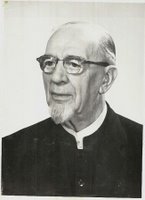 To compensate for his loss of sight, he had various capabilities and skills to fall back upon. In his youth, he had memorized a great many poems, and vast amounts of Scripture, so he could call up from memory these beloved passages. I have another vivid recollection of him—he and a friend, William Meikle (who for years taught at Messiah College and was himself a remarkable man: he lived in Harrisburg, some 15 miles from the college, and walked from his home to the college and back again!) would get together and entertain each other by reciting poetry.
My grandfather, who was a minister, also compensated for the loss of his sight by memorizing the number of steps he needed to take to get to specific places. Since he was sometimes called on to preach as a visiting minister, he memorized how many steps from the back of these churches to the pulpit in front, so that when he entered he could stride with purpose to the front. He always carried the quintessential blind person’s cane—tipped with white—and swung it back and forth in front of him, but always with purpose, never with hesistancy. When he moved to a retirement home, he and another elderly man would go for walks. My grandfather loved walking and would stride along. He compensated for his diminished vision by linking arms with this other man, who was unsteady on his feet, but clear-eyed. Thus my grandfather and his friend supported each other, together making a grand walking pair.
He was an inveterate letter writer, and continued to hand write letters to family and friends by guiding his pen along the paper with his non-writing hand, feeling where the edge of the paper was so he would stop writing. When his writing became too slanted, as he tended to write “up hill” using this method, and also began to overlap, he determined to learn how to type. So, blind and in old age, he taught himself to type. Tapping out on a manual typewriter, he resumed his letter writing. He put that typing skill to good use, as when his first wife (my grandmother) died, and he decided to “court” a woman who was a practical nurse at the nursing home where my grandfather lived, he did so in part by typing poems to her that he composed. I found some of these poems among my step-grandmother’s possessions after she died (I was the executor of her estate).
Several years ago, I wrote a biography of my paternal grandparents. In the course of doing research on them, I came upon a story about a conversation my grandfather, John, had with a brother of his, Laban. They were both in advancing years, and as they sat on a porch visiting, they had this interchange:
 To compensate for his loss of sight, he had various capabilities and skills to fall back upon. In his youth, he had memorized a great many poems, and vast amounts of Scripture, so he could call up from memory these beloved passages. I have another vivid recollection of him—he and a friend, William Meikle (who for years taught at Messiah College and was himself a remarkable man: he lived in Harrisburg, some 15 miles from the college, and walked from his home to the college and back again!) would get together and entertain each other by reciting poetry.
My grandfather, who was a minister, also compensated for the loss of his sight by memorizing the number of steps he needed to take to get to specific places. Since he was sometimes called on to preach as a visiting minister, he memorized how many steps from the back of these churches to the pulpit in front, so that when he entered he could stride with purpose to the front. He always carried the quintessential blind person’s cane—tipped with white—and swung it back and forth in front of him, but always with purpose, never with hesistancy. When he moved to a retirement home, he and another elderly man would go for walks. My grandfather loved walking and would stride along. He compensated for his diminished vision by linking arms with this other man, who was unsteady on his feet, but clear-eyed. Thus my grandfather and his friend supported each other, together making a grand walking pair.
He was an inveterate letter writer, and continued to hand write letters to family and friends by guiding his pen along the paper with his non-writing hand, feeling where the edge of the paper was so he would stop writing. When his writing became too slanted, as he tended to write “up hill” using this method, and also began to overlap, he determined to learn how to type. So, blind and in old age, he taught himself to type. Tapping out on a manual typewriter, he resumed his letter writing. He put that typing skill to good use, as when his first wife (my grandmother) died, and he decided to “court” a woman who was a practical nurse at the nursing home where my grandfather lived, he did so in part by typing poems to her that he composed. I found some of these poems among my step-grandmother’s possessions after she died (I was the executor of her estate).
Several years ago, I wrote a biography of my paternal grandparents. In the course of doing research on them, I came upon a story about a conversation my grandfather, John, had with a brother of his, Laban. They were both in advancing years, and as they sat on a porch visiting, they had this interchange:
John: It's not so bad to be blind. I'd rather be blind than be deaf.
Laban: Oh, no! It's not so bad to be deaf. I'd much rather be deaf than blind.
What struck me about this marvelous conversation between two old men is that they had each accommodated to the infirmity they had. Neither begrudged his limitation.
I have been thinking of my grandfather lately and his ability to forge ahead in spite of diminished eyesight, partly because I recently had surgery on my eyelid. I had a small red spot that had stayed put for almost a year. After asking three doctors about it, I finally was treated by an oculo-plastic surgeon who removed the spot, had it tested by a pathologist, and determined that it was a basal cell cancer. It has all been removed, but the presence of such a growth so close to my eye freaked me.
As someone who majored in literature in college, I know that the loss of eyesight is frequently a metaphor for gaining knowledge. Take, for example, Oedipus. He pushes and pushes for knowledge, trying to unravel the secret of his background as well as the cause of the curse that afflicts Thebes. Time and again, he is warned to cease his quest, that it could only end badly. One of the most urgent cautioners is the blind prophet Tiresias, who Oedipus accuses of lying. When Oedipus eventually discovers the truth, and learns all that he has done, albeit in ignorance, he cannot stand what he has learned, and seizing his wife/mother’s Jocasta’s brooch, he blinds himself. Once deprived of sight, he can fully see his predicament.
And, of course, there is John Milton, the famous poet who having become blind continued to write poetry composing it in his head, and then dictating to his daughter and aides who faithfully recorded it. Thus was Paradise Lost, Milton’s great masterpiece written. Here is the sonnet he wrote when he first became blind.
--------
Sonnet: On his blindness
When I consider how my light is spent,
Ere half my days, in this dark world and wide,
And that one talent which is death to hide,
Lodged with me useless, though my soul more bent
To serve therewith my maker, and present
My true account, lest he returning chide,
Doth God exact day-labour, light denied?
I fondly ask; but Patience to prevent
That murmur, soon replies, God doth not need
Either man's work or his own gifts, who best
Bear his mild yoke, they serve him best, his state
Is kingly. Thousands at his bidding speed
And post o'er land and ocean without rest:
They also serve who only stand and wait.
----------
Oh, yes, folks, the eyes have it.
Subscribe to:
Posts (Atom)