Showing posts with label disasters. Show all posts

Tuesday, October 30, 2012

It's Not Nice to Fool Mother Nature

I wonder how many of you will recall that commercial from a number of years ago.  The tag line of the commercial was “It’s not nice to fool Mother Nature” whereupon Mother Nature stands up and with a wave of her hands—boom--thunder and lightning.


I couldn’t help but recall that commercial with its closing line as the predicted Hurricane Sandy bore down on the East Coast of the United States.  Even now, a day after the hurricane has blown through central Pennsylvania—on its way to the Midwest—the storm is wreaking incredible havoc.  Manhattan, New York City has been hugely affected—power stations exploding disrupting power, cranes dangling from building construction sites, cars trapped in or out of Manhattan with bridges and tunnels closed. 
Of course, post-hurricane there will be debates—has global climate change made such super-storms inevitable?  I have read enough to know that climatologists are careful to talk about long-term trends, and steer us amateurs away from drawing hasty conclusions about individual weather events being caused by global climate change.  So, they are comfortable attributing the many heat records that were broken this past summer and the widespread extended drought to global climate change.  They are less comfortable attributing a single storm such as Hurricane Sandy to global climate change.

I find this whole topic maddening.  It is emblematic of a weird tendency in the U.S.—the tendency to subject something that either is (or isn’t) to a popularity contest.  So, polls are conducted to determine if people BELIEVE in global climate change.  And, while you might not think something such as global climate change would be an indicator of one’s political leaning, we find that depending on whether you are a Democrat or a Republican, global climate change is or is not happening.  85% of Democrats say there “is solid evidence of warming” as compared to 48% of Republicans who accept that.  (Source: Pew Research Center) (Incidentally, more than 70% of so-called Tea Party adherents do NOT believe that global climate change is occurring.)
Where my anxiety goes off the scale is when the political ramifications come to play in WHO provides leadership in our national governmental structures on these issues.  Where the Republican platform four years ago had an extensive section on climate issues, the whole topic of climate has disappeared from the Republican platform.  Thankfully, the Democratic platform still deals with global climate change.  I know, I know—the platforms don’t mean much.  They simply give a snap-shot of what matters to the respective parties.

It should come as no surprise that our regard for science—or, I should say, our lack of regard—has an effect on our success in science education.  A recent report found that the U.S. is lagging behind many countries in various subject scores.  As the report notes, we might have won more Olympic gold medals, but we aren’t winning gold in education areas including science.  Who ranks first in science?  China.  The U.S. ranks 23rd.  (Source: Huffington Post article)

I do not blame our public education system for this decline—not at all.  I blame the pervasive attitude in the U.S. that science just doesn’t matter.  After all, you can subject it to a popular vote—if most people don’t believe it (whatever IT is: global climate change, evolution, you name it), then it must not be true.  Not only is it NOT true, but it has to be disputed at every turn.  Layer on top of that scorn a constant drum beat of fascination with the most mindless topics imaginable—can you say Snooky? Honey Boo-Boo?  Boxers? Or Briefs?  (All those topics have been asked of recent candidates for President, where the candidate’s position on global climate change has NOT been asked.) 
Well, Mother Nature gets the last word.  It’s not nice to fool her.

Friday, March 12, 2010

A Thin Veneer

It seems that I often reflect on issues by making reference to my diverse career. It’s true—I have worked in a variety of places. At one time, I worked for the state medical society. While there, one of the physicians with whom I came in contact was a specialist in elder care. We were talking about what to do with doctors who are difficult to deal with as they age. His remark has stayed with me. He said—people don’t change with age, the patina just wears thin.

Now, this is not a post about aging. But it is a post about the patina wearing thin; the thin veneer of what makes us human that gets rubbed away over time. I have been thinking about the veneer of civilization and how quickly it wears thin. Sadly, we have had two recent examples of this inclination with the two earthquakes, first in Haiti and then in Chile.

In Haiti, with aid slow to arrive, people took whatever steps they could to provision themselves and their families. Unfortunately, some of those steps included inhumane acts. Events spiraled out of control as crowds overran water provisioning stations. There were reports that armed citizens intent on getting what they felt they needed killed other citizens. When soldiers didn’t restore order, the crowds tried to establish their own order but soon dissolved into mayhem.

Hard on the heels of the Haiti earthquake was the one in Chile—while unrelated geologically, these two events shared the sad aftermath of looting. Because Chile has tighter building standards, more people survived the earthquake, but the deprivation was very like that experienced in Haiti. Looters began ransacking grocery stores and warehouses. The outgoing president of Chile Michelle Bachelet had imposed a curfew, but did not initially call out the military. Chile has a troubled past where military rule is concerned, and I heard at least one report that hypothesized that since President Bachelet had herself been a victim under the former Pinochet government, she was reluctant to invoke military authority. Eventually she did call out the military to restore order.

The New York Times captured perfectly the abhorrence of looting noting in
a recent article that “Residents who formed self-defense posses were quoted saying that the “human earthquake” was worse than the geological one.” The human earthquake!

This article explores a difficult theme: when do people have the right to take what they lack? While I could argue that an equitable distribution of resources is a good thing, arming oneself with a machete and going after your fellow citizens is NOT. The thin veneer.

This theme is not a new one. One of the most powerful and disturbing books I read is William Golding’s Lord of the Flies. The book demonstrates how thin the veneer of civilization really is. Sounding rather like the plot line for an episode of the current TV show “Lost,” the novel features a group of British school boys whose plane crashes. All the adults are killed. The boys who survive decide to set up their own civilization.

At first, the boys manage to form some semblance of order, including getting a fire going. But it does not take long until the boys split into two groups, with one group more or less being “civilized” while the other groups becomes very savage and begins to hunt the other boys.

It is a difficult read—the final word in the story comes from the adult who finally rescues the boys. Finding the boys engaged in their savage fighting in the climactic scene—where, after killing two boys, the savage group is hunting a third boy—the adult remarks that he would have expected better of British school boys.

I don't know how to preserve the thin veneer--except to do what I can to respond to human need, and to avoid rubbing away the veneer of humanity that binds us all together.

Monday, January 18, 2010

Dust to Dust

Watching the news about the horrific consequences of the tragic earthquake in Haiti has got me thinking about dust.

With the first images coming out of this natural disaster, I have been struck with the way most people are covered in dust. Now, almost a week later, there are a few heart-warming stories of more survivors who are being pulled from the wreckage--and always, there is the dust.

The instant impulse is to cringe at the sight of so much dust--but then I got to thinking. There is an immortality to dust. One of my favorite church services in the cycle of the Christian calendar is Ash Wednesday. I grew up in a church tradition that did not emphasize the liturgical church calendar, so I came to Ash Wednesday services later in my worship experience. My personal faith tradition is solidly Protestant, but the current pastor of our church has a fine sense of the symbolism that a more liturgical approach affords.

He led us in our first Ash Wednesday service about a decade ago. Part of the service included the imposition of ashes--where we all go forward, and receive the sign of the cross on our foreheads. The ashes are derived from the burning of palms from the prior year's Palm Sunday service. For someone who loves and values poetic symbolism, I thrill to this cycle of meaning.

As each worshipper approaches the pastor, he asks our given name, and then says "Donna, remember that you are dust and to dust you shall return."* Now, you might think that smack of mortality would be depressing--but it's not. In fact, I find it reassuring. I am dust.

I find myself thinking about the endless cycle of life that dust encompasses. Even after we perish and return to dust, from that dust new life emerges. Some people hear that statement--you are dust and to dust you shall return--and despair. Not me. I hear that and think--how wonderful: Dust from the beginning of time still encompassing cells from the beginning of time, and continuing on into the forever.

There are two wonderful poems that capture this sentiment so much more artfully than I can express. X. J. Kennedy is a contemporary poet, and Walter Raleigh is--yes, that Walter Raleigh. His poem was written in 1618, the year he was executed by order of King James I--yes, that King James.


IN FAITH OF RISING
by X. J. Kennedy

When all my dust lies strewn
Over the roundbrinked ramparts of the world
I can be gathered, sinew and bone
Out of the past hurled
Delaylessly as I
Flick thoughts back that replace
Lash to dropped lid, lid to eye,
Eye to disbanded face
No task to His strength, for He
Is my Head—Him I trust
To stray the presence of His mind to me
Then cast down again
Or recollect my dust.


EVEN SUCH IS TIME
by Sir Walter Raleigh

EVEN such is time, that takes in trust
Our youth, our joys, our all we have,
And pays us but with earth and dust;
Who, in the dark and silent grave,
When we have wandered all our ways,
Shuts up the story of our days:
But from this earth, this grave, this dust,
My God shall raise me up, I trust.

-----------
*Genesis 3:19
Portrait of Walter Raleigh and son from the National Portrait Gallery, London

Sunday, March 22, 2009

In A Wooded Glen

For the past several days, I have been away from home attending a national advisory committee meeting. This is the same group for which I traveled to California last fall, and to New Orleans a year plus ago.

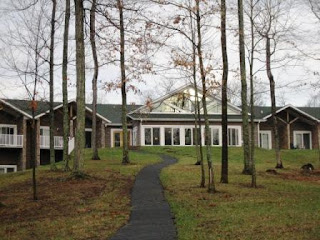
Since we meet twice a year, we try to meet once in a location where we have helped with disaster response and recovery, and once in a location near our national church headquarters. This meeting was in a wooded glen, actually at Wooded Glen, a lovely retreat facility near Louisville, Kentucky where the PCUSA headquarters are located.


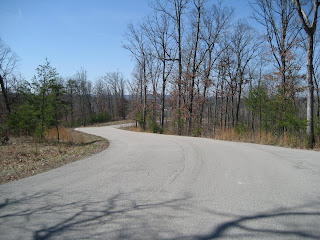
The winding road that you drive along to reach the lodge is still there. This is the road that I carefully inched my way down last year in the fog.


Since I remembered this time to bring a camera along, I can show you what the place looks like.

Herewith:


The view from my room window in the early morning.


The beginning of a lovely spring sunset.


A line-up of rocking chairs, just waiting for those meetings to end.


A pair of Canada geese on a small lake.


The checkerboard sets at the lodge!


The fireplace at the lodge.


I tend not to sleep particularly well when I am away from home. So I awoke one morning at 5 a.m., and listened to the marvelous sounds of the woods around me. I watched a quarter moon and its reflection dance off a small lake, and gazed at stars I rarely see with all the light pollution in central PA.


Another view of the small lake.

I also heard an early morning bird that sounded like a poor-will's widow--but not quite. I am not adept on bird calls, so it may have to remain a mystery.

As I drove away from the wooded glen, there was a glorious sunrise--the sky all washed with peachy pink glow, and a line of clouds around the perimeter of the sky made the entire sky glow. No fog to drive through this time. As lovely as the place is, I am now (gratefully) safely home.

Wednesday, October 22, 2008

Ring of Fire

If ever there were a woman who steps right out of the proverbial Garrison Keillor place "where all the women are strong" it was this woman. Her name is Kristen, an attestation to her Swedish background.


Her place was the last stop in our fire "tour." When we arrived at her place, we were greeted by the resident small herd of goats. They came ambling out, all full of curiosity.


We gathered in the shade of a large tree, and sat down to hear Kristen's story. She lives near Ramona, CA, with her husband, who is completely an invalid, having been rendered wheel-chair bound by severe arthritis.


She began to recount the events of a year ago--the fires struck their place on a Sunday. Her husband had wanted to go to church, but Kristen was uneasy, so they stayed home. As the fires pressed closer to their place--surrounding them in a ring of fire--she first got her husband into the van, along with their dogs and cats. Once she had driven him to safety, she returned to their place. She let the goats out, and they scattered. Then she released a pot-belly pig they had. She returned to her house, trying to get two remaining cats out.

She saw the wind driven embers fall on a wooden deck on the back of the house. Frantically, she tried to beat the flames back with a shovel.

All the while she recounted her story, she was somewhat matter of fact. But when Kristen got to part of the story about beating back the flames, her voice caught. She stood there for a moment, and then apologized.


She continued--she went down to the main road, close by, to try to hail some passing motorist to help her. A van came by with county prisoners who had shovels to help beat out the small fires flaring up. She persuaded the county official with them to let them come help her. As they pulled into her driveway, her house went up in flames.

Too late, the county official said. There's nothing we can do.

After hearing this heart-rending story, we sat quiet--what is there to say.

Once the fires had burned out, the goats returned. One of them had severe burns on her face and ears, but they all survived. Now, a year later, the goats continue their main task--eating the brush around Kristen's place.

Kristen and her husband have had a new house built--this time they were able to have it constructed to be handicapped accessible. Amazingly, Kristen said--that's a blessing.

As with Tom and Diane, Kristen also said--I just didn't think the fires would get us. Their place had been cleared of brush--thanks to the goats. But once the Santa Ana winds begin to blow, pieces of burning ember are picked up and can strike with great ferocity, even impaling glass windows. A house built with non-combustible materials can still burn once a burning ember comes flying through a window.

Her story told, Kristen went to her house and got her husband, bringing him down to see us--driving him in the van. We lingered a bit in this lovely spot--eating our box lunches. We even had brought several box lunches along for Kristen and her husband. The goats offered to help us with our lunches!


At each of the places we went to, we brought a small gift for the people who told us their stories. We had a silk scarf for each family--the scarves were made by survivors of the December 2004 tsunami. There is something wonderfully symbolic about these silk scarves--they embody the possibility of recovery. Life does go on, people who survive such great tragedy can regain their lives. It takes time--but with the help of work done by PDA (and many other fine organizations) the recovery will happen.

Monday, October 20, 2008

Smile When Your Heart is Aching

It has been my experience that some people in life are just determined to be miserable no matter what. And some people are upbeat even in the face of the worst adversity.


The second family that we met, as we surveyed recovery work being done by Presbyterian churches in the San Diego area, consisted of Diane, her son Mark and the dog Max. Diane's place is called Leaning Oak Ranch--it is really an 11 acre enclosed area. The leaning oak was a once tall lovely tree that burned to the ground in the fires.


As with the other people whose stories we heard, Diane said she was watching the fires as they raged around where she lived. Her house was down in a somewhat sheltered ravine, so she thought the fires would pass her by. Her neighbor whose house was a quarter of a mile away had external propane tanks. When the fires hit the neighbor's house, the tanks exploded, spewing burning fuel everywhere. Diane's house caught fire, and everything went.


Diane exuded a life affirming aura. Even though her place was gone, and the recovery efforts treated her as though she were a human pinball, she bubbled with affirmation. She immediately set up hummingbird feeders. She also planted flowers, and vegetables. Even the burned down oak is beginning to sprout new leaves.


To help her, the church built her a shed. She lives on the property, in a small motor home. She is afraid to leave the place, because looters have hit her place, stealing the few possessions she has left. As if life had not already dealt her a bad hand, her mother is in a hospital miles away


It is amazing that someone who has gone through the fires around San Diego last year could still be smiling after having lost everything, but Diane is still smiling.

Saturday, October 18, 2008

Where There's Smoke. . .

One of the advantages of my being a member of the national advisory committee for PDA is that I get to see various parts of the country. True, where we tend to go are those places where disaster has struck.

I have spent the last several days in San Diego, California. Exactly this time last year, they suffered devastating fires, and we were here to see the recovery efforts that have been taken by local Presbyterian churches. It is truly heartening to see how many just plain good folk there are out and about.

Just as with my visit to New Orleans last October, I was not on a trip to be a tourist. So, I by-passed many of the sights to see in San Diego. Oh, sure--we traveled around the area, but in each case we were going to see people whose lives had been devastated by the fires.


Today I will tell you Tom's story. He was born in Japan, but came to the U.S. decades ago. Just 2 years ago, his daughter and her family came to live with him. Last year's fire destroyed Tom's American dream. He lives in the environs of Ramona, CA. When the fires started, he kept watching and thinking--it won't come here, it won't come here. His house had a commanding view overlooking a valley.


With his daughter and her family safely away, he watched to see where the fires would go. Just as with each of the people we went to see, Tom said--suddenly the fire was there, virtually all around. He jumped in his vehicle and drove for safety. When he was able to return, everything was gone.


In helping him recover, the local church built a garage for him. Tom works as a handy-man repairing various machines. So, he not only needed a place to continue his work, but also to store his tools. The church also built him a tool shed--in fact, a shed is the first thing they build anywhere. A shed is small enough it doesn't require a building permit; it can be locked, and thus provides a place to store property. Sadly, looting is a post-fire problem.

Tom was so moved by the help of the church that he now goes along with them, volunteering and rebuilding other people's lives.


Tom's house has not yet been rebuilt--he hopes that will happen soon. Meanwhile, he has been living in this RV home, while his daughter and her family live elsewhere.

More stories in future posts.

Wednesday, September 03, 2008

Poor Pearlington

About a year ago, I travelled to the Gulf Coast, as a member of the Presbyterian Disaster Assistance advisory group. One of the places we visited was Pearlington, Mississippi.

It was with great sadness that I read today that Pearlington was once again hit hard by a hurricane, this time Gustav. And now folks are wondering if they should just pack up and leave. The New York Times featured an article on this tiny place. As the article notes:

"Now, Pearlington once again finds itself facing a painful question: Is it worth
it to rebuild?
Flooding from the latest hurricane covered roads and stranded several residents who could not bear the thought of leaving what they had only just renovated. The damage meant more construction bills, more calls to the insurance agent, more tearing out waterlogged walls and more neighbors who just disappear."

Read the whole piece here.

Disasters always affect people, as well as buildings and such. Life is sometimes too hard. Think about the people in Pearlington this week. And hope that the two new hurricanes forming in the Atlantic spare other small places such as Pearlington. And, if you are so moved, you can give time or money to help.

Thursday, October 25, 2007

The New Orleans Saints

No, this is not going to be about the football team—this post is going to be about the REAL New Orleans Saints—all the people who suffered through the devastation of Katrina, and stayed around to rebuild, and all the people who have gone to New Orleans to help the city recover.


There is a palpable difference between the Katrina recovery efforts in Mississippi and in New Orleans. Many factors contribute to that difference, and it is obvious that politics has played a significant role in that recovery. Immediately after Katrina had blown through the area, the governor of Mississippi was in contact with Washington DC. Perhaps you recall that the governor is Haley Barbour, formerly chair of the Republican National Committee. He received promises of aid from the White House that seemingly set a benchmark for federal aid.

You have no doubt heard of how dysfunctional New Orleans’ and Louisiana’s politicians were immediately before and after the storm. When they finally got around to requesting federal aid, they expected, reasonably, a level of response equal to what Mississippi got. Of course, the extent of damage was so much greater in New Orleans, and the White House balked. So the actual dollars, on a per capita basis, tracking to Louisiana for recovery is far lower than the funds that went to Mississippi.

Understandably, residents of New Orleans are deeply suspicious of the various government forces. This week’s election of a new governor in Louisiana bears testament to that. A young woman who drove me to the airport also bore testament to it—she said she can’t help but think that the government ALLOWED the levees to fail!

That’s enough said about the impact of politics on the recovery efforts. Money is the engine that drives the recovery machine.

After our visit to Mississippi, we drove around parts of New Orleans to see the damage. There is a seeming air of normalcy as you drive through neighborhoods, until you begin to look carefully and closely up and down streets. Apartment complexes stand empty—row after row of buildings that have been mucked out and the resulting pile of debris sits at the edge of a sidewalk. No rebuilding has gone on partly due to lack of finances for large scale reconstruction. So apartment complexes are devoid of life—no cars, no bikes, no kids.


Our next stop was a home dedication in New Orleans East. If you look at the map (see end of this post) of the section that we visited, and increase the resolution, you see a lot of blue—those are NOT swimming pools. Those are blue tarps slung over roofs that were damaged when Katrina winds ripped away the tiles.

New Orleans East was long outside the city of New Orleans’ limits, but in the early 20th century people began to build permanent homes there, as suburbs spread out. Initially, it was planned to be an area for wealthier whites, but they moved elsewhere, so middle class African-Americans, escaping poor areas in the downtown, moved there.

A combination of the effect of Hurricane Katrina itself, and the resulting breeching of the levees, caused much of the area to flood and with it the homes. The rebuilt home that we went to help dedicate was one such place. This place is now the home of Carol and Rudy. When Katrina hit, they were living elsewhere, and their home at that time was a single story home that was flooded with 11 feet of water in it. It was damaged beyond repair. So they were moved into a FEMA trailer. They tried to rebuild a semblance of their former lives, but the situation simply overwhelmed them. By his own words, Rudy suffered a near break-down. He would go to his sister-in-law’s house, and say—I just can’t stay in that trailer anymore.


The sister-in-law lived in New Orleans East, and nearby her place was a storm damaged house for sale. This house had 18 inches of water inside it, so it could be rehabbed. Here is where PDA stepped in. Because Carol and Rudy met the financial criteria, they qualified for rebuilding assistance. After they bought the house, and it was gutted, Rudy, still unable to stand staying in the trailer, would go into his new but damaged house and just sit on the floor.


In a city that had 80 % of its land mass flooded, that had 90 % of its resident evacuated, that had most of its protective levees breached which caused the majority of the flooding—in this city, it was a moment of sweet grace to stand in Carol and Rudy’s home. We gathered there, volunteers, visitors, Carol and Rudy and some of their family members—joining hands and singing “Amazing Grace.”


Thank goodness I have this image to replace the negative ones that haunt me: people stranded on roof tops, pleading to be rescued; people hacking their way out of their attics using axes they had placed there in a prior hurricane; pets wandering totally abandoned because their owners were forbidden to take them along; thousands gathered at the Superdome begging for someone, anyone to rescue them; police standing on the Gretna Bridge firing shots over the heads of people fleeing New Orleans; Michael Chertoff blithely responding on the evening news that he was unaware of a problem at the Superdome; President Bush standing in front of St. Louis Cathedral bathed in white light with no one around.

Amazing grace?—you bet. The deliverers of that grace are the true New Orleans’ saints—the people who survived and are rebuilding, and the volunteers from church organizations and from other organizations who come to help.


This statue of the Virgin Mary stands outside Rudy & Carol's new home
-----------------------

This is the last post on my visit to New Orleans and Mississippi. As I write this, I am listening to Fresh Air with Terri Gross interviewing Terence Blanchard who wrote music called "A Requiem for Katrina" to accompany Spike Lee's film A Tale of God's Will. And, of course, currently in the news are the fires in California, where 1 million people have fled their homes. Perhaps the lessons of Katrina will help others in disasters.
----------------
Map of New Orleans East--click on + to increase resolution and see blue tarp roofs

View Larger Map

Tuesday, October 23, 2007

Village People


Let me describe the conditions at Pearlington Volunteer Village.


Every volunteer who comes to work at this village for a week is given critical information to make sure no one is surprised. People sleep in pods—these are plastic huts that are set up on wooden floors. The village managers are working on getting air conditioning and heating into each pod, since the outdoor heat can be excessive, and the pods have no insulation or means of keeping cool. The pods have no electricity, though that is being worked on.


Meals are eaten communally. Everyone shares breakfast, and then gets set to head of to work sites. If they are not within easy access to the Baptist church doing the lunch feedings, the volunteers pack a lunch to take along. Then they head out for the day’s work.


People are advised to bring their own tools, and supplies if possible. The work that is being done varies depending upon the condition of the house being worked on. Most of the mucking out, of clearing debris, and tearing out ruined interiors, has been done. Now comes the rebuilding, or even the total building. Once framing is in place, dry wall is installed, electrical wiring put in place, plumbing done. Obviously, the difference between the mucking out stage and the rebuilding stage has changed the demand for work level skill. Now the great need is for people who know what they are doing with the electrical and plumbing stage. Of course, once the interior work is done, painting needs to be done.

After the long day of work, volunteers return to the village, and shower. The sinks for washing up, shaving or brushing teeth are outdoors. Toilets are porta-potties. I refrained from taking a photo of those!


Some of the volunteers come along to cook. The kitchen is probably the most civilized looking portion of the village.
Each evening, the group holds devotions. Many people who have made the trip reflect on the need to process what they have seen and what they are doing. The evening devotions helps to lend a time of quieting, of settling their minds.

Even with these most primitive of conditions, we met people at lunch who were returning for their second, or even third trip. Many faith groups and other groups continue to respond to the incredible need of this area. Frankly, without these volunteers, it is difficult to imagine that governmental agencies would have known what to do, much less muster the will and resources to do it.

The items hanging from the support beams of the dining tent are the name tags of volunteer workers who have come and gone--leaving their tags behind is a kind of symbolic way of leaving a bit of their hearts behind.

Sunday, October 21, 2007

Down in the Bayou

On the first day of our multi-day advisory committee meeting, we went touring. At 7:30 in the morning, we left New Orleans and drove east along I-10. Just as we crossed the Mississippi state line, we exited on to U.S. Route 190, connecting to Route 90. Within 10 miles, we were entering the small “town” of Pearlington.

Pearlington is really a “census-designated place.” I am not sure, but I suspect that is government-ese for “this town isn’t big enough to be called a town, but people are living here. . . so we’ll DESIGNATE it as a place.” About 1,600 people live there, of whom 77% are white and 20% black.

So, why all this information on Pearlington? Well, this little place was effectively ground zero when Katrina hit. The eye wall of the hurricane passed right over Pearlington. Here’s how someone who is keeping a blog about the recovery described it:

It is impossible to comprehend, in the comfort of our own homes, what it must be like to lose everything in a single day.
On Monday, August 29th, just after 10:00 a.m. local time, Hurricane Katrina made landfall, with the eastern eye wall directly over Pearlington, MS - sparing New Orleans the direct hit. Every home, building and vehicle in this town of 1600 was destroyed. If that wasn’t enough, a storm surge travelled 4.5 miles inland and drowned what little was left under 12-20 feet of the most toxic stew imaginable.
Since that day, a hardy coalition of volunteers - representing almost every faith, state, Canadian province, two European nations and an eastern Asian country - have travelled regularly to Pearlington to rebuild this forgotten bayou town.

Source:

While there are several churches in Pearlington, many of them some type of Baptist, there is no Presbyterian church there. Yet, I am told, the Presbyterians were among the first disaster recovery people there. One of the lessons we learned (mentioned in the previous blog) is that for volunteers to come and help rebuild, they need a place to stay. So Presbyterian Disaster Assistance (PDA) has set up a series of Volunteer Villages. One of these is in Pearlington.

We first met with some of the volunteer leaders, then headed off to lunch. The place for lunch was the fellowship hall of the First Missionary Baptist Church. Its sanctuary (pictured above in a photo gleaned from another website) had been rendered unusable by the storm, but the Fellowship Hall, once scrubbed out, stood strong. So the pastor and his congregation decided their ministry would be feeding whoever came to town to work, and anyone else, for that matter. They have continued this ministry now for more than 2 years.


Lunch was freshly caught fish, Southern fried, rice, green beans and ham, corn, cole slaw, salad, fruit salad, and corn bread. I was really struck by the simple but sumptuous meal. During our meeting, I had led devotions for our group, using the account of the miracle of loaves and fishes where Jesus fed the 5,000. And now at lunch, here we all sat, side by side, white and black, town people, volunteers from every place, even a crew of county inmates who were doing yard clean-up, eating "loaves" and fish.


Everywhere we walked in this little town, we could see newly built houses. We also saw trailers scattered here and there. We saw dogs that just wandered into the volunteer village and stayed. The scene was chaotic, and very like a developing nation. It did not look much like the United States that most of us are accustomed to seeing.

But the place moved me. Pearlington will come back. People have stayed there. The one by-product of the storm that the workers there told us of is the new founded cooperation. They said—before the storm, black and white people tended not to interact much—but now they do. Storms bring adversity, but they also unite us.


This small child played in the muddy driveway leading to his family's trailer, right next to the Fellowship Hall of the First Missionary Baptist Church.

The First Missionary Baptist Church, as it is being rebuilt.