Wednesday, March 25, 2009

Heroines

Were I not a subscriber to the Daily Almanac, that Garrison Keillor brings, I would not have known of the convergence of birthdays today.

A more unlikely pair you cannot find, I think. Yet Flannery O'Connor and Gloria Steinem share a birthday today. And each has been a heroine to me.

I suspect many people who know me well would say I am a feminist. Yes, I am. But I am not a strident one. I never burned my bra, for example. If pressed to define what kind of feminist I am, I may just offer my life--upon graduating from college, and getting married, and starting a family--I never stopped working. I worked the year my son was born--he was born at the end of January, I took February off and then resumed teaching. When my daughter was born, I worked the day before she was born, took three months off and then returned to working.

So I guess I would say that I am a feminist in terms of life choices--not marching, not philosophizing, just being.

Gloria Steinem was/is a feminist heroine for me. She is a very attractive woman--belying the old myth that all feminists must be ugly (take that, Rush!). In fact, early in her career she was a Playboy bunny. That particular detail always horrified and amused me. She was/is whip smart. As the founder of Ms Magazine, she may have had as much influence on current populist feminism as any one person.


On the other end of the spectrum of this shared birthday is Flannery O'Connor. As a lit major in college, I came upon her darkly grim and humorous stories. I knew little of her life then, but in graduate school I did a lengthy paper on her and learned a bit. Flannery was painfully unattractive. And she suffered from lupus that would eventually rob her of mobility, and cause her premature death. She lived a somewhat solitary life, staying on the family farm in Milledgeville, Georgia. After her father's death, it was just Flannery and her mother plus a menagerie that included peacocks.


With all of her writing done in the first half of the 20th century, her stories anticipated the kind of disassociation that characterizes literature of the 20th century. One of the most famous of her short stories "A Good Man is Hard to Find" has the kind of grim ending that we have almost come to expect with current movies--example No Country for Old Men.

Yet through all this dark view of humanity, Flannery was a fiercely devout Catholic, and you can find glimpses of the possibility of redemption everywhere in her fiction. Her body of writings is not extensive, since she died in 1964 at age 39. Yet she influenced many of today's writers.


Two of my heroines--born on the same day.

Sunday, March 22, 2009

In A Wooded Glen

For the past several days, I have been away from home attending a national advisory committee meeting. This is the same group for which I traveled to California last fall, and to New Orleans a year plus ago.

Since we meet twice a year, we try to meet once in a location where we have helped with disaster response and recovery, and once in a location near our national church headquarters. This meeting was in a wooded glen, actually at Wooded Glen, a lovely retreat facility near Louisville, Kentucky where the PCUSA headquarters are located.


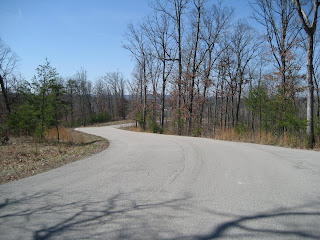
The winding road that you drive along to reach the lodge is still there. This is the road that I carefully inched my way down last year in the fog.


Since I remembered this time to bring a camera along, I can show you what the place looks like.

Herewith:


The view from my room window in the early morning.


The beginning of a lovely spring sunset.


A line-up of rocking chairs, just waiting for those meetings to end.


A pair of Canada geese on a small lake.


The checkerboard sets at the lodge!


The fireplace at the lodge.


I tend not to sleep particularly well when I am away from home. So I awoke one morning at 5 a.m., and listened to the marvelous sounds of the woods around me. I watched a quarter moon and its reflection dance off a small lake, and gazed at stars I rarely see with all the light pollution in central PA.


Another view of the small lake.

I also heard an early morning bird that sounded like a poor-will's widow--but not quite. I am not adept on bird calls, so it may have to remain a mystery.

As I drove away from the wooded glen, there was a glorious sunrise--the sky all washed with peachy pink glow, and a line of clouds around the perimeter of the sky made the entire sky glow. No fog to drive through this time. As lovely as the place is, I am now (gratefully) safely home.

Monday, March 16, 2009

Hamlet Has Gone to the Dogs

Since I promised (did I?) a review of The Story of Edgar Sawtelle, here goes.

Take Shakespeare's play Hamlet, add a hefty dose of dog breeding and dog training and what do you have? The Story of Edgar Sawtelle.

No kidding.

I wasn't that far into the book when I thought to myself--wait a minute, I know this story. Except for the main character's name being Edgar, instead of Hamlet, the parallels between this novel and Shakespeare's play are practically endless.

Let's do character names first. There is Edgar, the protagonist, his father Gar (presumably short for EdGAR) and his mother Trudy. In Hamlet, there is Hamlet, his father the Ghost (who you are told was old King Hamlet) and his mother Gertrude. There is Gar's brother Claude who has been away from the family homestead--the dog breeding place. In the play, there is the king's brother Claudius.


Of course, you remember Ophelia, the faithful long-suffering young woman who loved Hamlet beyond all reason. In the novel, that character is an extraordinary dog named Almondine. Two final characters linking are Dr. Papineau from the novel. He is a kindly, somewhat loquacious doctor. The mirror character from Hamlet is Polonius, a garrulous wind-bag of an old man who happens to be Ophelia's father. And there is also a mirror character in Papineau's son, Glen, who--like Polonius' son Laertes, tries to avenge his father's death.

With a tumbling host of dogs in The Story of Edgar Sawtelle there are plenty enough bit characters to fill up linkages to the various characters in Hamlet. One particular dog stands out--Forte. Forte is a legendary dog, mostly out of the time frame of the story. It just dawned on me, as I was doing these comparisons, that Forte is the mirror for Fortinbras, an important off-stage character for most of the play Hamlet.

Now to some plot elements. Where Hamlet begins with the father already dead, and haunting the castle at Elsinore, the novel begins with the story of Edgar's birth. Early on, the reader is informed that Edgar is born mute. I saw this detail as a wonderful twist on Hamlet's loquaciousness. Hamlet has more soliloquy lines than ANY other Shakespeare character.

When Edgar's father dies suddenly, Edgar and his mother naturally grieve. Edgar prefers to sleep in the barn close to the dogs, and one evening in a pouring rain, he sees a shape in the rain. The figure is of his father, who signs to him "remember me" and indicates that he may not have died a natural death. Oh, so like Hamlet. There, Hamlet encounters the ghost of his father, learns from the ghost that he was poisoned by his brother Claudius.

In Hamlet, Claudius is motivated by desire to take over the kingdom, and the queen. So too in Edgar Sawtelle. Claude eventually moves in, taking over the dog breeding business, and proposing to Trudy.

Hamlet tries to get Claudius to confess his guilt by presenting a play that features the recreation of the poison scene. He enlists the aid of a troupe of players who are visiting the castle. When they enact the death scene, Claudius rises, pale, and flees the room. The parallel scene in the novel involves the dogs that Edgar has been training. In a rather elaborate scene, he sets up to have one dog carry a glass syringe, the presumed mechanism for Claude delivering the poison to Gar, and present it to another dog. Eventually, Edgar has one dog trot over to Claude to tag him with the syringe. Claude gets very angry, his reaction setting off a pivotal scene.

A pivotal scene in Hamlet is when he confronts his mother in her bedroom, accusing her for taking up with Claudius. When Hamlet sees movement in a curtain, he rushes at it, stabbing with his sword. Out falls Polonius. The parallel scene in Edgar Sawtelle is when Edgar is with his mother in the barn, and thinks he sees a figure--perhaps thinking it his father--he lunges at it, while holding a bailing hook. He inadvertently hits Dr. Papineau, who suddenly appears, killing him.

Edgar flees, taking 3 of the dogs with him. He eventually encounters Forte, who is a kind of stray dog. I will skip the details of this escape interlude, so as not to spoil the plot, for those of you who plan to read the novel, and also to keep this post from getting much longer than it already is. One final word on Forte--just as in Hamlet, when Fortinbras appears to mop up the stage littered with bodies, so also Forte appears at the end of the novel. Enough said.

After writing this review of sorts, I did a quick Internet search and note that I am not the only one to have noted the similarities to Hamlet. I do want to aver, however, that I did NOT read them before I wrote my comparison.

What I found frustrating about Edgar Sawtelle is NOT that it is a reworking of a Shakespeare play--after all there have been many reworking of his plays. For example, West Side Story is Romeo and Julie, and A Thousand Acres is King Lear. My objection is that this reworking is somewhat inartful (is that a word?). If you want a good reworking of a Shakespearean theme, you will do far better reading A Thousand Acres.


My other primary criticism is that Edgar Sawtelle is a plot-driven, rather than a character driven novel. It is as though the author puts his characters in difficult situations, and says--OK, now what? A character driven novel, on the other hand, allows the events to grow out of who the character is.

When an author writes a plot driven novel, I get to the point, as a reader, where I feel like saying--LEAVE HIM ALONE. And that's eventually where I got to with The Story of Edgar Sawtelle.

Would I recommend the book? (You can't see it, but my hand, held out flat, is wavering back and forth.)
------------
The two illustrations:
German shepherd dog--the dogs in Edgar Sawtelle are their own breed, but there are references to the dogs having some markings similar to German shepherds.

The painting is by Eugene Delacroix, and it features the famous graveyard scene where the skull of Yorick is unearthed which allows Hamlet to say "Alas, poor Yorick. I knew him well." This is not a scene that is repeated in the novel.

Friday, March 13, 2009

In the Pink

Have you ever contemplated how colors can mean different things? The same colors--depending on context or culture--can have radically different meanings. Someone in a black mood is clearly not happy, whereas a business in the black is. If a person has a red letter day, that's good, but a business in the red is in trouble.

In the west, brides wear white; in some eastern cultures, they wear red. Eastern cultures reserve white for mourning, where western cultures use black for mourning.

Well, Friday March 13 is PINK FRIDAY. In solidarity with teachers in California, who will receive preliminary pink slips on Friday, my husband's employer--the PA State Education Association (which I belong to as a teacher) is urging people to wear pink.

So when we have our Friday night "date," my husband and I will both be wearing pink.

Think pink--remember all the wonderful teachers in California who will be saddened by a slip of pink paper.

Tuesday, March 10, 2009

Reading Miss Oprah

It's safe to say that reading is one of the passions of my life. I love to read. Make that--I LOVE TO READ. I am ALWAYS in the middle of at least one book. And I love to find and read "terrific reads"--I've even written about a few of those on this blog.

As an English lit major, I had better love reading. Out of curiosity, I began recording all the books I have read--as well as I can recall them. I try to write them down as I read them. Going back to my English lit days, I have read about 450 books. That means I have been averaging about 10 books a year. Hmmmm--I must have missed some on that list, as I know I read more than 10 books a year.

Painting: Young Girl Reading by Fragonard
Now that I have a Kindle (which I got as a Christmas present), I can read several books at once without making the book pile next to my bed too high. I have downloaded 6 books on my Kindle, and have finished one of those.

I haven't recommended a book as a terrific read for quite some time. The last book that I did recommend was Water for Elephants, which I finished in September, 2007. A few books that I read since then came close: Purple Hibiscus by the young Nigerian author, Chimamanda Ngozi Adichie, was very good. I also enjoyed Monica Ali's Brick Lane--but each of these fell short of "terrific read" because of a few flaws--example Brick Lane's fizzled ending.

So, what do I mean--Reading Miss Oprah. When it comes to picking books, I tend to eschew someone else's list: The NY Times bestseller list, or
Oprah's list. Pfffftttt--if I am not inclined, I won't read the book. But, this time, I did buy one that has the big OPRAH sticker on the front: The Story of Edgar Sawtelle. I am still midway in the book, so I won't know if I like this one or not for a bit.

Right before starting into Edgar, I read This Republic of Suffering. I found that work to be a marvelous piece of careful research. Written by Drew Faust Gilpin who is president of Harvard, the book details how the Civil War changed our view of death. Prior to the Civil War, death was a family affair--people died at home, surrounded by loving family. They were prepared for burial by family, and were lovingly laid in graves near their homes. The Civil War changed all that. Soldiers died under horrific circumstance, far from home, in absolute anonymity. Sometimes families did not even know if their sons, fathers, lovers, or brothers had died. The men died in battle, and lay on the abandoned fields of fighting for weeks and months after combat had ceased. Their corpses were left to the elements, and to scavengers--both human and animal. Rarely was a body shipped home. As a result of these radical changes in the manner of death, we never recovered that idyllic view of death that dominated pre-Civil War.

While the book is a terrific read (in my "book"), I recommend it only if the subject matter appeals to you.

So, now you can see why I needed to read Miss Oprah--after This Republic of Suffering, The Story of Edgar Sawtelle, about a mute boy whose father dies under mysterious circumstances, seems like a light read!

Friday, March 06, 2009

Teach Your Children Well

A number of years ago, Crosby, Stills & Nash came to town for a concert. My husband and I got tickets, and headed off to hear them. While I still love the close harmony of this vintage group, the concert was a bit of a disappointment for me. Why, you might ask? Because they didn't sing one number that I just love: Teach Your Children Well. (I did, however, manage to buy a T-shirt with that logo and words on it at the concert.)


My daughter knows how much I love this song--a kind of anthem for someone who is both a parent, and a teacher! She made a gift for me for some occasion--birthday, I think--in which she rounded up various photos of me with her and her brother, and then she typed the words to Teach Your Children Well, and framed the whole combination. It still hangs on the wall in my office where I can look at it daily.


Teach your children well. . .

And feed them on your dreams
The ones they pick
The ones you’ll know by.

Don’t you ever ask them why
If they told you, you would cry
So just look at them and sigh
And know they love you.


Two recent news stories got me thinking about these words. In a prior post a while back, I wrote how my husband and I taught youth Sunday School quite a few years ago. While our favorite means of engaging the kids was food, we did teach about other topics. One topic that came up was illness--and how Christ responded to people who are sick. Perhaps as a natural segue we began talking about AIDS, and sex education. After that lesson, one of the parents called us up absolutely irate that we would dare to broach that topic in church.

If I recall correctly, my husband got the call. He patiently, for a time, listened and queried the parent. The parent insisted schools should not touch the topic of sex education nor should the church. (Huh?) Besides, she said--her son was too young to learn about such things. Mind--he was in 6th grade at the time and had an older sister. I suspect he was already hearing a great deal about the topic. It came as no surprise to my husband and me that this young man and his girlfriend ended up getting pregnant just as their high school years were ending.

So, why am I writing about him. Well, a local news story of a day ago brought this news:


"Two ---- County men pleaded guilty to killing four whitetail deer out of season and firing in a safety zone too close to homes. Each paid fines of $2,340 and will have their hunting licenses suspended. . .The men were accused of shooting a pair of bucks on two separate occasions. Game Commission officers said the shots were fired as close as 75 feet from homes.

The illegal nighttime hunting, known as jacklighting, involves shining a spotlight at a deer so it freezes, making it a target. The game commission officer said dealing with jacklighting incidents takes up the bulk of law enforcement by wildlife officers. 'It's thrill killing,' he said. "
By now you are wondering the connection--well, this is the same young man. The one whose mother thought he was too young to learn about sex education, the one who got his high school girlfriend pregnant, is now the one who is a kind of scofflaw. Does it all fit together? Maybe I am being too harsh--but methinks someone did NOT teach this child well.

Second story--from the New York Times: entitled When Grandma Can't Be Bothered, this story broke my heart. First, let me say that I have not yet had the opportunity to be a volunteering grandparent, but I will most certainly volunteer, should the opportunity arise. Second, what I found heartbreaking about this story is that children need all the love they can get, and grandparents are a wonderful source of that love.

A study some time ago pointed out the benefits to children of available caring grandparents. These children thrive. They are taught well.
Well, I am done with this little reverie--now humming "Teach Your Children Well."


Monday, March 02, 2009

Calling the Names

A brief editorial note (though when I teach literature, I always say--never trust the poet to explain what she means)--I too frequently have conversations where I am saying something and--poof--just like that, the specific reference I wanted to make LEAVES my brain. It slips past my tongue without being said, and my brain refuses to re-supply it to my tongue. Until hours later--when I blurt it out.

Herewith such a conversation--of sort--in poetic form. An original poem for you, dear readers.

--------------

CALLING THE NAMES

I call out the names in random fashion
Black & Decker
Truman Capote
Bovine Spongiform Encephalopathy. . .
They have no connection to present reality
But short hours ago, they did.

We were strolling past some stores
Noting now vacant store fronts
And murmured--that's where. . .was--
But in that moment the name fled.

And then I wanted to remark
About an actor who had done a marvelous job
Portraying that writer
You know, the one who wrote
In Cold Blood
But the name refused to surface.

I read a recent article
That caught my attention
An explanation of Alzheimers
Prions are implicated
As in Jakob-Creutzfeldt
And you said--oh, that's like mad cow disease
But I knew that wasn't it.
But what? No name.

Then at midnight
The names arrive
And I call them out
Black & Decker
Truman Capote
Bovine Spongiform Encephalopathy. . .


But you are asleep
So tomorrow I will
Call the names
Without repeating the conversations
And you will understand.

© KGMom 2009

Friday, February 27, 2009

Stop Me if You've Heard This One

The one fear I have in telling stories on my blog is that I will repeat myself. No more sure sign of aging than repeating oneself. No more sure sign of aging. . .oh, I already said that.

Anyway, it's been a long time since I was stopped an officer of the law for a driving infraction. However, I have had my share. I am just hoping I haven't already written about those encounters.

Herewith, a few samples.

I have been stopped for speeding three times. Please understand, I am not heavy on the gas. But, nevertheless I must have a "please stop me--I am speeding" sign on my car.

The first time I was stopped, I had our son with me in the car. I was on a local expressway, and was travelling with the traffic. But, I was one of the cars pulled over that morning. When I went for my hearing, I tried the "I was moving with the traffic" argument. The hearing officer, who had absolutely NO sense of humor, said--just because everyone else does it, would you do it too? If everyone stuck their heads in an oven, would you? Huh? Too much of a parental approach.

The second time I was stopped for speeding, I was returning home from work, and this time our daughter was with me in the car. (I know--why are my children always with me to witness these infractions?) I was driving along a local road that has a posted speed of 25 miles per hour. One of our township's "friendly" officers was playing with a quasi-radar machine that day. It works by taking two points of reference, hitting a button when the car crosses the first and then again when it crosses the second. The machine then calculates speed. Based on that, he stopped me, and said I was going 40 MPH in a 25 MPH zone.

Now, I can get my "Irish up" so I challenged this ticket before a local magistrate. I also enlisted the help of an attorney friend of ours, who just happened to bring along to the hearing another attorney--who happened to be a priest. (It's a long story.) Anyway, when they walked into the magistrate's hearing room, the district judge said--hello Father So and So. Hmmmm.

When the local officer gave his testimony, he allowed as how that day he was letting drivers go if they were doing up to 30 + MPH, but I must have been doing more since he stopped me. Then, I was asked--how fast were you going. And I replied--I really have no idea, but I am sure I wasn't going 40. The judge ruled in my favor, since the local officer was capricious in whether he stopped people for speeding or not.

The last time I got stopped for speeding we were in upstate New York, visiting our daughter at college. We went out to eat near the college, and had to pass through a little town named Earlville. It was one of those one strip towns, where the speed limit drops from 55 to 40 to 25. Suspiciously, the speed limit signs are posted in such a way that you really couldn't see them, unless you knew the area. The great irony in this whole incident is that I am always the one to say--the speed limit changed here; slow down.

Anyway, as we drove through Earlville (I soon came to call it E-ville for reasons you will soon understand), I saw red lights flashing in the rear view mirror. I stopped the van. The local officer walked up to the window and asked--do you know why I stopped you. I said--I have NO idea. He told me I was speeding, told me where the speed limit changed, and wrote out a ticket with a hefty fine.

When we returned home, my husband took the ticket and called the local judge in E-ville. He learned that while I could appeal the ticket, I would have to drive back to New York, appear in person, and then very likely I would still be fined. So, I swallowed my principles, and agreed to pay the fine. I have never returned to E-ville, and will never return.

So, any speeding confessions out there, friends?

Monday, February 23, 2009

The End of Books?


An NPR story this morning caught my attention. The basic focus of the story is that some college campuses are switching away from textbooks and going to on-line versions instead. What? No books?

Well, that got me to pondering. Would the end of books be a good thing or not?

I remember watching the movie “Fahrenheit 451” with great fascination. Based on Ray Bradbury’s dystopic view of the future, the movie envisions a hyper-controlled world where books are outlawed. The temperature of the title refers to the degree at which books burn. People are encouraged to seek pleasure in various hedonistic ways. But they may NOT read. One of the great twists of the movie is that the firemen have the job of seeking out and burning books. Much of the plot turns on the attempts of characters to find and keep books. The movie ends with a refugee colony of people who have memorized books. The final scene is of them walking around, quietly murmuring their memorized book.

So, of course, a book is not specifically the paper on which it is printed. For Christmas, my husband got a
Kindle for me. While he was intrigued with the technologic possibilities, I read far more than he does. So he suggested getting ME one. At first, I demurred, but now that I have a Kindle, I find it a great new way to read. I can read the Kindle in places where books are not quite so handy—for example, while riding an exer-cycle.

The words on the Kindle screen are the same as the words on a printed page. The advantage, other than its shape and the instant access to books (which you “simply” download using cell-phone technology) is that you can look up word definitions or footnotes simply by clicking on the appropriate place.

But, back to college and whether or not we will see an end to books. Certainly, one of the advantages of going to on-line books is cost. Textbooks are outrageously priced. And, sadly, professors are somewhat like physicians. We order these textbooks and have no idea what they cost—just as physicians order tests or prescriptions with no idea of cost. The cost of a single textbook can be $200. Or maybe even more. The textbook that I am currently using in class (which was pre-selected by a faculty committee) costs about $50. I am aware of some college professors who write their own textbook and then require that text for class. Hmmm—can that be ethical? I don’t know if they get royalties or not.

So, how do on-line textbooks fit into this consideration? An on-line textbook is usually about half the cost of a paper one. Of course, I do wonder if you can sell the on-line version; many of my students are using second hand textbooks which naturally cost less than new ones.

Apparently, another major motivator for switching to on-line textbooks, other than cost, is that so much of what a student has access to in our present wired environment is on-line. Music, personal communication, calendars, information gathering, photo albums. . . .All on-line. So why not textbooks?

There is another consideration that causes me to pause in this mad dash to on-line textbooks. I recently read an analysis of how our wired environment is changing the way we think. The author pointed out that our tolerance for long discourse has plummeted. We simply don’t take the time to read long passages. He hypothesized that reading on-line combined with the instant availability of references that are cross-linked has changed how our brains are wired. We begin to read a piece on-line; we encounter an unknown term or a hyper-link. CLICK. We zoom away from our immediate reading task. And click again. . .and again. Next thing we know—we are far from our original assignment.

The end of books? Not for me. Oh, sure—I will keep reading my Kindle. I will surf the Internet, clicking further and further from my original place. But I will also finger the paper of a new book. I will look at the font, and admire it—even turn to the back to see if there is an explanation of the font. I will line books up on the shelves in my house. And, I will keep the 451 F firemen at bay.

Saturday, February 21, 2009

Saturday Soups-- Last Soup of Winter Season 2008/9

We come to the end of our soup recipes for the winter 2008/9 season.

Each day, the sun creeps a little higher on the horizon--the sunsets are a lovely coppery orange glow. With the promised return of spring, soup season (while not necessarily over) is winding down.


Last week, I suggested that I should have posted a RED soup, in honor of Valentine's Day in case you missed the reference. Well, here it is today--I know, I know--a week late, but hold on to the recipe until next year. Or, consider it comfort food for now. What can be more comfort food than tomato soup.


Classic Tomato Garlic Soup
Makes 12 servings.
This is an adaptation of a
MOOSEWOOD recipe.

INGREDIENTS

1/4 cup olive oil
10 garlic cloves, pressed (or very finely minced)
2 T. paprika

12 cups tomato juice (two 46 oz. cans)
2 cups water or homemade vegetable stock
1/2 cup dry sherry
3/4 lb. Fresh or frozen tortellini

HERBED CROUTONS:
6 cups small bread cubes pinch of dried thyme
3 T. olive oil pinch of dried marjoram
2 T. butter

1) Preheat the oven to 350 degrees F.

2) In a non-reactive soup pot, warm the olive oil. Add the garlic and sauté, stirring constantly, until sizzling golden, 1 to 2 minutes. Be careful not to burn the garlic!

3) Sprinkle in the paprika and cook for about 30 seconds more; be careful not to scorch the paprika or the soup will have a bitter flavor. Add the tomato juice, water or stock, and sherry. Cover the pot and bring the soup to a boil; then reduce the heat and simmer for 10 to 15 minutes.

4) While the soup simmers, make the croutons. Spread the bread cubes on an unoiled baking sheet and bake until crisp and dry, 10 to 15 minutes.

5) In a very small saucepan or in the microwave, heat the olive oil, butter, thyme, and marjoram until the butter has melted. Pour the herbed butter over the toasted bread cubes and toss to coat well. Let the croutons cool and crisp on the baking sheet.

6) Serve the soup topped with croutons, grated Parmesan, and parsley. Or for a different twist, add cooked tortellinis.

While in our household, I am unlikely to make this recipe with the garlic (my husband has an aversion to garlic) I have eaten this soup, and enjoyed it.

High on our list of comfort foods are tomato soup and toasted cheese sandwiches.

What are some of your favorite comfort foods?
------------

Friday, February 20, 2009

DISCLAIMER...It's Going Around


DISCLAIMER:
The following items are NOT original with me.
You might even have seen them before, as this list is going around the Internet.
But, they made me laugh. . .and, frankly, any time I can laugh, that is good.

Right now, I am knee-deep in round two of student papers, and, well, I need a laugh. . .
-----------------------
Some of the artists of the 60s* (and maybe even the 70s) are revising their hits with new lyrics to accommodate aging baby boomers. They include:

Bobby Darin --- Splish, Splash, I Was Havin' a Flash

Herman's Hermits ---Mrs. Brown, You've Got a Lovely Walker

Ringo Starr --- I Get By With a Little Help From Depends

The Bee Gees --- How Can You Mend a Broken Hip

Roberta Flack--- The First Time Ever I Forgot Your Face

Johnny Nash --- I Can't See Clearly Now

Paul Simon--- Fifty Ways to Lose Your Liver

The Commodores ---Once, Twice, Three Times to the Bathroom

Marvin Gaye --- I Heard It Through the Grape Nuts

Procol Harem--- A Whiter Shade of Hair

Leo Sayer --- You Make Me Feel Like Napping

The Temptations --- Papa's Got a Kidney Stone

ABBA --- Denture Queen

Tony Orlando --- Knock 3 Times On The Ceiling If You Hear Me Fall

Helen Reddy --- I Am Woman, Hear Me Snore

Leslie Gore---
It's My Procedure, and I'll Cry If I Want To.

And Last but NOT least:


Willie Nelson --- On the Commode Again

------------
There, I hope that provided a Friday chuckle. Any favorites here?


* For a sweet take on a 60s hit song writer--Neil Sedaka--reworking his OWN hits, visit Ginnie's blog here.

Monday, February 16, 2009

Mad Rush of Movies

Every year, we make a mad dash to get ready to watch the Academy Awards. As long as the NFL has games on Saturdays and Sundays, we tend not to go to the movies. So, we miss out on the movies that are being released in the second half of the year. These are the movies that usually garner the Oscar nominations.

We started this mad dash by going to see Milk. This movie tells the story of the political radicalization of Harvey Milk, in San Francisco in the 1970s, culminating with his death in 1978 (along with Mayor Moscone) at the hands of disgruntled former City Councilman Dan White, played by Josh Brolin. Sean Penn is simply stunning in his morphing into the personna of Harvey Milk. The story is well-told, alternately humorous, touching, and deeply saddening.

We next saw Slumdog Millionnaire. This is clearly the feel good movie of the season. The story covers about two decades of the life of a young Muslim boy in Mumbai, India. He is a desperately poor boy who gets a chance to go on the show "Who Wants to Be a Millionnaire." As he successfully answers each question, the movie shows in flashback how he came to know information that one would not expect a "slumdog" to know. There is no deep meaning to the movie--but in the uncertain economic times in which we live, it will have deep appeal to many viewers.

More recently, we saw Doubt--the vehicle for tour de force performances by Philip Seymour Hoffman and Meryl Streep. They play, respectively, a friendly Irish priest, and a stern, tight-lipped nun named Sister Aloysius. A young nun, played sweetly by Amy Adams, sees something potentially comprising that the priest does. She eventually reports it to Sister Aloysius who is the principal of a Catholic school. Sister Aloysius begins a campaign to oust the priest, based on her firm conviction that he is a child molester. The two are locked in battle that dominates the movie--but at the end of the story, the viewer is still in doubt as to the truth.

Today, we saw The Reader. Kate Winslett plays a former Nazi SS prison guard named Hannah Schmitz. There is no question here as to why someone good would become involved in the Nazi madness in Germany during World War II. The movie really revolves around another mystery. Saying much more about the movie would give away some of the essential plot elements, but I will say that the inability of one character to read functions as a metaphor for the inability of some people to come to terms with the horror of the slaughter of millions of Jews during the Holocaust. This message alone is timely, given the current controversy of the Pope's having reinstated Bishop Williamson, who persists in denying the Holocaust.

I am not sure if we will be seeing The Wrestler. While I understand this is Mickey Rourke's comeback role, I have heard that the movie is particularly violent, and that's not my favorite topic. How ironic--since last year's top 2 movies in contention for best picture were No Country for Old Men and There Will Be Blood.

And the Oscar goes to. . .

Saturday, February 14, 2009

Saturday Soups-- # 12 Winter 2008/2009

Last week, I indicated I am winding down the season of Saturday soups, but that I would take a request or two, should there be any.

Well, this one is for Laurie. She requested a split pea soup recipe--I confess that split pea is one of my favorite soups.

Today is also Valentine's Day--I suppose based on that fact, I should have posted a RED soup--I will do that next week, unless someone has a very special request.

Of special note this week are the anniversaries of two important births: by coincidence Abraham Lincoln and Charles Darwin share a birthday--February 12, 1809. Much has already been written about this convergence in history, so I won't try to add to it.

Then, yesterday I celebrated my birthday.

Now today--Valentine's Day. . .and my aunt's birthday. When I was growing up, I thought having your birthday on Valentine's Day would be great. She has told me that she hoped I would be born on her birthday--but I rushed things a bit.


Split Pea with Rosemary
Makes 12


Ingredients


3 cups green split peas
4 tsp. olive oil, divided
4 cups chopped onion
2 cups diced carrot
2 bay leaves
2 T. (about 6 cloves) garlic, divided
2 T. minced fresh rosemary, divided
2 tsp. paprika
1/2 tsp. black pepper
2 T. tomato paste
2 T. soy sauce
8 cups water
4 cups chicken broth (low-salt if using canned)
1/2 cup chopped fresh parsley


1) Sort and wash peas; cover with water to 2 inches above peas, and set aside.

2) Heat 2 tsp. of oil in a heavy soup pot over medium-high heat. Add onion, carrot, and bay leaves; sauté 5 minutes, stirring frequently.

3) Add 1-1/2 T. of garlic, 1 T. of chopped rosemary, paprika, and pepper, cook 3 minutes.

4) Add tomato paste and soy sauce; cook until liquid evaporates, scraping pan to loosen browned bits.

5) Drain peas. Add peas, 8 cups water, and chicken stock to onion mixture; bring to boil. Cover, reduce heat to medium-low, and simmer 1 hour, stirring often. Discard bay leaves.

6) Place soup in blender or food processor (in batches); process until smooth. Pour puréed soup into a bowl. Repeat with remaining soup.

7) Combine 2 teaspoons oil, 1/2 T. garlic, 1 T. rosemary, and parsley. Stir parsley mixture into soup.

8) Options--you can use vegetable broth, if you want a completely vegetarian soup. Or, if you want a meatier soup, you can add chopped ham.

Wednesday, February 11, 2009

Let's Hear it for the Old Dog

Every year, I get sucked into watching the Westminster Dog Show. I cheer wildly and enthusiastically for my favorite breeds.

First, dachshunds--the dog of my teen years. My parents had a dog named Willie who was my baby. He slept at my feet. Then one day he wandered out on a busy highway next to my parents' house--and that was the end of Willie.

Then, boxers--the dog of my husband's teen years. He had a lovely boxer named Ginger. She mostly didn't like outsiders to the family, but she loved me. I would stroke the bridge of her nose, and she would go all gooey eyed and lean against me.

Then, English setters--our family has had two English setters, both rescue dogs. The first, Shannon, came to us after I answered a newspaper ad for a free dog. The owner brought her to our house, where I saw an over-weight 7 year old dog who drooled--and my husband and son saw a wonderful pet. And she was--she lived another 6 years with us.


And Wanda, our second setter--was just great. As with many show setters, she had reserves of great patience with our children. She tended to be somewhat--shall we say--stationary. Mostly she liked to lie around, except when she played with our neighbor's dog--a Rottweiler named Jagger. They would chase around our yard, as she always outran him.


Finally, border collies. Our current dog--Tipper--is only half border, but all the breed traits are there.


So, the last two nights--I cheered for these dogs.


As the final judging proceeded, I noted--what an unusual combination of dogs. The only "predictable" one in the group was a poodle (not my favorite breed in showing--although they are great dogs as pets--I just hate the poofiness). In addition to the poodle, a Scottish deer hound, a Scottish terrier, a Puli (a PULI? as a herding dog--puh-lease), a Sussex spaniel, a Giant Schnauzer, and a Brussels Griffon. Compare that list to last year's winner--the all American dog: the beagle.

Anyway, a fun group. And the winner is. . .THE OLD DOG who just came out of retirement a week ago: the Sussex spaniel. This dog is ten years old, which I guess is sort of like someone aged 70 winning a major prize. Oh, there is hope for me. . .in several years, of course.

Let's hear it for the old dog!

Monday, February 09, 2009

Hard Times

Only a hermit living in an isolated cave can be unaware of the financial crisis which grips the world. These times are indeed frightening. But I find myself thinking comforting thoughts—the gist of which is this: what we are living through is NOT new in human history.

That’s right—there have been hard times before. And people have survived.

When our son was in grade school, one of his teachers gave the class an assignment—interview your grandparents. Ask them what it was like to live in the Great Depression. So, when he was with his grandparents, our son began asking questions. Grandpa, what was life like for you during the Depression. Same question to Grandma.

The curious thing is that is the only time I ever heard stories from my parents about the Depression years. I just never thought to ask.

My mother’s family probably fared a little better than my dad’s. My mother’s family were mostly farmers. I previously told my mother’s story
here, but a few details serve now. My maternal grandfather owned a dairy farm. Of course, that was hard work, but it also meant there was food. They had their own garden, milk readily available, probably eggs too if they had chickens, which they must have. My mother did say that clothing was harder to get—so she and her sisters used the feed sacks, which were printed with floral designs, to make into dresses.

My dad’s family made the trek from Oklahoma to California, but not for the reasons immortalized in John Steinbeck’s Grapes of Wrath. My dad’s family moved, so his father could teach at a college in southern California. It was a small church-related school, so my grandfather’s salary was not lavish. Part of his compensation was the fact that his children could attend the college. (When this provision was removed from his contract, it resulted in my grandfather losing his job—but that’s another story, told
here.)

My dad has said that while the family always had food, there were times when only one item was served for dinner. If they had potatoes, well, that was what they had for dinner—potatoes. My dad and his brothers also worked—in their pre-teen and teen years, and contributed some of the money earned to the family finances.

My aunt, my father’s sister, recalls that a few years beyond the Great Depression, as World War II was gearing up, that they had a Victory garden. I don’t know if they called it that, but it was a large vegetable garden where much of the produce they ate was grown.

The Depression was not the only hard times that we have been through. World War II was surely an example of hard times, for many countries. Yet, with all the difficulties that people experienced during the war, people still married and had children. My parents married in 1942 and I was born two months before the end of the war in Europe.

Hard times—yes. We are in hard times—whether at the beginning, or in the middle, or even near the end, only time will reveal. As our family stories can instruct us, there are many things we can do to survive.

And we will survive hard times. We always have.

Saturday, February 07, 2009

Saturday Soups-- # 11 Winter 2008/2009


Several years ago, my husband and I went on a cruise--our daughter and her now fiancé were along. The ship sailed to Bermuda, so we had several days at sea, and then several days to explore Bermuda.

Bermuda was the first place out of the United States that my husband and I ever visited together--and we have been there a couple of other times. It is a lovely, entirely manageable island. When we first went there, we were charmed by its beaches, and its overall island beauty. Since then, we have begun to travel more internationally, so Bermuda is no longer a destination we long for.


However, at this time of the year--mid-February with the dreary days of winter dragging on--some Bermuda sun would be welcome.

In its place, I offer a recipe for Bermuda Fish Chowder. Perhaps the pepper will help warm you (along with the rum and sherry peppers).

Bermuda Fish Chowder
Makes 10 servings.
This recipe is adapted from A COLLECTION OF RECIPES FOR OUTERBRIDGE’S*


Ingredients:

5 white fish fillets
1 tsp. salt
1 T. black peppercorns
2 tsp. dried thyme
2 bay leaves
8 whole cloves
3 large onions
8 stalks celery, chopped
1 clove garlic, crushed
2 green bell peppers, chopped
28 oz. canned whole tomatoes, chopped
10 oz. canned beef consomme
1 cup ketchup
2 T. Worcestershire sauce
2 T. chopped parsley
2 tsp. fresh lemon juice
2 pounds potatoes, peeled and diced
6 carrots, chopped
Dark rum, to taste
Sherry Peppers Sauce*, to taste

1) In a large pot, simmer fish fillets in 4 quarts of water with salt and a sachet bag composed of peppercorns, dried thyme, bay leaves and whole cloves.

2) In a large frying pan, sauté onions, celery, garlic and green bell peppers. Add tomatoes and consomme. Simmer 1/2 hour. Add to fish.

3) Add ketchup, parsley, Worcestershire sauce,
lemon juice, potatoes and carrots.

4) Add the dark rum and Sherry Peppers Sauce to taste and simmer 3-1/2 hours.

*Sherry Peppers Sauce is available
online at Outerbridges, but the best way to get it is to visit Bermuda yourself!


-----------------

I plan to post one or two more soup recipes for this season, then turn my attentions elsewhere--such as planting flowers in the spring. So, if you have any requests for a particular type of soup--let me know.

Thursday, February 05, 2009

All is Mystery

"All is mystery; but he is a slave who will not struggle to penetrate the dark veil."

Benjamin Disraeli

In the fall of 1982, I was in Chicago for an American Medical Association sponsored meeting on jail health care. At the time, I was staff person to a project in Pennsylvania to improve health care rendered in county jails.

The contents of that meeting were quite sufficient to occupy me. But as I turned on the television in my hotel room, I had the sudden overwhelming need to call home. True, I minded being away from home--at the time, our daughter was just a year old. While Dad could cope quite well, I always checked in. This time, however, the need to call was prompted by the news.


There had been a series of unexplained deaths in the immediate Chicago area, all of them linked to people who had recently bought and taken Tylenol. And the national news was reporting hourly of another death. The only link--Tylenol, that turned out to have been tampered with. My message home--I am fine, and--no--I have not bought any Tylenol.

Fast forward 27 years, and once again the Tylenol poisonings are in the news today. The New York Times reports that the FBI has searched a building where a man connected with the Tylenol poisonings now lives.

Whether or not today's news indicates a near term solving of this long time mystery remains to be seen. I certainly hope so--it is incomprehensible to me why someone would do such a thing--take capsules, open them and insert cyanide, and then reseal the capsules. Not only did the person who committed this crime cause the death of 7 people, but he (or she) has forever altered the way we all live. Next time you struggle to open a tamper-proof container, that is now shrink-wrapped, plastic sealed, and foil-covered--thank (or curse) the Tylenol poisonings perpetrator.

Immediately after the cessation of deaths, the makers of Tylenol--and every other vulnerable company--went to work to make it obvious whether a container has been opened. The lack of such packaging is what made it possible for the Tylenol poisonings to take place. But, frankly, who would have thought that some nut would do all that was involved with that scare?

Mostly, I have a mind that likes to "penetrate the dark veil." I now know who Deep Throat was; I don't really care about D.B. Cooper, and Judge Crater disappeared long before I was born. Maybe next we'll know who the Tylenol murderer is. It will be another mystery solved.


Any dark veil mysteries you are puzzling over?

Monday, February 02, 2009

Contemplation on Groundhogs

About the least original topic on which I could write on this day would be groundhogs. Anyone who has lived in Pennsylvania has heard of groundhogs. And, many people outside of Pennsylvania have also heard of groundhogs. Here' s a New York resident who has heard of them.

In my somewhat running battle with local television news, I have never addressed the topic of groundhogs. I don't even need to turn on local news today to know exactly what the top story will be today. . .well, maybe the story will be that the Steelers won 6th Super Bowl. BUT after that story, the news will talk inanely about groundhogs.

There will be a report from Punxsutawney, and one from Octoraro--each featuring a groundhog held aloft, blinking miserably at all these crazy humans holding it. I think the one groundhog is real, and the other is . . .well, stuffed. Rather like the plot of the movie "Groundhog Day" the predictable repetition of this story gets old.

I have nothing against groundhogs. In fact, I quite like them. Today's The Writer's Almanac adds to my store of knowledge about Groundhog Day. Frankly, the information here has NEVER been used on the local television reporting of this day. And the information is fascinating.

Groundhog Day is yet another day where a Celtic celebration--Imbolc--morphed into, or was appropriated by the Catholic Church. The holiday became Candlemas Day, the celebration of the day when the infant Jesus was presented at the temple, 40 days after birth. Garrison Keillor referenced an old English saying about Candlemas:
If Candlemas day be fair and bright,
Winter will have another flight.
But if Candlemas day bring clouds and rain,
Winter is gone and won't come again.

The weather observations of February 2 become clear, but how do we get to Groundhog Day? Well, apparently Europeans had a tradition on this day of observing wild animals and their behavior to see if winter was drawing to a close. They particularly liked to observe badgers, which are all but non-existent in Pennsylvania (only 4 sited here since 1946). But, let me tell you, there are LOADS of groundhogs. Apparently, an enterprising German immigrant living in Pennsylvania made the transposition.

Herewith a quote from Garrison Keillor's The Writer's Almanac:

German immigrants in Pennsylvania found that there weren't a lot of badgers in America, but there were a lot of groundhogs, so the holiday evolved into Groundhog Day. The first reference to Groundhog Day is from 1841, in the diary of a storekeeper in Morgantown, Pennsylvania. He wrote: "Last Tuesday, the 2nd, was Candlemas day, the day on which, according to the Germans, the Groundhog peeps out of his winter quarters and if he sees his shadow he pops back for another six weeks' nap, but if the day be cloudy he remains out, as the weather is to be moderate."

And thus was begun a seemingly never-ending tradition here in Pennsylvania.

Now me and my affinity for groundhogs. Several years ago, I journeyed to the house of a local pastor, and his wife--also an ordained minister--for a church meeting. As I drove over the lovely back roads in central PA, I was struck with an unshakable sense of having been on that road before.

And I knew exactly when. While I was in high school, I had a one time date with a young man, whose grandparents owned a horse farm on that road I traveled several decades later. We went horse-back riding--please know I am NOT an accomplished rider--and as we rode along in the open field, we were having a pleasant getting-to-know-you conversation. Suddenly, the young man pulled up his horse, jumped off, and went running across the field. From a nearby barn, he grabbed a baseball bat, and proceeded to bludgeon a groundhog to death.

I know horse owners can despise groundhogs for their penchant of digging holes that a horse can step into and come up lame. BUT--really--killing a groundhog on a first date? A bit over the top. Do I have to add I never saw the young man again?

Since then I have enjoyed observing groundhogs. I find their slow undulation across a grassy space almost comical. I delight in their popping their heads up suddenly to peer around. I do not, however, take their weather prognostications as having any soundness. So, if it's OK, I will tune out on Groundhog Day to local news coverage.